
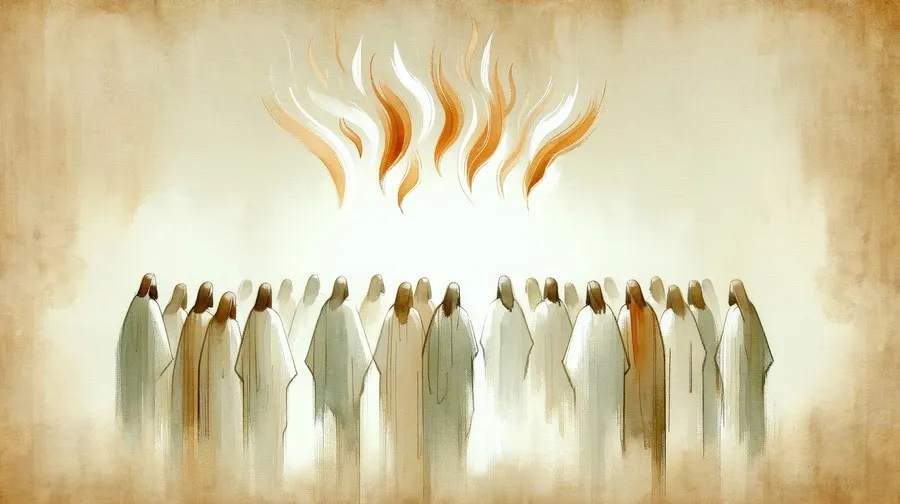
On May 24, 2026, most Christians following the Gregorian Calendar will celebrate Pentecost, a feast that commemorates the descent of the Holy Spirit on the early followers of Christ. It is also a celebration of the birth of the Christian Church. Like all celebrations that mark the birth of a person or an institution, it calls for a time to pause and reflect on the wonders, aspirations, and even failures that have defined one’s life until that moment. It is on that note, that I intend to reflect on what this day means and ought to mean for the Christian Church and all its members.
“Pentecost is not a moment in time. Rather, it is a continuum of God’s salvific history that plays out in the kairos time of the Spirit.”
Growing up in Nigeria, I recall vividly what defines this day in my humble parish. My parish is called Holy Spirit Catholic Church in the Archdiocese of Benin City, Nigeria. This day was defined by festivities and prayers of thanksgiving. As a parish dedicated to the Holy Spirit, it reflected a sense of intimacy that defines both the Church’s relationship with the Holy Spirit and the intimacy of all who call themselves Christians. Consequently, the parish was very particular in creating spaces of visibility and recognition for the marginalized ones in society. The parish community welcomed the poor and the homeless ones to celebrate the banquet of life that is a gift from the triune God.
My memories are also intimately linked to my own work as a former missionary member of a religious community that is dedicated to the Holy Spirit – the Congregation of the Holy Spirit (Spiritans). The dying words of Venerable Francis Mary Paul Libermann, the co-founder of the Spiritans, are worth repeating here as it intimately captures the essence of what it means to be a church of Pentecost: “above all charity… charity above all… charity in Jesus Christ. Charity through Jesus Christ… charity in the name of Jesus Christ; fervour… charity… union in Jesus Christ… the spirit of sacrifice” (Spiritan Rule of Life, #38). Reflecting on these words of Venerable Libermann, members of the Congregation of the Holy Spirit remind themselves that “this charity, the Spirit’s greatest gift, is the sign that it is the Lord who brings us together and send us out” (Spiritan Rule of life #39). Reminding themselves of what constitutes discipleship in Christ, they embrace the mandate found in the Johannine Gospel – “It is by your love for one another, that everyone will recognise you as my disciples” (John 13:35).
“If the Church is truly a Church of Pentecost, then charity must become its most visible language in the world.”
I do not want to re-engage the meaning of charity as a theological virtue. Many great minds have already done that. But what I intend to do is to link it to the Pentecost event and what it helps to unpack for us as children of the Pentecost event. Secular understanding has watered down the transformative power of charity. It is important that Christians reclaim it for what it truly evokes. As a pneumatological gift, charity embodies a sense of renewal that awakens one to an anamnetic presence (a presence that roots one in a historical consciousness) to a relational connection. Let us take for example, the biblical parable of the Good Samaritan found in Luke 10: 25 – 37.
The man who is found by the roadside has lost both his property and bodily dignity which the robbers have stolen from him by their immoral acts. The charitable act of the Samaritan is not just about providing care for the victim. Rather, its efficacy is that it orients the victim to an anamnetic consciousness (reclaiming a sense of dignity that he was deprived of by the robbers). The victim rediscovers his dignity. Yet, it does not end there. Charity, as a ritual of recovery, does not end in looking back. It orients one both to the present and to the unfolding future. Thus, the victim finds in the Samaritan a companion, a friend, an agent of new meaning that helps him not to lose hope in his fellow humans after such a traumatic experience.
Though the parable does not tell us what happened between them, the bonds of friendship that charity evokes both in the hearts of the recipients and those who are agents of charity produce a vision of new imaginations that orient all towards a future of possibilities. Hence, charity grounds us in our historical memories of what life was before the crisis. It orients us to look at the present reality with new visions that are oriented towards hope that refuses to be defined by the despair that comes from the trauma of violence experienced in the hands of others. Finally, its pneumatological power is that it orients us to look beyond the present and to joyfully await the future of promise. Through charity, humans experience life as a continuum of history that is rooted in the promise of hope. This is because charity serves as a witness to the enduring resiliency of the goodness of the human heart even when other realities want to define the human condition as one radically defined by evil and violence.
“The courage of Pentecost transforms fear into witness, isolation into communion, and despair into hope.”
What does this mean for the Church and how is it connected to the Pentecost event? Pentecost is about the celebration of the ritual praxis of charity. The followers of Jesus, having experienced the traumatic reality of state power used unjustly to murder an innocent man, Jesus, went into hiding as a traumatic response to such unjust violence on their friend and teacher. Fear has stolen from them their existential innocence. At this time of existential crisis, the Holy Spirit encounters them as a Spirit of charity who reorients them by grounding them in their initial joy that they experienced when they first said yes to the invitation that Jesus extended to them when he called them by their names.
By doing this, the Spirit is grounding them in a historical consciousness that is anamnetic (a living history that links the past with the present and the unfolding future of promise). Since charity is not a turn solely to the past as though it is an archival reality, the Pentecost gift, if it is to be truly pneumatological and grounded in charity, must orient the followers of Jesus to the present and the unfolding future. Acts of the Apostles captures this well when it presents the transformative power of the experience on the followers of Jesus. Their fear is transformed into courage.
Their withdrawal from society is transformed into a strong desire to want to connect even with those who were previously strangers. Since charity is the essence of the Pentecost experience, then it must orient the followers of Jesus towards a future of promise. Consequently, the followers of Jesus embrace the Spirit who invites and leads them into the future awaiting them. They became witnesses to the resurrection to peoples and cultures far away from their native world of Judea. The future became a place for ritualizing connections that give life to discipleship in Christ for all whom they encountered.
What does this mean for the Church today? While we celebrate the birth of the Church, the celebration is not about looking back. Rather, it is an anamnetic celebration that invites the Church to ground herself in the foundation of her origins. Such a foundation is saturated with courage, joy, hospitality, friendship, curiosity to engage, reflection, and a prophetic witness to God’s truth in the world. This grounding is also an invitation to the Church to take seriously the realities she faces today. If she is to be a church of charity as a Pentecost gift, then, she ought to be able to mediate life for all who seek healing in our times. She ought to speak truth to power and to insist that God’s peace must reign on earth, where all have a right to flourish. As a product of charity, the Church is always oriented towards an unfolding future. For this future to be welcomed as a place of renewal for the Church, trust in the guiding hand of the Holy Spirit must prevail. The fear of the past ought to be rejected so that the courage of Pentecost can be the driving wind behind the Church as she journeys into a future that only God can define for her.
“To be renewed is to be born again — to abandon the old baggage of fear and rediscover the prophetic courage of the Spirit.”
Paying close attention to the liturgy on Pentecost Sunday, one is struck by the motif of renewal that the Holy Spirit can bring about in the life of the Church. If renewal is to be taken seriously, it means then that to always be a church of Pentecost, the Church must always embrace her identity as a church of the present that is radically oriented towards the future of promise. To be renewed is to be born again. Thus, to be born again is to abandon old baggage and narratives of empire that have previously defined the life of the Church. As a disruptive statement, the Church, as a Pentecost church, is always celebrating her birth because Pentecost is not a moment in time. Rather, it is a continuum of God’s salvific history that plays out in the kairos time of the Spirit.
Just as Venerable Libermann, a Jewish convert to the Christian faith, reminded his fellow Spiritans, charity must radically define the Christian understanding of discipleship in Christ. The fervor of charity is the energy that the Pentecost event revealed in the actions and witness of the first disciples of Jesus. It was also what defined the collective witness to the Gospel in my home parish in Nigeria. If this fervor is to be embraced by contemporary Christians, then their social witness to the peace that the Good News of Christ reveals demands that they speak up against structures of violence playing out in our world today.
In a special way, let us celebrate our birth as Christians, crafted in the gift of charity that the Pentecost event reveals in our hearts. Happy Pentecost!



