
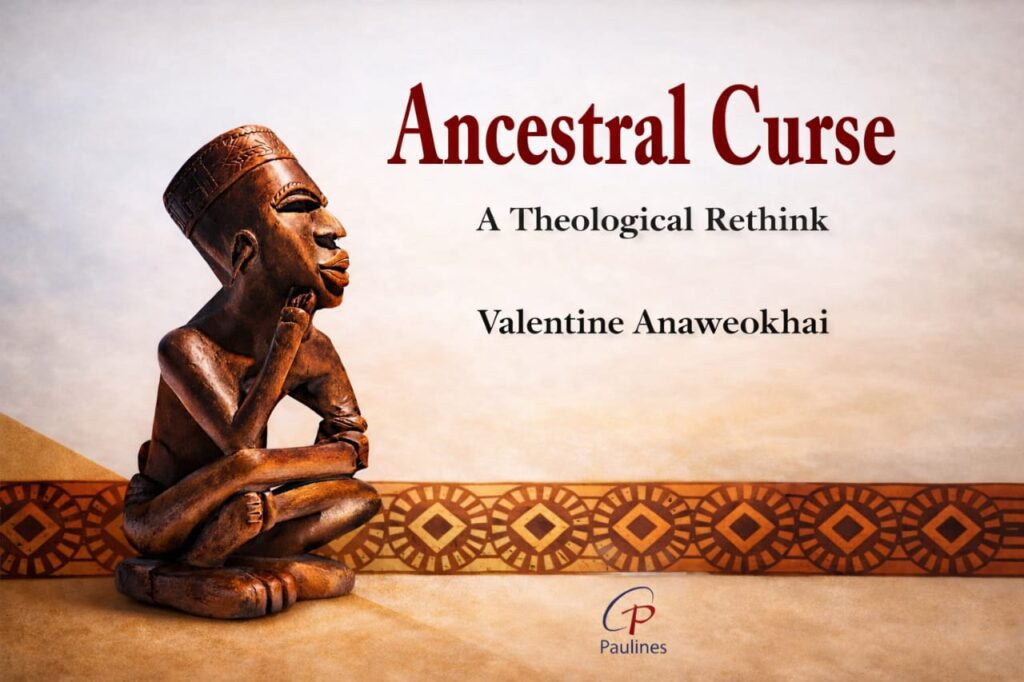
Book Title: Ancestral Curse: A Theological Rethink
Author: Valentine Anaweokhai
Year of Publication: 2025
Publisher: Paulines Publications West Africa
Page Count: 111
Price: ₦3000.00
A popular Nigerian politician, provoked by the ills and evils he encountered, is said to have asked his electorate during one of his campaign tours, “Are we cursed, or are we the cause?” This politician is no poet, and his question was not an attempt at a rhetorical flourish. One imagines that, faced with the enormity of the challenges bedevilling his state, he sincerely wanted to know whether—using Nigerian parlance—something was being done to them or whether they were doing it themselves. It is also said that, upon winning the election, the politician went on to demonstrate that, rather than being cursed, both the electorate and those they elected often colluded in producing their own misfortunes—primarily through corrupt practices.
Like this politician, Valentine Anaweokhai occupies a position of authority, though of a very different kind. While the politician’s authority is temporal, Anaweokhai’s is spiritual. Yet, like the politician, he too is confronted with the same unsettling question: curse or cause? Marking twenty years in the Catholic priesthood, he reflects on the recurring issues for which his parishioners have sought his guidance and identifies one concern as particularly pervasive: the belief in ancestral curses. From this pastoral and theological concern emerged his 2025 book, Ancestral Curse: A Theological Rethink.
Family relationships have been wrecked, marriages have been broken, innocent lives have been taken… and false prophecies have been paraded as the gospel truth.”
His decision to rethink the concept of ancestral curse is not merely theological but deeply pastoral—perhaps even more pastoral than theological. No shepherd in love with the flock entrusted to his care would sit back and watch as this wolf of ancestral curse devours them without attempting to dismantle it.
So-called African ministers of God exploit this concept—like they do many other beliefs—because there is already in place an active demonization of African ancestors in the name of Christianity. The belief already exists, Anaweokhai writes, “that everything about Africans and Africa is black, fetish, and evil. So, everything about our ancestors, too, is considered pagan, satanic, and evil.” Thus, his first task in the book is to redeem the image of African ancestors.
There is no doubt that some of our ancestors committed evil, just as there is no doubt that many of us living today are living in evil. That, however, does not mean that our ancestors are this vast cloud of harvested curses hovering over our heads. Anaweokhai, therefore, turns to African traditions of ancestorhood and to Scripture to correct a deeply ingrained negative imagination—one wrought upon our collective memory by an uncritical brand of Christianity that continues to hold sway among many Nigerians, and by extension, African Christians.
Drawing extensively from African cultural literature on ancestral veneration, as well as from his own pastoral experiences, Anaweokhai arrives at the informed conclusion that “to attain ancestorhood, one must have led a morally sound life as understood in the African cultural setting one lives within. An ancestor is regarded as the model or exemplar of conduct in the community.”
If these ancestors lived exemplary lives, then the appropriate response is not denigration but veneration. To speak of African saints, as Emmanuel Ojeifo reminds us, is “to talk about models of living in Africa.”
Anaweokhai, however, acknowledges that this mental reassessment is challenging. Like early Christians who believed in the power of their ancestors—those later called the Church Triumphant—many Nigerian Christians still believe in ancestral power but perceive it negatively. Traditional practices are quickly dismissed as fetish or diabolical, leading to wholesale condemnation of ancestral heritage.
Using libation as an example, Anaweokhai explains that “the little drop of palm wine and a chip of kolanut on the ground symbolize a nourishment of the living relationship between the dead and the living”—a relationship not disputed even within Catholic theology.
What Anaweokhai exposes is not simply a theological error, but a crisis of imagination—one in which African Christians have been taught to fear their own history. ”
Anaweokhai further draws from Scripture—Exodus 3:6, among others—to show that God’s self-identification as “the God of your ancestors” affirms the dignity and ongoing significance of ancestral memory. This, he argues, enhances self-worth rather than undermining Christian faith.
Even moral stains within a lineage do not amount to a cursed ancestry. As Anaweokhai notes, “God writes straight on crooked lines.” He points to figures such as Tamar and Rahab in Jesus’ genealogy, arguing that scandalous ancestry does not negate divine purpose. David’s lineage, despite adultery and violence, remains central to salvation history.
This book succeeds where many pastoral interventions fail: it refuses to let fear have the last word, insisting instead on responsibility, memory, and grace. ”
Having dismantled the demonization of ancestors, Anaweokhai turns to biblical and doctrinal texts often cited to justify ancestral curses—Genesis, Exodus, Numbers, and especially the Doctrine of Original Sin. He argues that these passages must be read contextually and in light of Christ’s redemptive work.
Drawing on theologians such as Hellwig, Rahner, Moore, and Ormerod, he advances Ezekiel 18, Romans 3, and Galatians 3 to argue that even if a curse had existed prior to conversion, “the blood of the lamb cleanses all.”
Pastorally, Anaweokhai shows how belief in ancestral curses leads to psychological enslavement, moral irresponsibility, fear-driven spirituality, and the practical denial of sacramental grace. To believe that a baptized Christian remains under the ancestral curse is, he argues, to question the efficacy of Baptism, Confirmation, and the Eucharist themselves.
The book concludes with lived examples—such as the case of a man blaming an ancestral curse for consequences rooted in criminal activity—illustrating how “curse” often masks human responsibility.
Despite its strengths, the book is not without limits. Anaweokhai’s critique of the Doctrine of Original Sin remains cautious, perhaps overly so. His engagement with non-African theologians lacks synthesis, and the absence of African theological voices in this section is notable.
Yet, these limitations do not diminish the book’s importance. Ancestral Curse: A Theological Rethink remains a valuable pastoral and theological contribution—one that challenges fear-based Christianity, restores African dignity, and re-centers Christ’s salvific power.
The slim volume is accessible, prayerful, and deeply pastoral. It is, ultimately, a call not to blame the ancestors, but to reclaim responsibility, faith, and freedom.


