
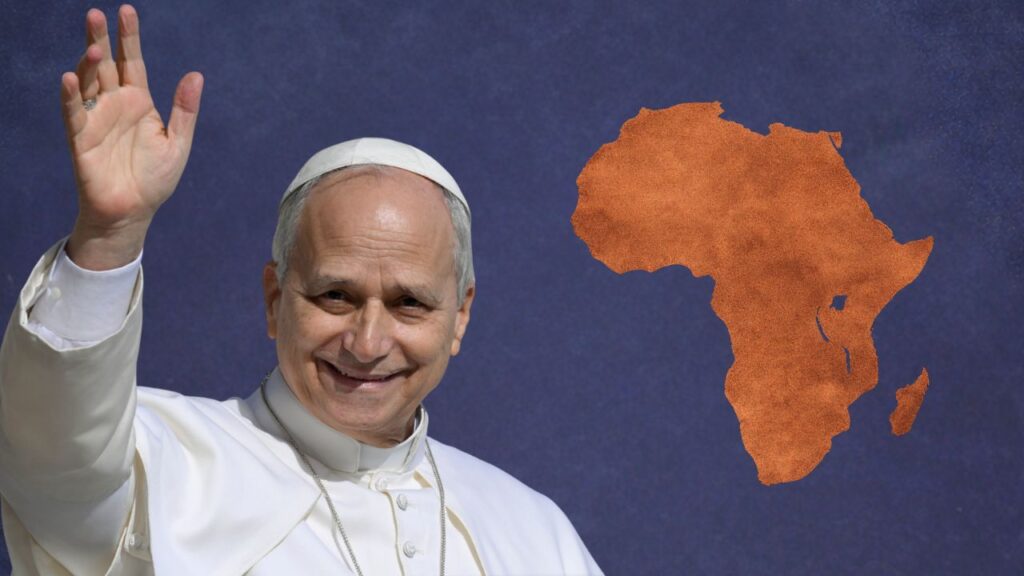
With deep joy, VoiceAfrique welcomes Pope Leo’s proposed historic Apostolic Visit to Africa (April 13–23). It promises to be one of the longest journeys of his pontificate and among the most significant papal pilgrimages to the continent in modern history. From Algeria—walking in the footsteps of Saint Augustine in Algiers and Annaba—to Cameroon (Yaoundé, Bamenda, Douala), Angola (Luanda, Muxima, Saurimo), and Equatorial Guinea (Malabo, Mongomo, Bata), the visit bears the marks of memory, mission, bridge-building, and peace.
Africa is a continent of ancient Christian roots and rich traditions, immense cultural diversity, youthful energy, and the world’s fastest-growing Christian population. The Church here is no longer a marginal outpost of missionary expansion; it is a vital center of gravity within global Christianity. The last popes who visited Africa returned to Rome visibly moved, even surprised, by the depth of faith they encountered.
Flying back to Rome after his five-day “pilgrimage of peace and apostle of hope” to Africa in 2015, Pope Francis said, in answer to a question about the most memorable part of his trip: “For me, Africa was a surprise. God always surprises us, but Africa surprises us, too. I remember many moments, but above all, I remember the crowds… They felt visited, they are incredibly welcoming, and I saw this in all three nations.” In those words, one hears not romanticism, but astonishment before a living faith and enduring treasure that is Africa.
Pope Francis joined the line of past pontiffs—beginning with Pope Paul VI—who extolled the beauty and depth of African culture and spirituality reflected in African Catholicism. When Pope Paul VI made his first visit to Africa in 1969, he spoke of the spirituality of Africans, their closeness to God and to one another, and the abundant fruit borne by the seed of faith on African soil. It was then that he uttered words that remain etched in the memory of African Catholics: the time has come for Africa to have “an African Christianity.” It was a recognition of maturity and responsibility.
Pope John Paul II, in Ecclesia in Africa (1994, n. 6), described the continent as experiencing “a sign of the times, an acceptable time, a day of salvation.” It seemed to him that “the ‘hour of Africa’ has come, a favorable time.” Pope Benedict XVI, in Africae Munus (2011, n. 13), spoke of Africa as a “spiritual lung” for humanity in crisis, highlighting the extraordinary human and spiritual riches of its peoples. These expressions— “spiritual lung,” “new center of gravity of World Christianity,” “historical moment of grace,” “hour of Africa”—signal a profound conviction: the Church in Africa has come of age and is emerging as a strong spiritual force in what scholars of Christianity project as the fourth great age of Christian expansion.
Yet praise must not become pious amnesia or empty triumphalism.
Growth in number does not always translate into growth in faith because not every growing Church is healthy, and not every healthy Church is growing. VoiceAfrique believes the growth in African Catholicism has not been matched by a corresponding increase in vitality, but there are signs of hope everywhere in Africa.”
The beauty of Africa or the enthusiasm of African Christians for the faith or the joy in the forthcoming papal visit should not erase the crisis of religion and state in Africa today and the undeserved suffering of the masses of our people.
Africa is marked by poverty, fragile institutions, a crisis of governance and succession, displacement, ecological stress, youth unemployment, and the persistent capture of the state by a selfish and greedy narrow elite. In places such as the Anglophone regions of Cameroon, a decade-long conflict has scarred families and futures. Entire communities have been uprooted. Trust has eroded, and the social fabric is frayed.
Indeed, there are many Cameroonians who argue that Pope Leo should not visit Cameroon while the country remains under the long and controversial rule of President Paul Biya, whose decades in power, in the view of many critics, have been marked by electoral manipulation, repression of dissent, and a cabal that has effectively captured the state. For some, a papal visit risks being interpreted as an unintended endorsement of a regime that many believe has left the nation in a state of suspended animation.
These concerns cannot be dismissed lightly. The optics matter.
And yet history also teaches that papal visits can be catalytic in unexpected ways.
A papal apostolic visit does not legitimize injustice, misrule, corrupt and repressive governments of the Biyas and Obiangs of this world when it is accompanied by prophetic speech that speaks truth to power. On the contrary, it can unsettle it.”
When a visibly frail Pope John Paul II visited Nigeria in 1998 during the dark days of the Abacha regime, many civil rights activists were skeptical. Some opposed the visit outright. Yet within months, events unfolded that led to the death of that dictator and opened a path—however fragile—toward democratic transition. A papal presence does not legitimize injustice, misrule, corrupt and repressive governments of the Biyas and Obiangs of this world when it is accompanied by prophetic speech that speaks truth to power. On the contrary, it can unsettle it.
The same moral tension arises in Equatorial Guinea, where President Teodoro Obiang Nguema Mbasogo has been in power for forty-seven years. His rule has been marked by the effective suppression of opposition in one of Africa’s most oil-rich yet deeply unequal nations. Last year, residents of the island of Annobón protested against environmental degradation and neglect. The protests were swiftly suppressed, and internet connectivity was cut. The image of two long-serving rulers standing side by side with Pope Leo will be striking. It will raise questions, but it will also create an opportunity for Pope Leo to speak clearly about some hard truths to those leaders who are destroying our beautiful Africa.
Pope Leo must speak with prophetic courage—not in partisan tones, but in the language of conscience. He must address not only the faithful but also the ruling elites whose internal enslavement of their own peoples contradicts the Gospel they publicly profess.
The social heritage of the Catholic Church—its teaching on human dignity, subsidiarity, participation, solidarity, good governance, and the common good—must not remain hidden in the Church’s social documents. It must be proclaimed in presidential palaces as well as parish churches and in the public squares.”
Pope Leo’s visit should awaken the dormant prophetic voices among Church leaders in Africa. His decision to visit places affected by internal divisions should remind the Church’s leaders on the continent that the preferential option for and with the poor remains central to Christ’s mission. Additionally, it should prompt them to the cries of the poor whose future these modern-day autocrats have jeopardized.
Bad political and religious leaders who ruin Africa should tremble and weep (should not be smiling) in the presence of Peter’s successor—not because he wields temporal power, but because he carries moral authority and will use his winnowing fork and the Word of God to pierce their consciences more sharply than any double-edged sword (Heb 4:12).”
Pope Leo must call for a second liberation of Africa and show Church leaders in Africa how they can play a vital part in this second liberation. A second liberation in Africa must come about through institutions that serve the people, through leaders who fear God more than they fear losing power, and through citizens empowered to participate in their own destiny and ready to fight for an end to the leadership albatross that holds us all in thralldom.
All in all, this Apostolic Visit is a gift to Africa. That the Successor of Peter journeys to the peripheries, to the poor, to caregivers, and to those who keep hope alive amid fragile circumstances speaks volumes. The visit matters—for reconciliation, for peacebuilding, for healing historical memories, and for affirming Africa not as a problem to be solved but as a gift to the universal Church.
May this journey strengthen peace.
May it heal memories. May it remind us of the resilience of our people. May it call forth our spirit of service, heroism and martyrdom
May it renew the Church’s solidarity with Africa.
And may it summon both rulers and peoples to the hard work of just peace, reconciliation, justice, and social transformation through good government, a vital church that mediates abundant life for all God’s people in Africa so that the hour of Africa may indeed become a time not only of growth, but also of freedom, prosperity, human and cosmic flourishing.


