
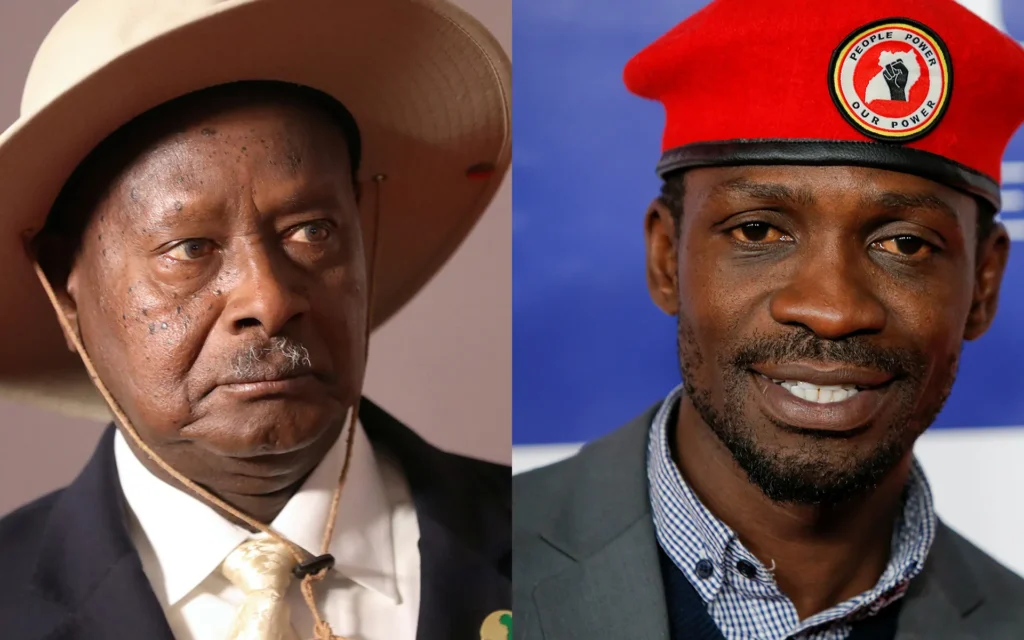
Uganda’s President, Yoweri Museveni, has been declared winner of yet another deeply flawed election—his seventh term—thus extending a rule that has now lasted four decades. According to official results, he secured nearly 72 percent of the vote. The main opposition candidate, Bobi Wine, has rejected the outcome as fraudulent and has called for non-violent protests. But are Ugandans opposed to this status quo brave enough to take to the streets? It is most unlikely. The international community has already offered its familiar ritual of concern, condemnation, and—predictably—eventual silence over this shambolic poll.
In Uganda itself, no one is surprised. This is business as usual after yet another empty electoral ritual and democratic parody. Museveni—or M7, as his ardent supporters like to call him—is not going away, at least not for now. He cannot be voted out of power because, in Uganda, he cannot lose an election. Ugandans often joke that everything changes in their country except the president. In the days leading up to the vote, opposition media circulated photographs of Museveni standing beside every American president from Ronald Reagan to Donald Trump. The message was unmistakable: regimes rise and fall elsewhere, but not in Uganda, where Museveni appears to endure forever.
Museveni has ruled with an iron fist since 1986, having seized power after a five-year guerrilla war. Along the way, he rewrote the constitution to remove presidential term limits. In a 2016 interview, he stated plainly, without embarrassment or irony: “We do not believe in fixed-term limits.” That declaration explains the national mood today. Ugandans are not celebrating. They are not grieving. Many are not even protesting. What prevails instead is a weary sense of inevitability—a collective resignation to Museveni’s total dominance of Uganda’s political, economic, security, and even religious narratives.
Ironically, Museveni himself has repeatedly articulated a very different vision of power in public forums. In one widely circulated interview, he argued that “peaceful transfer of power is part of civilization” and insisted that leadership positions are “temporary special offices.” In that exchange, he questioned why societies should descend into violence simply to decide who governs for five or ten years. In a later interview, he went further, suggesting that “if you want very active leaders, it should be good to have the ones below 75.” When pressed on whether he himself would go beyond 75, his response was unequivocal: “Not at all, certainly. This just concluded election, however, tells another tale.
International observers have merely confirmed what Ugandans already know. The United Nations described the campaign as marred by “widespread repression and intimidation.” There was a nationwide internet shutdown on election day and in its aftermath. Opposition rallies were violently disrupted. In Uganda, standing up to Museveni means that you may be “put in the fridge for some days,” as the president himself once remarked when asked about the arrest and detention of Kenyan civil-rights activists who had traveled to Uganda last October to show solidarity with the opposition. The same fate befell Father Deusdedit Sskabira, a young Catholic priest of Masaka Diocese, who was picked up and detained by the military for daring to tread where angels dread—publicly criticizing the government. Kizza Besigye has been subjected to a perpetual cycle of arrest, detention, and harassment for repeatedly daring to run against Museveni. Civil-society actors are routinely arrested or abducted, especially in the period surrounding elections. No wonder that, out of caution or sheer self-preservation, many Ugandan scholars and religious leaders have kept quiet in the face of Museveni’s personalization, perpetuation, and absolutization of power. Even so, former Nigerian President Goodluck Jonathan, who led an African Union observer mission, admitted that fear, intimidation, and the internet blackout had “eroded public trust” and “increased suspicion.” Yet the final verdict was still couched in diplomatic restraint: the vote was described as “peaceful.”
In Uganda, standing up to Museveni is no longer an act of citizenship but an act of personal risk. To criticize the president is to risk detention, disappearance, or being ‘put in the fridge for some days.’ Fear has become normalized, internalized, and routinized, shaping how citizens, scholars, and even religious leaders calculate survival in a state where dissent is treated as a crime”
Museveni now rides the crest of victory. He belongs to a familiar African category: the sit-tight ruler—part benevolent patriarch, part ruthless autocrat. Like the late Robert Mugabe, Paul Biya, and Denis Sassou-Nguesso, he combines selective development with repressive control. Over time, he has cultivated a messianic self-image, portraying himself as the indispensable guardian of national stability. In the process, he has subdued the military, co-opted religious institutions, and neutralized much of the intellectual class. Prophetic voices are rare—not because Ugandans lack courage, but because fear has been normalized and internalized.
All sit-tight regimes follow a similar pattern.
First, they personalize power. Governance becomes a system of patronage, rewarding loyalty and punishing dissent. Those aligned with the regime enjoy access to resources and protection; critics are marginalized, surveilled, or silenced.
Second, they rule through fear. In Uganda, as in Cameroon and Congo-Brazzaville, power is spoken of in mystical terms—as a matter of life and death. The ruler becomes a demi-god. His wishes are commands. His enemies are rendered expendable. One Ugandan Catholic priest told Voice Afrique that after preaching against misrule, he was summoned and warned. That warning was later repeated publicly to a gathering of church leaders: criticism of the president would not be tolerated.
Third, sit-tight rulers hollow out the state. Constitutions are amended. Courts are weakened. Parliaments are subdued. Electoral bodies lose credibility. Confusion itself becomes a tool of control. After more than two decades of engagement in Uganda, one of Voice Afrique’s correspondents admits that even seasoned observers struggle to explain how the country is actually governed. That confusion is not accidental. In uncertainty, brute force becomes the compass of statecraft.
All sit-tight regimes eventually hollow out the state from within. Power becomes personalized, fear replaces accountability, institutions are weakened, and confusion itself becomes a tool of governance. In such systems, elections are rituals without consequence, laws are selectively applied, and brute force becomes the final language of authority”
Many Ugandans readily acknowledge what Museveni has done right. There is relative peace in much of the country. Schools function. Markets operate. People farm, travel, and worship. But poverty remains pervasive, youth unemployment is crushing, and the future feels increasingly foreclosed. No one desires a return to war. Ugandans have already paid that price under Idi Amin and Milton Obote.
Yet a nation held together for forty years by repression—even benevolent repression—cannot outlive its strongman. Zimbabwe is a warning. So too are Rwanda, Cameroon, and Congo-Brazzaville. Beneath the surface appearance of stability lie unresolved traumas, silenced grievances, and stored anger. Ernest Renan once observed that a nation is a “daily plebiscite”—a continuous negotiation of shared life. Democracy, with all its disagreements and imperfections, is how societies heal, grow, and renew themselves over time.
When a ruler presents himself as the embodiment of wisdom, destiny, and national survival, he betrays Africa’s participatory spirit and mortgages the future of his people. Power does not belong to one man, one family, or one generation. Uganda is not a monarchy. The presidency is not an inheritance to be passed on to a son or a circle of loyalists.
This must be Museveni’s last election.
Those who continue to prop him up—politically, militarily, and religiously—must now tell him the truth: twilight has come. The greatest gift he can offer Uganda is not another term, but a legacy of peaceful transition.
The Church in Uganda, in particular, must recover the prophetic vocation of voices like Archbishop Janani Luwum and Cardinal Emmanuel Kiwanuka Nsubuga, and stand with the people rather than appease power. It must tell this presumably deeply religious president a hard and necessary truth: you are not God, and Uganda can do without you. Forty years is enough”
What Uganda needs most today is a transparent, orderly, and inclusive transition to a new generation of leadership. This is not a threat to Uganda, nor a denial of Museveni’s mixed legacy. It is, quite simply, Uganda’s only hope for enduring peace and genuine prosperity.
