Even before I knew the word libation, I had already understood its language of silence. In the early mornings, my elder sister and I would sit beside our grandfather, watching him pray to the Creator and pour a libation to our ancestors. I was too young to understand the words he spoke, but my body remembers his gestures, his face and the reverence with which he entered into communion with the Creator, the ancestors and all our human and more-than-human relations. We followed every movement as his ageing hand raised the kola nut and poured the liquid, one offering after another.
He died when I was three, yet the memory of those morning ceremonies remained inscribed within me. For many years, I thought the ceremony had disappeared from my life; that I am now far away from the sacred world of my earliest years. Then, on the traditional and unceded territory of the Algonquin Anishinaabeg Nation, an Effutu king from Ghana, Neenyi Ghartey VII, poured libation again, nudging the child still within me to remember. The ancestral ceremony returned to me in a land where the language of libation required more than translation.
Many African Christians of my generation, and younger generations, were taught to regard libation as incompatible with Christianity. We were taught to see it as worship of the dead, superstition or even evidence of an unconverted past. We were repeatedly told that it was a pagan practice—a past to be exorcised.
Yet such hasty judgments about the cultural and spiritual practices of Indigenous peoples were often instilled in missionaries before they ever encountered the peoples and lands they had been sent to serve. They therefore seldom listened carefully enough to grasp the ethical and religious meanings of the ceremonies they encountered. For generations, missionaries often saw only liquid being poured upon the earth. Even those of us who later became missionaries have sometimes perpetuated that narrative. We continue to see the gesture without appreciating the relationships it renews, gratitude to the Creator, remembrance of the ancestors, communion with the land and commitment among the living.
This text does neither argue for an indiscriminate incorporation of ancestral ceremonies into Christian worship, nor try to romanticize all ancestral ceremonies. When a ceremony is absorbed into Christian categories without respect for its own integrity, such incorporation risks becoming another form of assimilation rather than genuine inculturation. Certainly, the Christian reception of ancestral traditions requires discernment, but discernment cannot begin with disrespect. A Church that calls itself catholic can neither neglect Africa’s sacred memory nor dismiss its spiritual treasures as superstition. It must first listen, enter into relationship and seek to understand the ethical and spiritual meanings these traditions carry.
Today, I wonder whether we have listened carefully enough for the echoes of libation in Scripture. The Hebrew Scriptures contain numerous accounts of drink offerings. At Bethel, Jacob pours a drink offering and oil upon the pillar where God had spoken to him (Genesis 35:14). The Law of Moses also prescribes drink offerings to accompany other sacrifices (Numbers 15:1–10).
Paul later draws upon this ancient ritual vocabulary to interpret his own life: “I am already being poured out as a libation, and the time of my departure has come” (2 Timothy 4:6). In Philippians 2:17, he similarly imagines himself being poured out upon the sacrificial offering of the community’s faith. Although Paul does not reproduce libation as a Christian ceremony, he draws upon its spiritual grammar. In doing so, he presents the faithful life as a libation—a life poured out in love so that others might live.
The biblical understanding of libation and African ancestral practices should not be compared, for they arise from distinct histories and spiritual worlds. Nevertheless, their shared common language of offering, communion and self-giving allows them to shed light to one another.
The significance of libation in the imagination of Black communities also extends beyond the shores of the motherland. In many Kwanzaa observances, libation is poured, often using the kikombe cha umoja, or unity cup, to honour the ancestors and reaffirm the bonds uniting the living.
The Middle Passage, enslavement and dispersal fractured communities, but they could not entirely erase this ancestral memory. Across generations, Black communities continued to renew relationships among the divine, the ancestors, the living and the more-than-human world.
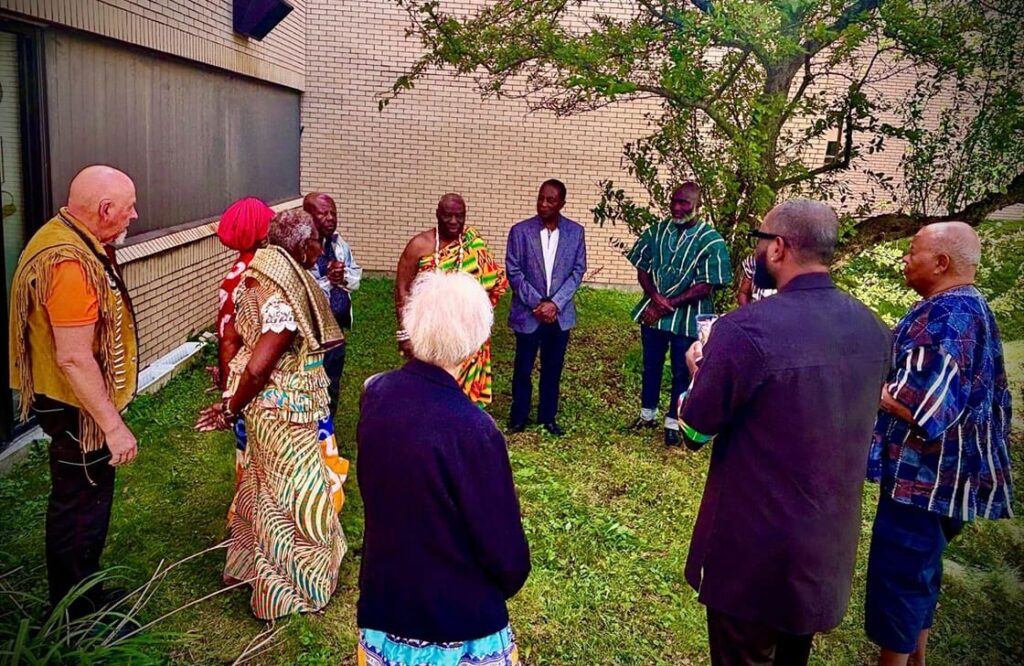
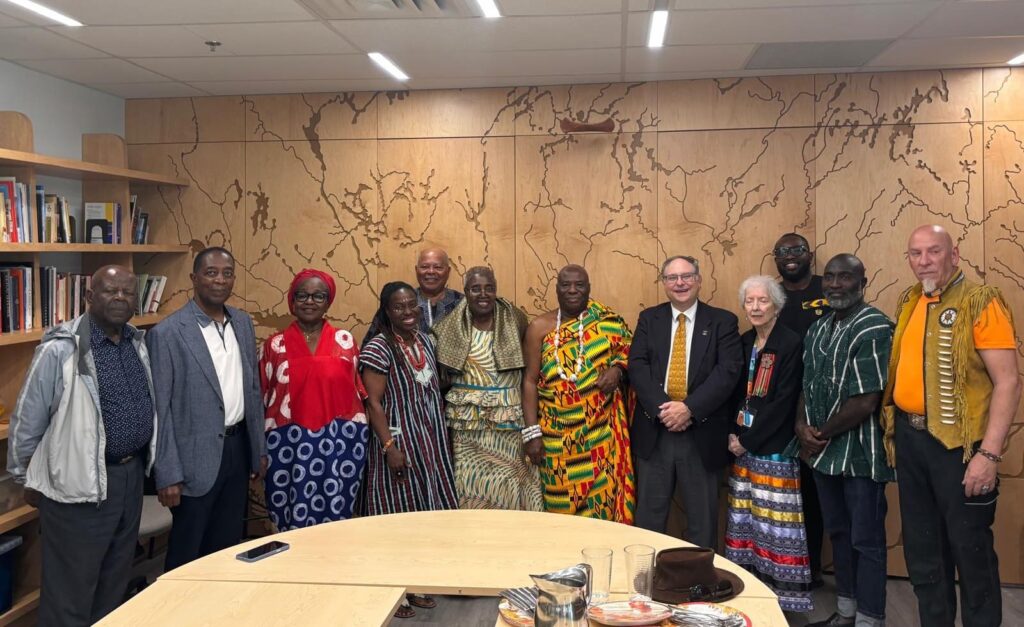
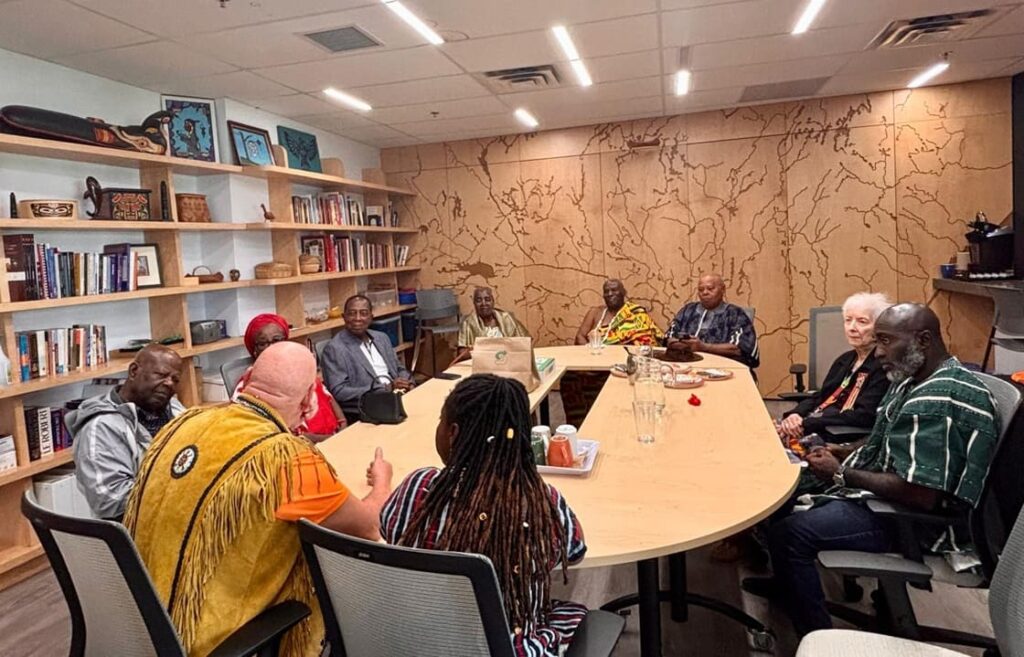
I came to understand this anew through Neenyi Ghartey VII, the Paramount Chief of the Effutu Traditional Area and traditional ruler of Winneba, Ghana. Although he had come to Ottawa to meet members of the Ghanaian community, the ancestors seemed to open another path for his visit: a conversation about traditional approaches to conflict resolution with Elders at the Indigenous Centre. At the beginning of that conversation, he called upon the Creator and the ancestors to accompany the journey upon which our different peoples were embarking.
That day in the Indigenous Centre at Saint Paul University, an Effutu paramount chief poured libation on an Algonquin territory, and the Igbo child within me recognized the gesture even before the theologian within me could explain it.
For me, pouring an African libation on Algonquin territory did not transform that territory into African ground. Instead, it reminded me that the land is never empty. It was already alive with memory, responsibility and relationships, and the ceremony was only calling me to remember my ancestors and to honour the people whose land had received me.
Before that encounter, I had often returned to the mornings I spent beside my grandfather, but I never expected to feel so deeply welcomed back to the ancestral circle, and to the maternal embrace of the land of my forefathers. Perhaps the ancestors had neither abandoned me nor withdrawn their gaze. Perhaps I was the one who had wandered beyond the circle, lost in a territory far away from the rivers that for centuries quenched the thirst of our people. Years of philosophical and theological formation may have deafened my ears to the call of our ceremonies or trained my ears to hear concepts more readily than whispers, to discuss creation while becoming less attentive to the Creator’s call through the land that carries and nurtures me.
Who could have told me that the ancestors accept libation even in foreign lands? Or perhaps the deeper revelation is that, before the Creator, no land is entirely foreign, because no land is empty of relationships.
Yet, wherever we find ourselves, we must learn the ethics of the guest, we must honour those who came before us, respect the people who receive us and pour out our lives in commitment to one another.
Perhaps that is also what Paul understood when he described his life as a libation, for what we pour upon the earth cannot be separated from what we pour out for one another.
Have any thoughts?
Share your reaction or leave a quick response — we’d love to hear what you think!
-
 0
0
-
 0
0
-
 0
0
-
 0
0
-
 0
0
-
 0
0