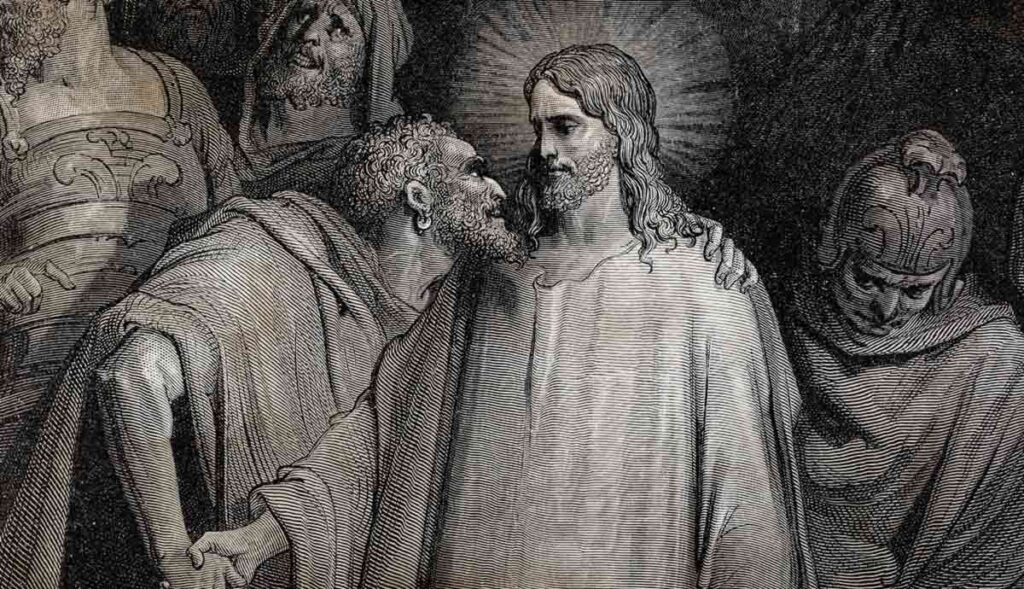
The Shadow in the Garden
It was night in Gethsemane. The olive trees stood still, like silent witnesses. The stars, veiled by heavy clouds, withheld their light. In that darkness, a man kissed another man—a gesture of friendship turned into betrayal. The man who received this kiss had just fed Judas a morsel of bread dipped in rich soup—an act of love, honour, and intimacy—even as he knew Judas was already entangled in greed and deceit.
That kiss has echoed through the centuries, forever tied to the name Judas Iscariot. To most of Christendom, Judas is the villain of the Passion narrative—the apostle who sold his teacher for thirty pieces of silver, the one who, realizing the weight of his crime, threw the money into the temple and hanged himself in shame. “It would have been better for that man if he had never been born” (Mark 14:21), Jesus said—words that have shaped how generations remember him.
But is this the whole story?
“Judas is not only the betrayer we condemn—he is the mirror we avoid.”
The Gospel of Judas
In the canonical Gospels, Judas is portrayed in a grim light. He is the outsider among the twelve, the keeper of the moneybag, who—driven by greed or perhaps disillusionment—facilitated the arrest that led to the crucifixion. The traditional Christian understanding is clear: Judas failed not only in betrayal but in despair.
Peter denied Jesus, too—but he wept, repented, and returned. Judas despaired and was lost.
Yet a question remains: why did Jesus choose him in the first place? Could divine foreknowledge have overlooked Judas’s future? Or was he chosen because he would do the unthinkable?
A Saint in the Shadows? Reframing Judas
Among the most controversial interpretations in theological history is the idea that Judas may have been a necessary agent in the story of salvation. This view appears in certain Gnostic traditions, particularly in the Gospel of Judas, a 2nd-century Coptic text rediscovered in modern times.
There, Judas is not a villain but the disciple who truly understood Jesus. Jesus tells him:
“You will exceed all of them. For you will sacrifice the man that clothes me.” (Gospel of Judas, pp. 56–57)
In this account, Judas’s act is not treachery but obedience—he alone carries the burden of initiating the events that lead to the cross. Without Judas, there is no crucifixion; without the cross, no resurrection.
The Church, however, has never accepted this interpretation, maintaining that Judas acted in freedom and bears responsibility for his betrayal.
Still, the question lingers:
Could Judas have been the necessary shadow—the one through whom redemption unfolded?
“Without Judas, there is no cross; and without the cross, there is no resurrection.”
Literature’s Reckoning with the Traitor
Writers and thinkers have long wrestled with Judas’s legacy.
Jorge Luis Borges, in Three Versions of Judas, imagines a theologian who argues that Judas was the true sacrifice—one who embraced eternal infamy as the ultimate act of self-denial.
Nikos Kazantzakis, in The Last Temptation of Christ, portrays Judas not as a mere traitor but as a loyal friend who carries out a painful mission at Jesus’ request.
These interpretations do not excuse Judas—but they complicate him. They force us to look again, not just at Judas, but at ourselves.
The unsettling truth is this: Judas is not only a figure to judge. He is also a mirror.
The Question of Betrayal
We all betray—sometimes in small ways, sometimes in ways that wound deeply. We betray others, ourselves, and even what we claim to believe.
Sometimes it is greed. Sometimes confusion. Sometimes fear. Sometimes a misguided sense of purpose.
But the crucial difference is what happens next.
Like Peter, we can repent and return.
Or like Judas, we can let shame hollow us out until we no longer believe that mercy is possible.
And when we are the ones betrayed, we face another choice:
to remain trapped in bitterness—or to see even betrayal as part of a larger story, one that may yet lead to healing and renewal.
The Unanswered Question
Judas Iscariot remains a troubling figure—one we cannot fully explain or dismiss. His story refuses to stay in the past. It confronts us with the reality of freedom, sin, and grace.
The question is not simply whether Judas was lost or redeemed.
The deeper question is this:
When we fall, do we still believe that mercy can reach us?
Because in the end, the story of Judas is not only about betrayal.
“The real question is not whether Judas was lost, but whether we still believe mercy can reach us when we fall.”
It is about the terrifying—and beautiful—possibility that even in our darkest moments, grace still waits.
Have any thoughts?
Share your reaction or leave a quick response — we’d love to hear what you think!
-
 0
0
-
 0
0
-
 0
0
-
 0
0
-
 0
0
-
 0
0