
From Emptiness to Fullness: The Gospel of Creation
The Potter and the Broken Clay
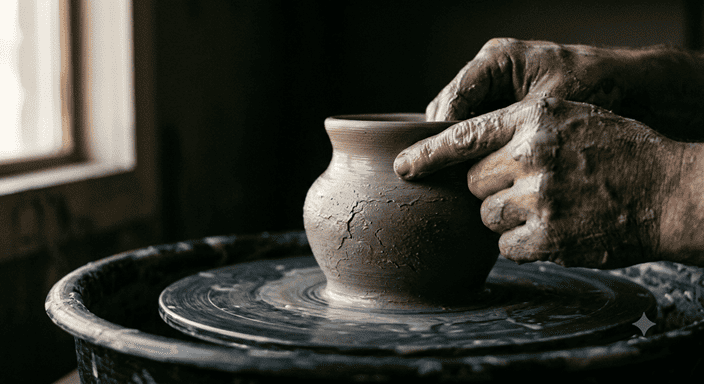
The old potter sat before his wheel, his hands covered in clay, his heart heavy with grief. His son had died the previous moon, and the potter had not touched his wheel since. The clay on his workbench had dried and cracked. The village children who once gathered to watch him work now passed by in silence. Even the birds seemed to sing more softly.
One morning, his young apprentice came to him with a lump of clay that had fallen to the floor and been trampled by goats. It was misshapen, full of stones and dry cracks – a formless, useless thing. “Master,” the boy said, “this clay is ruined. Shall I throw it away?”
The potter looked at the broken lump. He took it in his hands – hands that had not held clay in many weeks – and he began to knead it. He worked water into its dryness, picked out the stones, and pressed it with the patience of one who knows that even the most worthless clay can be made beautiful again. The children returned. The birds sang. And by sunset, the potter had fashioned from that trampled, formless lump a vessel so fine that the village chief himself came to marvel at it.
“Master,” the apprentice whispered, “how did you make something so beautiful from something so ruined?”
The potter smiled and held up the vessel. “This clay,” he said, “was not ruined. It was waiting. Every formless thing is only a beginning. The void is not the end – it is the womb of creation. My hands did not create this vessel from nothing. They found the beauty that was already hidden in the clay, waiting for the right hands, the right water, and the right heart.”
He set the vessel in the sun to dry.
Every formless thing is only a beginning.”
This story serves as a parable – not a precise theological statement, but an illustration of how patient hands can bring forth beauty from brokenness. It mirrors what God did at the beginning of time in Genesis 1, and what God continues to do with every life that comes to him. However, it is important to clarify that the story depicts transformation, not the complete Christian doctrine of creation. While the potter works with existing clay, the God of Scripture ultimately calls all things into being from nothing. The two visions do not compete; they complement one another, revealing a God who is both Creator of all and Redeemer of the broken.
The Formless and Empty Reality
Not infrequently, we find ourselves living in varying states of confusion, bewilderment, muddled realities, and divided loyalties. And when we are asked about the reason for our discomfort or inconvenience, we answer – NOTHING! But upon closer observation, our “nothing” usually becomes “something” – perhaps still undefined, and definitely not within our grasp or control. The pathway to our redemption begins whenever we begin to face up to our “nothing”, whenever we recognize in its vicissitudes and its possibilities unique opportunities for God to give our lives a new beginning.
The pathway to our redemption begins whenever we begin to face up to our ‘nothing.’”
Our Catechism describes God as creating the world “out of nothing”. This teaching is not derived directly from the story of Genesis 1, which speaks of God creating heaven and earth out of the formless void. The doctrine of creation ex nihilo finds its explicit biblical basis in 2 Maccabees 7:28, where a mother exhorts her son: “Look at the heaven and the earth and see all that is in them, and recognize that God did not make them out of things that existed.” The Catechism of the Catholic Church affirms this in nos. 296–298: “We believe that God needs no pre-existent thing or any help in order to create… creation is the common work of the Holy Trinity.”
The Hebrew words tohu and bohu (Gen. 1:2) describe the earth as without form or structure, and empty or void. This condition is not merely physical – it is also a metaphor for spiritual emptiness and chaos. Yet the void represents a space where God can create and bring order to what is chaotic. Just as God brought light and structure to the formless earth, so too can God bring transformation and purpose to our often broken lives.
God and Scrambled Eggs
The concept of “nothing” or the “void” is a profound theme in our lives and spiritual journeys. In his book Forgotten among the Lilies, Ronald Rolheiser (Forgotten among the Lilies: Learning to Live Beyond Our Fears. Doubleday, 2005) has a chapter on “God and scrambled eggs.” One of the stories he tells is of a young man who has gotten a young lady pregnant. Both were very young. The pregnancy was going to disrupt their lives. Marriage was out of the question. And no matter what the two young people decided, a formless reality had been introduced into their lives: a certain ease and innocence had been destroyed. The young man ended his confession by affirming: “There is no way I’ll ever live normally again, beyond this. Even God can’t unscramble an egg!”
It is these images of the potter and the ruined clay, God and the scrambled eggs, that we want to evoke in this reflection. These metaphors raise questions about the limits of God’s power and about his ability to take the broken pieces of our lives and create something new and beautiful.
The Void at the Beginning of Every Effort of Creativity
The Bible opens its account of creation with a brief but significant attention to a reality that resembles a scrambled egg – the formless void (Gen. 1:2). Various translations call it by different names: “formless wasteland”, “formless and empty”, and “formless and void”. It may not be possible for us today to recapture the exact living realities represented by the void in the story of creation. But we can imagine the dynamic of creation as a movement from the scrambled world of the void to the beauty and splendour of heaven and earth – a movement from emptiness to fullness, from lack to completeness.
The void is not final; it is potential. It is the raw material upon which the Creator’s hand works. In the ancient Near Eastern imagination, the deep waters (tehom) represented chaos, the untamed forces that threatened order. Yet God does not destroy the deep; God hovers over it. The Spirit of God broods like a bird over the nest of what is not yet formed. This hovering is not passive observation – it is anticipation, preparation, the pregnant pause before the first word of creation: “Let there be light.” The formless void serves as a backdrop for divine power, highlighting God’s ability to bring structure and purpose to chaos, to transform what is broken into something beautiful and meaningful.
For many, it is truly a paradox that the void should be so highly appreciated in religion yet be so difficult to comprehend and deal with in practical life. Any truly attentive person whose life has been marked by a mistake, a betrayal, or calamity will inevitably confront the existential question: how can the chaos of my life be given order, straightened out, and set right? How could my life be restored to the movement of creation after a confrontation with emptiness?
And so the story of creation in the Bible should strike a chord with all those who are looking for ways to bring order and structure to the chaos of their lives, and who seek to find meaning and purpose in the complexities of these experiences. The Genesis account does not promise that brokenness will be undone; it promises that brokenness will be worked upon. The Spirit hovers. The Potter kneads. And from the formless deep, light emerges – not because the darkness is destroyed, but because God speaks into it.
The Genesis account does not promise that brokenness will be undone; it promises that brokenness will be worked upon.”
The Vessel Hidden in the Clay
The potter in our story did not throw away the trampled clay. He did not declare it beyond repair or cast it aside as worthless. He took it into his hands, worked water into its dryness, and shaped it into something beautiful. He found the vessel hidden within the ruined lump and brought it to light.
The potter’s story is our story. We are the clay – trampled, cracked, formless. But we are also the vessel – waiting to be shaped and filled. The journey from emptiness to fullness is not a journey we take alone. It is a journey the Potter takes with us, working water into our dryness, picking out the stones, and pressing us with the patience of one who knows that even the most worthless clay can be made beautiful again.
The journey from emptiness to fullness is not a journey we take alone.”
The void is not the end. It is, and always has been, the beginning.
