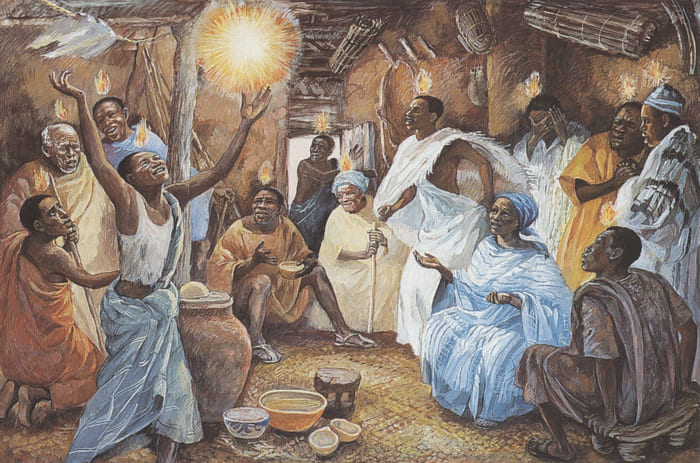
Every year we celebrate Pentecost, bearing in mind that the African continent continues to face increasing violence, insecurity, political fracture, and economic hardship. The situation has become an everyday experience in some parts of the continent, affecting populations of diverse creeds, tribes, and religions. In many circumstances, however, churches and mosques have been burned, and both Christians and Muslims have been displaced. Yet African Christians have often been targets and victims of this growing insecurity and terrorism influenced by religion. Like the early apostles before Pentecost, they are left afraid, steeped in doubt, and anxious, feeling hopeless.
On Thursday, 30th April, jihadists burnt down a historic church in Cabo Delgado, Mozambique. For nine years, arson and killings by jihadists affiliated with the Islamic State have increased. In eastern Democratic Republic of Congo, a majority-Christian region, Christians face growing violence from a militant group linked to the Islamic State. This group is accused of massacres, abductions, and systematic terror. Nigeria’s Middle Belt and Benue, predominantly Christian areas, also endure bloodshed. Here, Christians face recurrent attacks from jihadists, extremists, and bandits. The Easter Sunday massacres on April 5th, 2026—when jihadists simultaneously attacked, burned churches, and killed worshippers—remain fresh in memory. These have been followed by more attacks and killings of Christians.
“Like the disciples who moved from fear to courage after Pentecost, African Christians are strengthened by the Spirit.”
Like other people on the continent, Christians also battle with the daily deterioration of political and social conditions. Recent outbreaks of the Ebola virus in the Democratic Republic of Congo and Uganda have created a health emergency on a continent already battling poor health infrastructure and disease control. Other challenges, such as the rising cost of food and fuel across the continent, add to the growing anxiety, fear, and hopelessness experienced by many Christians.
A Time of Healing, Solidarity, Communion, Hope, Courage, and Renewal
In the face of these situations, Pentecost is not just a historical event for African Christians. It is an ongoing reality—one where the Holy Spirit empowers the Church. Pentecost marks when the Holy Spirit transforms a fearful, scattered community into a bold, missionary church. Like the disciples who moved from fear to courage after Pentecost, African Christians are strengthened by the Spirit. They persist in worship, fellowship, and witnessing, even under threats and uncertainty. During disease outbreaks like Ebola and with fragile health systems, Pentecost becomes God’s life-giving breath over human vulnerability. The Spirit that empowered the apostles brings healing, restoration, and unity. The Church in Africa draws inspiration to combine prayer with practical care. The Holy Spirit works through human efforts—such as hospitals, clinics, humanitarian response, and compassion for the sick—providing hope and transforming fragility into strength and fear into courage.
“Pentecost becomes God’s life-giving breath over human vulnerability.”
— Augustine Anwuchie
Pentecost is often called the birth of the Church. Pentecost lies at the heart of the Church’s communion and identity. It makes the Church a community in which each member’s needs are met. This image of communion becomes for African Christians an ecclesial foundation for community and solidarity. Christians share resources, support the less privileged and people with disabilities, aid widows and orphans, and promote education and grassroots development. Amid lack, exploitation, and hardship, the Spirit creates a communion that resists exploitation, discrimination, and isolation.
Like Peter and the apostles who preached with courage and boldness, Pentecost invites the African church to denounce the structures that build political exploitation and social vices. It must denounce forces that institutionalize poverty, insecurity, tribalism, corruption, and other violations of human dignity and human rights. Pentecost is also a call to reclaim the African identity by incarnating the gospel in African cultures. It also means allowing the Holy Spirit to speak through African cultures, values, music, symbols, and communal traditions, as in Paul’s encounter with the Greeks at the Areopagus or Peter’s encounter with the Gentile Cornelius. It is also a time for Christians filled by the Holy Spirit to testify to the power of the resurrected Christ, offering hope and encouragement to Muslims, traditionalists, and other faith communities – a time to work together for the restoration of peace and the abolition of violence and for light to triumph over darkness, and love to rule over hatred.
A Moment of Present Hope and Eschatological Future
“Pentecost reaffirms a providential truth that history is not closed by violence and poverty, but open to God’s renewal.”
The transformative power of Pentecost points beyond present suffering towards hope. For the African Christians facing traumatizing experiences of insecurity, persecution, violence, hunger, and poverty, Pentecost reaffirms a providential truth that history is not closed by violence and poverty, but open to God’s renewal. It is a reaffirmation that the same Holy Spirit who transformed the early church is still active – giving courage in persecution, healing in disease, unity and strength in time of war, and hope in the face of violence. Pentecost provides spiritual strength and calls Christians to love, communion, and courage in the face of difficult realities.
Have any thoughts?
Share your reaction or leave a quick response — we’d love to hear what you think!
-
 0
0
-
 0
0
-
 0
0
-
 0
0
-
 0
0
-
 0
0