
Embracing the Grace of Doubt as Part of the Easter Gift

The Johannine Gospel (20:19–31) narrative read on the second Sunday of Easter presents an image of Thomas, one of Jesus’ followers, that has come to define how history remembers him – the doubting Thomas. In fact, when one reads that passage, one immediately thinks that to doubt is itself an expression of lack of faith from which one is supposed to distance oneself. After all, Christian faith is grounded in the belief that God’s salvific encounters with humanity are grounded in concrete evidence of God’s intimate intervention in human history. We can imagine how frustrated the other followers of Jesus would have felt when Thomas refused to accept their stories. We can also imagine how his resistance can be seen as a negation of the women’s testimony. After all, the Johannine text grounds the narrative of the empty tomb and Jesus’ post-resurrection appearance in the testimony of Mary of Magdala and her companions (John 20:1–18). Permit me to invite you to suspend judgment and to explore together a different hermeneutic of the so-called doubt of Thomas. To do this well, it is important that I also explore the motif of doubt as it is examined by a famous theologian and saint whose works and insights continue to influence our contemporary era.
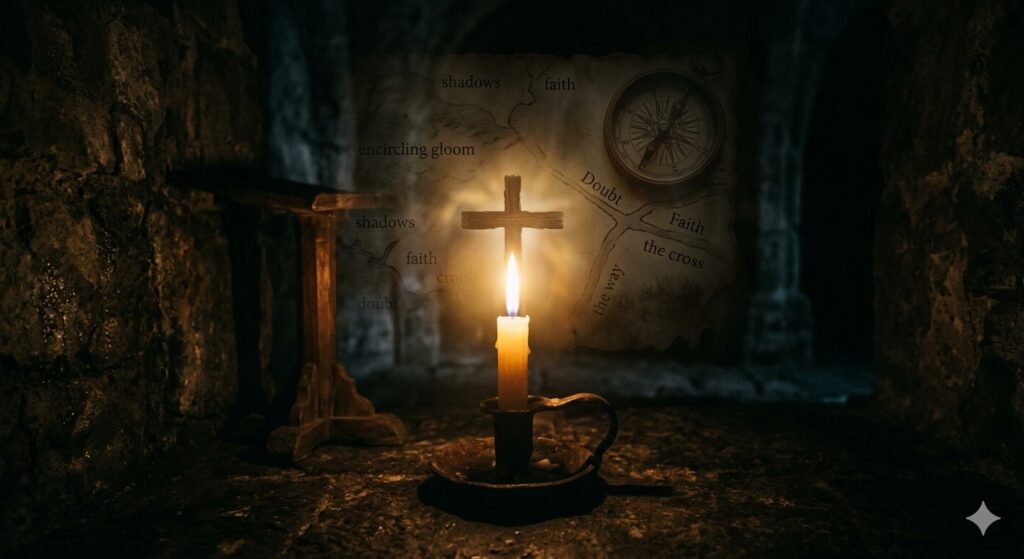
The famous theologian of the Victorian Age, Saint John Henry Newman, distinguished two types of doubt: interdenominational doubt and fundamental religious doubt. The former addresses uncertainty surrounding certain religious traditions, and the latter concerns the existence of God within the Abrahamic traditions.[1] Newman’s focus on doubt transcended just the bias for rationality as the mode of investigation. Rather, reason, conscience, and moral journey that are grounded in personal experience and desire for meaning ought to define the response to doubt as one seeks meaning in a turn to faith.[2] For Newman, to have faith is to have a moral responsibility to nurture it. Not doing that is neglecting the gift’s care. Doubt, in this context, calls for leaning more into the intimacy the gift makes possible for the believer. Such intimacy demands that the believer take the role of imagination, conscience, reason, and moral fidelity in the formation of one’s character seriously. One can thus understand the essence of those soothing lyrics that Newman wrote while experiencing personal and spiritual struggles on his journey from Palermo to Marseille in 1833 – “Lead, Kindly Light, Amid the Encircling Gloom; Lead thou me on!…”[3] Faced with many life struggles, his father losing his banking business as a result of the Napoleonic Wars, experiencing the death of his sister, and dealing with many health problems, anxiety and self-doubt plagued Newman even as he turned to his Christian faith as a source of self-grounding.
A basic understanding of grace is that it situates intimacy as the connecting reality between the source of grace, God, and the recipient of the gift of grace, creation. Since God is goodness itself and whose intention for creation is to bring about our collective and individual flourishing, one can easily see how one can conclude that doubt is itself a negative response to the one who invites us to be intimate with it. But doubt is not a vice in itself. It is not an opposition to the divine invitation to be intimate. Rather, doubt is saturated intimacy at the crossroads of encounter, waiting for God to initiate the bond toward recognition. What do I mean by this? To doubt another person is not to hate them or despise them. Rather, doubt originates from the domain of intimacy. It is an expression of care and commitment to the other. But it is also a covenantal summons to the other to respond accordingly. The motif of the crossroad perfectly expresses what doubt evokes not only in the one who doubts but also in the one to whom the doubt is projected. If I doubt you, it means that I am taking our relationship seriously, and I want you to show me that you really care and lead me to the domain of certitude in our relationship. Thus, the covenantal turn arises in the expression of doubt. For the believer, to doubt God is to take God seriously and to demand that God be God in the relationship – a God of life, a God of care, and a God of assurance.
Thomas’s doubt evokes two realities that define the Christian vocation. First, Thomas’s doubt offers the Christian world grounds for taking the content of Christian hope seriously: the resurrection. To reduce the belief in the resurrection of Jesus from the dead as a mere fantasy on the path of his followers is to ignore the evidential power of the doubt of Thomas. Thomas’ doubt attests to the reality of Jesus’ resurrection rather than to a fantasy. It reveals the empirical turn as the witnesses to the post-resurrection sittings of Jesus are narrated. One may doubt the women based on the cultural bias of patriarchy. One may doubt the testimony of the other follower of Jesus based on the fact that they were having nostalgic moments of hallucination as they grieved their friend and teacher, Jesus of Nazareth. But Thomas’ doubt signals an empirical turn and grounds the post-resurrection appearance of Jesus. “Unless I see the mark of the nails in his hands and put my finger into the nail marks and put my hand into his side, I will not believe.” This empirical claim evokes a covenantal turn that demands that God make the content of the Christian faith real. Because God is a God of the promise, the risen Christ fulfils the covenantal content of the doubt.
The second reality that Thomas’s doubt evokes for Christians is the relevance of faith in Christ. As the Easter liturgies reveal, Christian faith is communitarian in its expression. In fact, on the Octave of Easter, the priest invites the community to pronounce their baptismal promise to reject the devil and turn to the risen Christ, who stands as the true light and promise of our salvation. Yet, that which is received as a community must also have meaning in the inner sanctum of our lives as individual persons. Without its grounding in the sacred spaces of our hearts, such a faith would be despotic and meaningless. What we are in the koinonia of our faith as the body of Christ, we must also become as individuals in our own corporeality. Hence, the testimony of Christ’s followers to Thomas about their encounter with the risen Christ is validated by Christ himself in his dialogue with Thomas. This dialogue and encounter occur within the koinonic space of gathering, symbolic of the Church. It is as though the risen Christ is insisting on preserving the link between the individual and the community, even though the individual needs to be nurtured in ways that address their unique needs. The dialogue and encounter between Christ and Thomas symbolise the intimate link between the individual Christian and the fellowship of Christ through the church.
Both Thomas and Newman reveal something that defines a healthy koinonic embrace of the Christian vocation. The covenantal fulfilment that doubt evokes in one’s relationship with God is not limited to the individual. Rather, it serves as a bridge between the pruning of the communal faith and the expansion of the boundaries of its expression and understanding. Just as the individual needs the community, so does the community need the individual. Thomas’ doubt serves to expand the Church’s communal faith. It offers a concrete response to the fulfilment of doubt, helping the community ensure that it is responding adequately to the gift of faith in Christ – “My Lord and my God!” This is not just a statement. It is a witness to what the Christian vocation demands of all Christians as a community of believers in Christ – to surrender to the risen Christ as our Lord and our God. It is to insist that the risen Christ must be at the centre of all that we are and desire. It is to insist that the risen Christ is worthy of worship and to put our trust in Him. Similarly, Newman’s lyric best expresses this Thomistic response to the risen Christ. The risen Christ, who responds to our doubts by encountering us in a unique manner that best addresses our needs and desires, is the one to whom we should call upon in times of crisis. Like Newman, we should ask him to lead us like a generous light when we are unsure of our purpose in life. Even when our reason tells us that our reality is logically progressing towards failure, we must always trust that the risen Christ, who stands as a symbol of God’s illogicality in the world, can counter our logic with the illogicality of God’s grace. This is because to surrender to the risen Christ is to ask Him to guide our feet as we walk the path of life so that our destinies will reveal the wonders of God.
Both Thomas’ and Newman’s lives reveal the fruits of surrendering to the risen Christ, who guides all tenderly. Thomas became a bastion of faith in India, where the Christian faith continues to shine brightly and offer hope to many facing realities that breed hopelessness. Newman continues to serve as a credible witness to a life of faith, even though doubt may be among the ingredients that define that faith. Today, the Catholic Church honours him as a doctor of the Church to remind us that we can learn how to be faithful disciples of Christ even though we may be plagued by doubt.
Finally, both Thomas and Newman remind us that the beauty of the Christian vocation resides not only in our collective faith, where sometimes the contours of our individuality are blurred to allow for the communal to emerge, but also in the individual expressions of the faith that can serve as concrete markers of guidance for others who seek faith mentorship in their lives. Both Thomas’s doubt and Newman’s surrender in times of great distress serve as signposts for all in our contemporary world who seek new narratives of life and the intimate touch of the risen Christ. I am cognisant of the current realities of the people of Lebanon, Iran, the Arab world, Ukraine, Russia, Israel, the United States, and all lands where state machineries are being used to wage unjust wars. Innocent civilians are dying unnecessarily. Like Thomas and Newman, your tears and desperation as you lose all that you cherish and have laboured for are the covenantal content of your prayers as you lament before the throne of God. Just as the risen Christ addressed the needs of Thomas and those of Newman, may your needs be met by the God of life. May laughter be found on your faces again. This is the prayer of the Easter people – death never wins before the God of life under whose arms we all find refuge. Happy Easter!!!
[1] Anthony Kenny, “Newman and Victorian Doubt,” New Blackfriars, vol. 92, no. 1038 (2011): 157 – 169.
[2] See chapter “Chapter 6: Faith and Doubt,” John Henry Newman: A Very Brief History, by Eamon Duffy (London: Society for Promoting Christian Knowledge, 2019).
[3] “John Henry Newman Writes the Lyrics to Lead, Kindly Light,” The Tabernacle Choir, https://www.thetabernaclechoir.org/articles/lead-kindly-light.html?lang=eng.




Join the conversation