
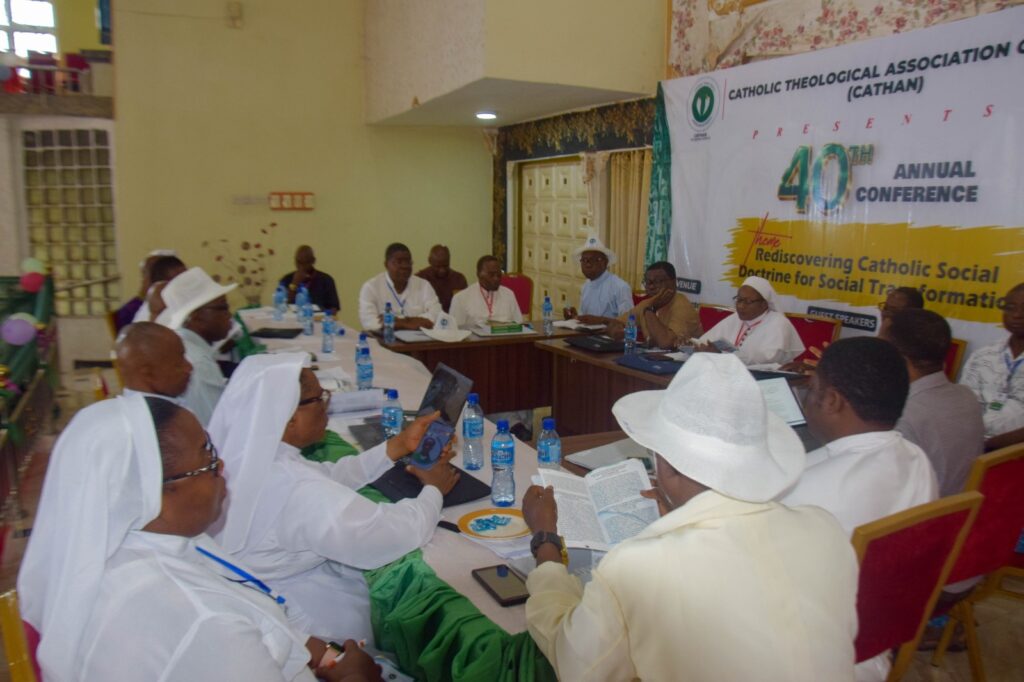
At the Sacred Heart Pastoral and Retreat Centre, Orlu, Imo State, the Catholic Theological Association of Nigeria (CATHAN) at its 40th annual conference held from 7th to 10th April 2026 emphasized the need to redefine Nigeria’s path to social transformation through a renewed commitment to catholic social teaching. The significance of this year’s conference is amplified by its timing, occurring close to the historic inaugural apostolic visit of Pope Leo XIV to Africa, starting on Monday, 13 April 2026.
The three-day event of robust intellectual engagement, theological reflections, and socio-religious exchanges, began with a solemn Eucharistic celebration presided over by the Chief Host, His Lordship, Most Rev. Augustine Ukwuoma, the Catholic Bishop of Orlu.
Held under the theme “Rediscovering Catholic Social Doctrine for Social Transformation,” the conference advanced CATHAN’s tradition of connecting Catholic theologians in Nigeria, fostering collaboration between theology and culture, and reflecting on national questions that affect Church and State.
The Catholic Social Teaching (CST), which formed the basis of this year’s conference, is a compendium of teachings articulated by the Catholic Church on matters of human dignity, justice, and the common good. It is rooted in Sacred Scripture and Sacred Tradition, with the dignity of the human person at its core.
Reflecting on Nigeria’s social question vis-à-vis CST in his keynote address at the opening ceremonies of the conference, the Metropolitan Archbishop of Owerri, Most Rev. Lucious Iwejuru Ugorji, drawing from the Fathers of the Second Vatican Council, insists that the joy and hope, the grief and anguish of the poor and the marginalized in society are also the joy and hope, the grief and anguish of the followers of Christ. “The Church in Nigeria cannot and must not remain indifferent to our social question or turn her back to the plight of our people.”, he said.
Other prelates whose eminent presences and valuable inputs boosted the conference included His Grace, Most Rev. Anthony Obinna, the Archbishop Emeritus of Owerri, and His Lordship, Most Rev. Augustine Echema, the Catholic Bishop of Aba.
CATHAN was founded in 1985 to foster theological research, dialogue, and ethical reflections, articulating the faith of the local Church using African idiom, symbols, languages, arts and thought pattern as means of contextualizing and making theology genuinely localized and meaningful to the people. . In his presidential address, CATHAN president, Rev. Fr. Dr. Idara Otu, MSP, reiterated the founding mission of CATHAN, as articulated by the association’s pioneer president, the late Rev. Msgr. Theophilus Okere, “To move Nigerian theology from passive consumption to creative and contextually grounded production, one that speaks meaningfully to the lived realities of our people and contributes to both ecclesial life and national development.”, he said.
The Secretary General of the Catholic Secretariat of Nigeria, Very Rev. Fr. Dr. Michael Banjo, and the Director of Programs, YIAGA Africa, Ms. Cynthia Mbamalu, presented the conference’s two commissioned papers that further reflected on CATHAN’s mission in the context of this year’s theme. Their contributions highlighted how the structures and agencies of the Church as well as strategic engagement with socio-political processes can serve the cause of social transformation in Nigeria.
Coming from different ecclesiastical and secular institutions and establishments across the country, the conference participants -priests, religious, and lay people converged at the serene and scenic hilltop hosting the Sacred Heart Pastoral and Retreat Centre, Orlu, overlooking a verdant woodland below with its lush green vegetation reinforcing the intellectual stimulating moment
Through their high-quality scholarly papers and in-depth discussions, the theologians explored CST from the perspectives of theology, Scripture, Christology, and Mariology, among others, and underscored the paradox of the Nigerian state: A nation richly endowed with human, natural, and mineral resources, yet “marked by pervasive poverty, inequality, and injustice.” This contradiction, the association notes in a communique issued at the end of the conference, “raises fundamental moral and theological questions concerning stewardship, distributive justice, and the ethical legitimacy of socio-political structures.”
At the end of the conference, CATHAN reaffirmed through a communique that human dignity forms the core of CST and calls on the State to ensure the safety of citizens in order to safeguard that dignity. “We are hopeful,” the communique states, “that social transformation and integral development of Nigeria can be achieved through the appropriation of Catholic Social Doctrine, which entails a transformation that is both ecclesial and societal.”
