
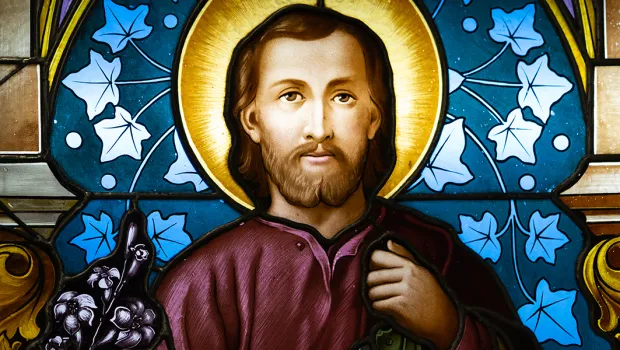
The readings for the fourth Sunday of Advent are saturated with important pastoral and theological themes that can benefit our contemporary world and church as well. In this short reflection, I focus solely on the Matthean pericope (1:18-24). That said, most churchgoers would not consider Saint Joseph to be the one they ponder the mystery of Advent. After all, the focus is most often given to Mary and her infant child, Jesus. But today’s gospel reading invites us to think otherwise and to focus on some of the many virtues of Joseph, the foster father of Jesus. Matthew chooses to ground Jesus in a social world and the histories that arise from it. Jesus did not fall from the sky. He had a history just like ours, and his history connects him to those of others. In doing this, Matthew turns to Joseph to ground the content of that history.
Yet, Joseph becomes not just the link to encountering the Jesus of history but also a type of social virtue that will come to define the entire ministry of Jesus. Even the Christian way of life will be defined as fidelity to the ministry and teaching of Jesus Christ. The purity laws of biblical Israelites, when looked at critically in hindsight, portray a patriarchal bias that favors men and not women because of the burden it places on women to embody social virtues that were strictly defined, unlike for men. However, it will be erroneous to then conclude that such laws have no legitimacy in the contemporary world. As Peter Leithart would argue, contemporary societies continue to be shaped by a vision of social purity, whether in the domains of politics, religion, philosophy, and so on.[1] No matter how much we claim to be sophisticated societies, we have residues of purity laws and uphold the biases that exude as well.
As I write this reflection, I am reminded of how purity laws were used to prevent many Jews from becoming Catholic priests in many religious congregations. The Venerable Francis Mary Paul Libermann, C.S.Sp., a revivalist/co-founder of the Congregation of the Holy Spirit under the Protection of the Immaculate Heart of Mary (Spiritans), suffered religious and social rejections simply because he was a Jewish convert to the Catholic faith. Yet, through him, the Church and all who are familiar with the Spiritan charism are grateful for his insightfulness in articulating a spirituality of Practical Union—offering one’s daily activities to God as acts of prayer—which continues to be the foundation of the Spiritan approach to the world and finding God in all that they encounter.
To understand the relevance of purity laws is to reject a tunnel-vision approach and instead embrace a broader perspective that highlights their socio-psychological significance. However, with reservations, I must insist. Pre-marital virginity that was demanded of Israelite women in Deuteronomy 22:13-21 points to an attempt to account for social currency for women in a world that had erased women from the main book of social history. Though one can dispute the intentions of the biblical Israelites in articulating the purity codes, the fact remains that women had one fundamental claim to respect and integrity by using their own virginity as a tool of protection, social acceptance, and embodied agency in the social world of biblical Israelites.
This truth may not be easily discerned in many Western societies, where social dynamics differ. But in many African societies, a married woman who was a virgin before marriage has some social power and legitimacy that she can use to shape discourses and decisions that affect her life and her circle of influence. As Dejene Gemechu and Jatani Didaa Haro rightly titled their article, “Virginity as a Sign of Masculinity: The Case of the Borana Oromo, Ethiopia,” female premarital virginity serves as a social currency for women in shaping society and having a voice in the communal deliberations, where men would naturally have total control. Female virginity is masculinized to allow such women to lay claim to certain rights as do men.
However, it cannot be denied that there is still the instantiation of patriarchy as a bias that defines the place and role of women in society, including Africa. The fact that a woman will have to use her virginity as a social currency of acceptance by society speaks of the reduction of women’s access to abundant life in our world, including the era of the biblical Israelites. Yet a closer reading of the Matthean text offers a disruptive turn in rethinking ways to undo patriarchy. This is where the wisdom of Joseph becomes an expression of Advent grace for our times, one that attempts to address the essence of the consequence of the sin of Adam and Eve.
Shame is a direct consequence of the sin of Adam and Eve. Having eaten of the forbidden fruit and going against God’s direct command, they became aware of their own nakedness. To address this content of sin, they put on clothes as though to hide their shame. When the time came for them to own up to their actions, they lied to God to cover up their sin once again. Shame becomes part of the human condition after the fall and thus steals away the ability to embody the joy of abundance in humanity’s mode of being in the world. With this in mind, the consequence of losing one’s virginity was to incur the punishment of social shaming. The woman was to be shamed publicly before she was put to death. As though to heal what was caused by the sinfulness of Adam and Eve, Joseph is used by God to embody a different way of addressing shame, especially that brought about by society on women. Seeing that Mary was with a child, one that he could not account for, Joseph chose to divorce Mary quietly without exposing her to public shame. His action is not just to protect Mary from public shaming, but also to protect the future of Jesus as well.
Joseph’s action is not just to protect Mary from public shaming, but also to protect the future of Jesus—modeling the grace Advent invites us to embody.”
If one is to follow the letter of the law, Joseph would be considered as being disobedient to the social purity laws that bound all biblical Israelites. But the spirit of the law transcends the letter of the law. A woman who loses her virginity before marriage is considered a bad person according to the letter of the law. However, social realities lead her to a place where she thinks that promiscuity is a proper mode of being in the world. To address this fact, one must ask the thick question: what are the social realities shaping this type of behavior? Punishing the woman is a shallow response to a larger issue. Joseph’s action reminds us of the type of grace the season of Advent invites us to embody. It is grounded in undoing the social structures of marginalization that affect women and anyone who has been reduced to the footnotes of history.
Punishing the woman is a shallow response to a larger issue; Joseph’s action reminds us that grace invites understanding before judgment.”
For our contemporary world, Joseph’s action is a reminder that in our struggle for justice, we must never lose focus. The focus is to bring about the flourishing of everyone, including those who perpetuate marginalities. Shaming one because they have sinned or fallen from grace may not always be the best way to transform them. But attempting to understand how social systems have defined their social behavior is a credible first step. As they are being corrected or called to repentance, their dignity ought to be protected at all times. Joseph protected Mary’s dignity. And for this act, Joseph is given a singular gift: an angel of God appears to him, and he is told of God’s plan for Mary, for Jesus, and for the entire world.
Blaming Israelis, Russians, Sudanese, Nigerians, or Palestinians for these acts of violence is too simplistic and falls within the domain of the letter of the law. Instead, we ought to ask the thick question: what social structures are shaping these conflicts? This question shows that both perpetrators and their victims are affected by flawed social systems that need reform.”
In conclusion, this week has been marked by some violence around the world. Innocent members of the Jewish community who were celebrating Hanukkah in Australia were attacked and killed by persons with antisemitic biases. A mass shooter shot innocent students studying for their finals at Brown University. Wars continue to be waged by Russia in Ukraine. Palestinians continue to suffer under Israeli occupation in Gaza. Many regions of Africa, including Sudan and Nigeria, continue to suffer unnecessary violence. To address these social issues, we ought to use the wisdom of Joseph. Blaming Israelis, Russians, Sudanese, Nigerians, or Palestinians for these acts of violence is too simplistic and falls within the domain of the letter of the law. Instead, we ought to ask the thick question: what social structures are shaping these conflicts? This question shows that both perpetrators and their victims are victims of flawed social systems that need reform. Advent grace invites us to embrace a culture and praxis of calling in our neighbors when they err, while allowing them to redeem themselves. It points to the limitations of calling out that is sometimes grounded in a false claim to a savior complex. It is a season of waking up and being aware of the marginalizing social systems we have all embraced as members of different social worlds. In fact, it is a time of choosing to reform such systems. Through an embrace of Joseph’s wisdom, we will be gifted by God with a new vision of what God hopes to realize in our lives, in the lives of others, and in the world at large. May Saint Joseph guide each of us during this season of Advent. Amen.


