
Pope Leo’s African Moment: A Prophetic Political Theology— A Test for African Bishops and Theologians, Part II

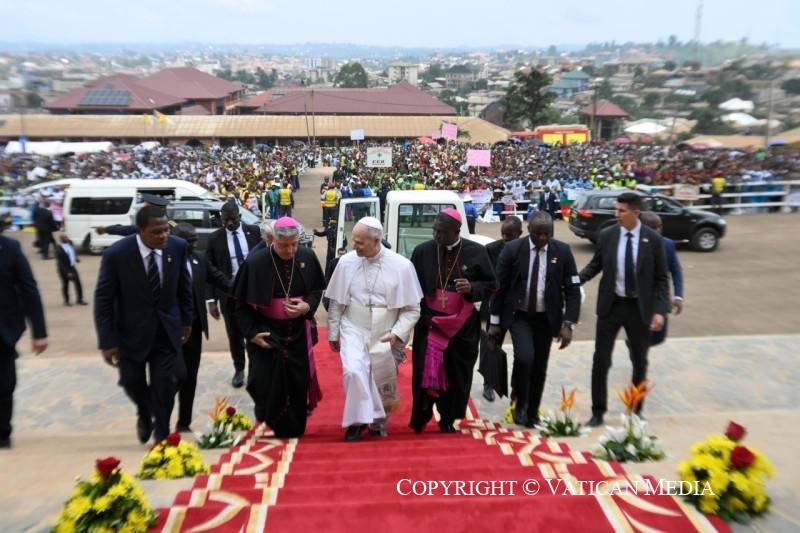
Pope Leo’s African moment is an epiphany, revealing to the Church and the world the kind of Pope God has given us. We are at the early stages of a papacy rooted in our ancient tradition and bold in proclaiming the truth of the faith with humility and joy. It is a papacy marked by deep respect for the many pathways and the diversity of cultures, races, nations, and religions that flow into the vast ocean of God’s mission, within which the Catholic Church carries on her fragile yet sacred vocation.
What stands out most clearly in Pope Leo’s mission to Africa, amid today’s complex socio-political and ideological divisions, is his enunciation of a prophetic political theology. In this, he not only retrieves Catholic Social Teaching but applies it with remarkable boldness to the moral and spiritual crisis of our confused world, addressing national and global politics, the dignity and rights of all peoples, the ethics of war and peace, love of neighbor especially the poor and suffering, and offering a critique of the sinful structures of domination, corruption, and manipulation in defense of the common good.
What is Pope Leo’s Prophetic Political Theology?
This prophetic political theology, in Leo’s emerging usage, is not partisan theory, clerical statecraft, or papal overreach, as some whose consciences have been whipped by the prophetic sting from the mouth of the Pope might claim. Rather, it is a Gospel grounded reading of political life that makes an ethical judgment of the social order according to how far it is ordered to peace, justice, social friendship, truth, human dignity, the participation of all citizens, and the common good, while calling rulers, citizens, and institutions to conversion so that the reign of God may emerge in history.
The heart of this prophetic political theology is articulated through a closer reading of Pope Leo’s speeches and in-flight interviews during his ongoing pilgrimage of peace to Africa.
This prophetic political theology could be understood, I argue, through a set of interrelated questions about the right ordering of society in light of the Gospel, namely: How is authority and power exercised as a form of service, ordered to the common good and the flourishing of all, especially the poor and most vulnerable? How are structures of governance shaped to foster certain outcomes: participation, co-responsibility, and the dignity of every person in a spirit of communion akin to the African ubuntu? How are the diverse identities, interests, and aspirations of people discerned, reconciled, and integrated within a social order that respects difference while nurturing unity, solidarity, and social friendship? By what means are collaboration, coordination, and mutual accountability cultivated among persons, communities, and institutions, so that subsidiarity and solidarity work together in advancing the common good, shared purposes, and promoting human and cosmic flourishing? And how are questions of justice, equity, and fairness discerned in light of the dignity of the human person and the demands of the Gospel, so that social, economic, and political arrangements are rightly ordered, relationships are restored, and all people participate through their assets to building a society of abundant life for all where no one is excluded from the goods of creation?
All these questions, I believe, can be understood within what I see as the Church’s preference for institutionalism as a political theory. Here, to borrow an idea from Lowndes, Marsh, and Stoker in Theory and Methods in Political Science, there is a focus on the “rules, norms, and values” that govern politics and governance, and on the institutions that regulate and promote the common life and the good of order. These norms are derived from natural law, divine positive law, the Gospel message, and the living Tradition and Magisterial teaching of the Church, discerned within history, human experience, and ecclesial life. They are universally applicable because they relate to the good of all human beings, whether they are Christians or not. However, in Pope Leo’s view, these values are not arbitrarily dictated, nor should the institutions that govern our common life locally or globally be imposed on the populace or the rest of the world by a few individuals or a few nations, and sustained by a tightly knit, narrow political class.
This is the problem in a country like Cameroon or Equatorial Guinea, where a thin top layer of the political class, or a cabal of patrons who has captured the state, as it were, turns statecraft into thievery, extraction, prebendalism, and extraversion, while using the state’s monopoly of violence to maintain tight control over a restive and disinherited masses who cry daily to God.
This is also the challenge the world faces in America’s unilateralism or exceptionalism, where it uses its military or economic might to advance a narrow vision of history, spiced with a warped Christian eschatology that, sadly, has the ugly face of a new form of idolatry, having nothing to do with the reign of God, and the God of peace and love revealed to the world by our Lord Jesus Christ. Pope Leo is inviting the world and Christians to take away the robe of Christianity from right-wing white Christian nationalists, who wish to resurrect the ideals and projects of a defunct Christendom.
I think Pope Leo is inviting Christians to infuse their societies with Christian values rather than to dominate them through Christian politics or a Christian theocracy.
From this perspective, it seems that Pope Leo invites the world to recognize that institutions of power should be continually renewed through reflective practices. This renewal should be informed by a social imagination that connects an understanding of people’s daily joys and sorrows with the norms and ideals of good governance. These norms should arise from, resonate with, and address the social conditions to ensure that the social order is just, equitable, and promotes human security and the common good, which everyone should be able to access like a wellspring. How has Pope Leo illustrated these principles and practices of Catholic Social Teaching in his speeches in Africa?
Six Principles of a Prophetic Political Theology
First, Pope Leo defines the Church’s political role as moral and evangelical, not partisan. Reuters reports him saying, “I do not look at my role as being political, a politician.” But in the same breath, he insists that he will continue to speak “against war” and for “dialogue and multilateral relationships.” This posture is reinforced in his address to authorities in Cameroon, where he declares: “I come among you as a shepherd and as a servant of dialogue, fraternity and peace.” This pairing is decisive: not a politician, but not a silent observer of world events either. Here, the Church’s political theology is neither partisan nor withdrawn, but prophetic, moral, and evangelical, addressing the concrete historical condition of God’s people.
Second, he offers a substantive account of what government is for. In Yaoundé, drawing on Augustine, he reminds rulers that they serve those they seem to command, insisting that serving one’s country means dedication “to the common good of all people in the nation.” He adds that authorities must “serve the people and foster their development,” and that “to govern means truly listening to citizens.” In Algiers, he advances the same claim in a complementary idiom: the “true strength of a nation lies in the cooperation of everyone in pursuing the common good,” and “authorities are called not to dominate, but to serve the people and foster their development.” This is one of the clearest through lines of his trip: governance as service, authority as responsibility, and power ordered to the common good of all citizens.
Third,
he links political order to interreligious fraternity, inter-ethnic harmony, human dignity, and the rejection of exploitation. We must daily negotiate the basis and ethics of our common life. National life in an increasingly pluralistic society must be characterized by constant negotiation among all sectors to achieve a just and inclusive common life.
Algeria is pivotal here. In his address to authorities, he affirms: “We are brothers and sisters, for we have the same Father in heaven,” presenting Algeria’s religious sensibility as fostering “a culture of encounter and reconciliation.” At the Great Mosque, he deepens this vision by tying the search for God to “the dignity of every human being,” to mutual respect, harmony, and “a world of peace.” At the same time, he condemns gains derived from exploiting human life, exploiting religion and ethnicity, insisting on the inviolability of human dignity. Here, political theology is grounded not in abstract rights language, but in a theological anthropology that binds fraternity, dignity, and peace in an “ordered universe willed by God” (Paul VI, PP, 76). Fourth, he turns to citizens, especially young people, as active makers of political society. In Cameroon, he calls the youth “to help shape a world that is more just, including in the political sphere,” describing their education, training, and entrepreneurship as a “strategic choice for peace.” At the Catholic University of Central Africa, he expands this further: universities must form consciences, future leaders, public officials, and professionals capable of acting “within an ethical framework at the service of the common good.”
He challenges young people to resist migration as a default imaginary and to place their knowledge at the service of their societies. This is a powerful vision of civic education, participation, and co-responsibility in the ordering of society.
Fifth, he insists that love, joy, and encounter are not private sentiments but political realities that are realizable in history. He thus offers a picture of a social imaginary that should inform a politics of hope. In Cameroon, he states with striking clarity: “to govern means to love one’s own country as well as neighboring countries.” This is not sentimentality but a redefinition of politics itself. In one of the most programmatic statements of the entire trip, he declares: “without encounter there is no politics; without the other there is no justice.” Here, love becomes a public virtue, encounter a political method, and justice the fruit of rightly ordered relationships. Even the joy and hope of Africa, especially among the young and the poor, are presented as political realities, signs of a people who still dream and seek to shape their future.
Finally, and perhaps most prophetically, is the boldness required today, a boldness akin to the courage of the early Church and of John the Baptist, all of whom embodied the urgency of St Paul the Evangelist’s warning: “Woe to me if I do not preach the Gospel!” (1 Corinthians 9:16). This is not rhetorical excess; it is the inner necessity of a Church faithful to its mission.
Pope Leo gives this courage a concrete and public form. On his way to Africa, he declared, “I am not afraid of the Trump administration.” By this, he signals that African Church leaders, too, must not be afraid of those he has elsewhere named as tyrants. What we are witnessing here is a recovery of the Church’s prophetic voice, one that speaks not from power but from truth. With unusual clarity and moral precision, Pope Leo names the forces of corruption, violence, and domination. In Cameroon, he insists that “the chains of corruption … must be broken.” He calls for “transparency in the management of public resources” and demands respect for the rule of law, warning that even security must always be exercised within the bounds of human rights.
In Bamenda, his tone becomes even more urgent, visceral, and direct. He denounces those who “manipulate religion” for “military, economic or political gain.” He speaks of “masters of war.” He condemns the theft of resources and the deliberate fueling of instability. And he laments, with stark realism, that the world is being ravaged by “a handful of tyrants.” This is the boldness of a prophetic political theology that rejects accommodation and complicity with corrupt and repressive governments: truth spoken with clarity, courage, and love.
Here,
the prophetic register of his political theology is unmistakable: it not only articulates principles but names actors, unmasks structures of sin, and calls for conversion.
These six elements reveal a coherent and emerging prophetic political theology: one that is moral but not partisan, realistic about conflict yet ordered to the common good, grounded in human dignity and fraternity, committed to participation and civic responsibility, and unafraid to confront the forces that distort and destroy the tranquility of order
A Challenge to African Bishops and Theologians The final consideration in this analysis is whether African Church leaders will follow Pope Leo’s lead.
What is evident is that the future of Africa cannot be constructed solely through national days of prayer and fasting, nor through the Church in Africa aligning with those whom Pope Leo has rightly described as tyrants.
African Church leaders are invited to follow Pope Leo’s example, who publicly criticized the failed and destructive policies of his own country’s president, stating clearly that he is not afraid of the Trump administration. We, as Church leaders, can no longer afford to be afraid of the dictators and tyrants who are destroying our beautiful continent. Without embracing a prophetic political theology in Africa, the Church will continue to function like an NGO, offering humanitarian support to the poor while failing to address the root causes of the impoverishment of God’s people and the enchantment of the sacred within the secular in Africa.
Archbishop Andrew Nkea Fuanya expresses this urgency with striking clarity: “The Pope has given speeches and messages. We have all clapped. We are all happy. What next?
Fuanya calls us to “sit down to digest all those messages,” and in Bamenda, he asks concretely how to make peace “now happen.” He even proposes the development of a Pope Leo “catechism of peace.” The challenge for the African Church is not the absence of statements, documents, committees, or prayers for peace, against bribery and corruption, or for a nation in distress (said every Sunday in Nigeria). It is the challenge of translating wishes and prayer points to political practice and pragmatic solidarity with the poor and the disinherited of Africa hanging on the Cross. Last year, I was part of the SECAM team of experts that drafted the 12 pillars for Africa’s transformation. One of these pillars focuses precisely on how the Church can play a decisive and transformational role in African politics. Sadly, nearly a year after the formal launching of this initiative in Kigali, little has been done to translate this vision into action.
My hope is that the prophetic political theology of Pope Leo will be translated into a concrete framework for action, in continuity with the Vision 2025–2050 of the African Catholic Church, so that we may become a light amid the challenging political realities of Africa today. Only then can we truly become a continent where the reservoir of hope and joy that Pope Leo speaks about is embodied as a praxis of action through a commitment to social and spiritual transformation of our beautiful continent.

Jenerica Lesengei
I followed Pope Leo xiv apostolic journey to Africa and he has energies my faith as a catholic. Its my prayer that God will enable me financially to pay him a visit in Vatican. Be blessed Santo Padre.
Jenerica Lesengei
Here in Kenya, Samburu County. I followed Pope Leo xiv apostolic visit to africa and he has renewed my faith with a lot of energy. Its may prayer that one day our able God will uplift me financially to enable my family visit Vatican where the Pope lives. Live long Santo Padre .