
All Saints, All Souls and African Reverence for Ancestors

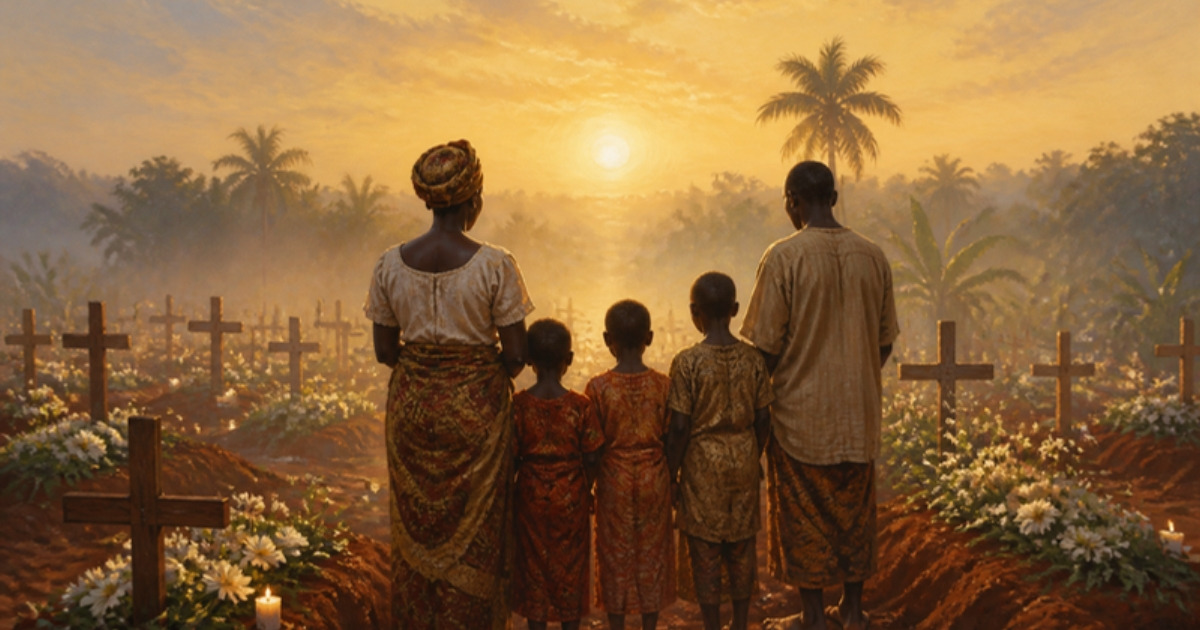
Whenever we celebrate the Solemnity of All Saints and the Commemoration of All the Faithful Departed (All Souls), something strikes at the heart of my faith as a Christian and my identity as a priest and an African: many Africans have a deep reverence for departed souls, especially their ancestors. Christianity and African Traditional Religion approach the dead from different theological perspectives, yet there is a remarkable connection in their understanding that death does not necessarily end the relationship between the living and those who have departed.
In traditional Igbo cosmology, the universe comprises both visible and invisible realities. In the hierarchy of being, there is God, the spirits, both benevolent and malevolent, the divinities of the land and the ancestors. Emefie Ikenga-Metuh, in African Religions in Western Conceptual Schemes (1985), provides an important framework for understanding this worldview.
The ancestors are not merely dead relatives. The benevolent ones, in particular, are believed to continue their existence in the spiritual world, watch over their descendants and, in certain traditions, intercede on their behalf. They are remembered and invoked during prayers, family and community gatherings, communal ceremonies and the preservation of oral history. The ancestors never truly die in the consciousness of the community; they live and endure. As Francis Cardinal Arinze explains in Sacrifice in Ibo Religion (1970), sacrifices and offerings to ancestors form an important part of the traditional religious relationship between the living and the departed. Such offerings express the belief that the ancestors remain interested in the affairs of their descendants.
This reverence is not exclusive to Africa. In Latin America, particularly Mexico, Día de los Muertos (Day of the Dead) is marked by flowers, family altars, candles, food and prayers in honour of departed relatives. Families gather to remember those who have gone before them, expressing the conviction that death does not erase the bonds of family and love. The African experience, however, has its own distinctive expressions.
Among the Izzi people of Abakaliki, in Ebonyi State, Nigeria, there is a traditional feast called Otu Utara, literally understood as a day of feeding the dead, usually celebrated around October. Families prepare sumptuous meals, which they take to the graves of their departed relatives, symbolically feeding them. According to the traditional understanding, failure to honour the dead in this manner may attract ancestral displeasure, sometimes believed to manifest in sickness or even death.
Growing up in this culture, I recall a woman who had recently converted to Christianity abandoning her home in fear and trembling when the period of this feast approached. She was afraid that the ancestors would kill her because she could no longer participate in the ritual, having become a Christian.
It was my mother, a pillar of Christian faith, whose voice and encouragement came to her rescue. She welcomed the frightened woman into our home, where she stayed for about a week. My mother strengthened her faith and helped her overcome the fear that had taken hold of her. Eventually, the woman discovered something that became a powerful lesson in her Christian journey: the ancestors had not killed her. Her conversion to Christianity had not made her vulnerable to the dead. That experience raises an important question for African Christianity: must becoming a Christian mean abandoning every form of reverence for one's ancestors?
The Christian origins of All Saints and All Souls
The celebrations of All Saints and All Souls grew out of early Christian memorial practices and the reverence shown to martyrs. From the second century, Christians commemorated those who had died for their faith. They gathered at their tombs, decorated them and celebrated their birth into eternal life. Their death was understood not as defeat but as victory through fidelity to Christ.
The biblical foundation for this understanding of sainthood finds a beautiful expression in Revelation 7:2–14. St John describes the 144,000 and, subsequently, an innumerable multitude from every nation, tribe, people and language, standing before God's throne, clothed in white robes and holding palm branches. They are identified as those who have survived the great tribulation. The passage explains: "They have washed their robes and made them white in the blood of the Lamb" (Revelation 7:14).
This imagery captures the Christian understanding of sainthood: those who have overcome suffering and remained faithful to Christ. The white garments symbolise purification, while the palm branches signify victory. This multitude represents the countless men and women, known and unknown, whose faithfulness has brought them into God's presence. It is this multitude that the Solemnity of All Saints celebrates.
The Church gradually developed common celebrations to honour groups of martyrs and eventually all the saints. The Western celebration of All Saints developed over several centuries, with 1 November becoming its established date. All Souls' Day developed through the initiative of St Odilo of Cluny in 998, who encouraged the commemoration of all the faithful departed on 2 November.
The Communion of Saints: A family that death cannot separate
The celebrations of All Saints and All Souls express the Communion of Saints. According to the Catechism of the Catholic Church (CCC 954), the Church exists in three states: those who are pilgrims on earth, those undergoing purification after death and those already in glory, contemplating God. Traditionally, these are called the Church Militant, the Church Suffering and the Church Triumphant. These are not three separate churches but one Church united in Christ. The Catechism (CCC 955) explains that the union between those journeying on earth and those who have died in Christ is not interrupted by death.
The New Testament does not reserve the word "saints" exclusively for those who have died and been canonised. St Paul addresses living Christians as saints (1 Corinthians 1:2). Through baptism, we are united with Christ in his death and resurrection (Romans 6:3–5), called to holiness and to become the salt of the earth and the light of the world (Matthew 5:13–16). Throughout history, the Church has also recognised particular Christians whose lives reflected Christ through their love of God and neighbour, sacrifices and heroic virtues. Through canonisation, they are proposed as models of holiness and intercessors for the living (CCC 828).
A point of clarity is needed here. Catholics pray for the faithful departed, asking God's mercy on them, and ask the canonised saints to intercede for us. These are different acts, and neither is worship, which belongs to God alone.
African ancestors and the Communion of Saints
Here lies an interesting meeting point between African religious consciousness and Christian theology. African ancestors are remembered not simply because they existed but because of the values they represented: courage, justice, generosity, hospitality and commitment to the community. This offers an important cultural starting point for appreciating the Communion of Saints.
Of course, the ancestors of African Traditional Religion cannot automatically be equated with canonised saints. Nevertheless, the Church recognises that God's grace is not restricted to those who have received explicit knowledge of the Gospel. In Lumen Gentium 16, the Second Vatican Council teaches that those who, through no fault of their own, do not know Christ but sincerely seek God and follow the dictates of conscience can attain salvation. St Justin Martyr, through his teaching on the Logos spermatikos, also recognised the seeds of the Word among human beings, even before the coming of Christ. The fullness of truth belongs to Christ, but traces of goodness and truth can be found beyond the visible boundaries of Christianity. St Paul teaches that such persons, who do good and choose the truth even though they do not know Christ, will be judged according to the law of their conscience (Romans 2:14–15).
Africa has had ancestors who defended the vulnerable, upheld justice, protected their communities and sacrificed themselves for the common good. Their goodness should not be dismissed simply because they lived before Christianity reached their communities. We can entrust them to the mercy of God.
Africans do not have to abandon their ancestors to become Christians
Perhaps the greatest pastoral challenge is helping African Christians distinguish between reverence for ancestors and the worship of ancestral spirits. Worship belongs to God alone. We must not worship ancestors or live in terror of their supposed powers. But neither must we despise them, erase their memories or abandon the moral values they transmitted to us. We can honour our departed parents, preserve their histories, visit their graves, celebrate their lives and pray for them.
What Christianity must reject is the idea that the dead should be appeased through sacrifices motivated by fear, or that our survival depends on satisfying ancestral spirits. A family meal organised in memory of a departed grandfather, for example, need not be an act of feeding his spirit. It can become an expression of gratitude, family unity and remembrance, accompanied by prayers for the deceased and acts of charity.
God is the God of the living, not the dead
Ultimately, the Christian understanding of death changes the way we relate to our ancestors. When Jesus challenged the Sadducees over their denial of the resurrection, he declared that God is not the God of the dead but of the living, for to him all are alive (Luke 20:38). St Paul, in 1 Corinthians 15:42–44, explains that the body is sown perishable but raised imperishable, sown in weakness but raised in power. This is the victory of Christ over death.
The African Christian, therefore, does not have to approach the grave with terror of ancestral retaliation. We approach it with reverence, gratitude, prayer and hope in the resurrection. We can remember our ancestors without fearing them, preserve our family heritage without worshipping them and entrust their eternal destiny to the mercy of God.
The African tradition of remembering ancestors, despite the shadows and ambiguities that accompany some of its practices, reveals a profound human yearning: that love, family and human relationships should not simply disappear at death. Christianity does not destroy that yearning; it gives it a fuller meaning through the resurrection of Jesus Christ.
The celebrations of All Saints and All Souls invite African Christians to rediscover something important about their cultural heritage. We do not have to abandon our reverence for the departed to embrace the Christian faith. We must rather allow the light of Christ to purify our understanding of death, transform our relationship with the ancestors and lead us towards the Communion of Saints.
Our ancestors are not gods. They are not to be worshipped or feared. They are human beings whose lives formed part of our history and whose eternal destiny belongs to the judgement and mercy of God. In Christ, death does not have the final word, and the bonds of love are not destroyed by the grave.
That, perhaps, is the deepest connection between African reverence for ancestors and the Christian celebrations of All Saints and All Souls: our final hope is not in the power of the ancestors but in the resurrection of Jesus Christ.

Join the conversation