
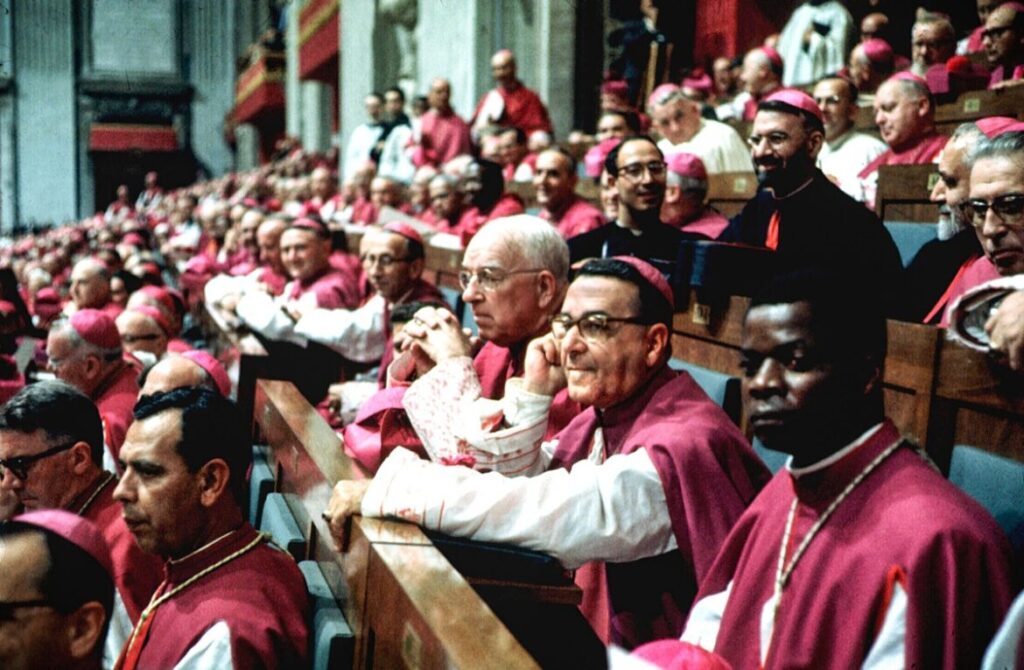
In his Angelus address on the eve of the celebration of the sixtieth anniversary of the closing of the Second Vatican Council on December 7, 2025, Pope Leo reminded the Church that Vatican II remains a living experience—a work of the Spirit whose fruits continue to unfold in unexpected ways. He noted that the Kingdom of God often buds forth in surprising places, bearing fruit even in weak vessels and “even in those things which humanly speaking would be impossible.” That insight captures well both the promise and the unfinished reception of Vatican II in Africa.
Vatican II was a decisive milestone in the life of the Church, not least because it marked what Karl Rahner famously described as the emergence of the world Church, or what Walbert Bühlmann called the coming of the Third Church. The Council signaled the end of Western Christendom as the unchallenged center of Catholic life and the recognition of a global, polycentric Catholicism—one increasingly shaped by Africa, Asia, Latin America, and the margins. In a post-Christian Western world, Vatican II acknowledged the emergence of a post-Western Catholicism.
The Council signaled the end of Western Christendom as the unchallenged center of Catholic life and the recognition of a global, polycentric Catholicism—one increasingly shaped by Africa, Asia, Latin America, and the margins. In a post-Christian Western world, Vatican II acknowledged the emergence of a post-Western Catholicism.”
For Africa, the timing was dramatic. As the historian Adrian Hastings observed, “The years of the Council and immediately after the Council were for many Catholics in Africa a particularly exhilarating time, if often confusing and frustrating.” What made the experience distinctive in Africa was its suddenness. Newly independent nations, young local churches, and emerging African leadership encountered Vatican II not as a reform of a long-established ecclesial order, but as an invitation to invent a future. Yet, Hastings also warned that “the currents of renewal and reform unleashed by Vatican II continue to wax and wane against the retaining wall of legalism, clericalism, and conservatism.” That tension has never disappeared.
What Vatican II did—perhaps more radically than any previous council—was to invite the Church to embrace history, contingency, and incompletion. The Council accepted what might be called the ecclesial crack as a space open to divine providence: a Church unfinished, learning, listening, discerning, always in the making, and always on the move as God’s pilgrim people. It opened a window to the world—not merely to speak to it, but to be addressed and transformed by it. For Africa, this ecclesial posture carried a liberating potential: freedom from excessive attachment to European narratives, categories, liturgical rituals and gestures, and pastoral models, and permission for a new, confident, and joyful celebration of the Christian faith on African soil.
Pope Paul VI captured this moment with remarkable clarity in his 1967 Apostolic Letter Africae Terrarum. He insisted that the Gospel does not abolish African cultures but purifies, elevates, and perfects them. “The African who becomes a Christian does not disown himself,” he wrote, “but takes up the age-old values of tradition in spirit and truth” (AT, 14). This teaching resonated deeply with the Council’s affirmation of religious freedom (Dignitatis Humanae, 9), its esteem for other religions (Nostra Aetate, 2), and Gaudium et Spes’ insistence that the Gospel is not alien to any culture but causes it to blossom from within (GS, 58).
Becoming a Christian for us Africans was never meant to produce cultural orphans or undiscriminating neophytes. Instead, it involved judgment and discernment on the one hand, and appropriation and assimilation on the other. This dynamic of inculturation did not apply only to individuals; it applied to the Church herself. From the earliest councils, Christianity had always borrowed cultural categories—logos, homoousios, theotokos, trinitas, episcopos—to express revealed truth. Africa was now invited to do the same, not as imitation, but as genuine participation in the Church’s self-understanding through an African spiritual and cultural grammar.
However, there is an aspect of Vatican II’s significance that is rarely discussed: it marked a generational change for Africa within a broader epochal shift for the Church and the world. The Council took place at a moment when Africa was experiencing the birth pangs of a post-Western missionary phase in the life of the Church. At the same time, the continent was witnessing the emergence of post-colonial African nation-states. Leaders who arose through these parallel struggles—both ecclesial and political—carried with them the residues of the domineering and condescending attitudes of some Western missionaries and colonial administrators. Even as they espoused African values of community and inclusiveness, many exercised leadership through forms of paternalism and patronage, the centralization of power, the trading of loyalty for positions, and intolerance of opposition.
Within the Catholic Church in Africa, the leaders and theologians who emerged in the post-Vatican II period fell broadly into two strands. The first were those African church leaders shaped by ultramontanism, with its ecclesial visibilism, curial centralization, and restorationist approach to maintaining uniformity in the Church from Rome to the local churches. For them, the world appeared as a vast pit of darkness standing in opposition to the pure emergence of the eschatological fruits of God’s kingdom—hence their perpetual struggle with the forces of modernity and change. The second strand comprised African church leaders and theologians who sought a reform-driven Church: a Church responsive to the needs of God’s people and open to drawing from the boundless faith, cultural, and social resources of Africa to reimagine and reinvent the future.
At the heart of these synodal efforts lies the enduring and pithy question posed by Cardinal Thiandoum to the Church in Africa: “Who do you wish to become today that will give you credibility?”
The two African Synods of 1994 and 2009 were significant attempts by African church leaders to lay foundations and develop a praxis for the renewal and reform of the Church in Africa, rooted in pastoral solidarity with God’s people and inspired by the spirit of Vatican II (Ecclesia in Africa 8, 71, 103; Africae Munus 136). At the heart of these synodal efforts lies the enduring and pithy question posed by Cardinal Thiandoum to the Church in Africa: “Who do you wish to become today that will give you credibility?”
I argue that the struggle to respond to this question has been central to the life of God’s people in Africa. The generation that first received it labored—often heroically—to answer it, raising further questions and experimenting with different pathways. Yet the moment has come for a new generation to take up the baton from these heroes of faith and to run faster and better to bring about in Africa a Church whose credibility is shaped through and through by its total commitment to the reign of God and the transformation of the lives of God’s people in Africa. For all the efforts made in post-Vatican II and post-colonial Africa, the situation on the ground points to a sobering reality: our people in Africa are still hanging on the Cross of suffering, and our churches are, in many ways, more dependent on the West today than in the past and often preoccupied with cultural Catholicism and its external ecclesial accoutrement than the inner work of conversion of hearts, structures, systems and institutions with a missionary and transformational orientation.
This reality underscores the urgency of charting a new path through a new generation—one born after Vatican II, our own generation. This generation must work together to build a Church in Africa that serves as sentinel and credible voice of the Lord: crying out against injustice and misrule, suffering and violence in the land; embodying the practice of hope amid pain and despair; and standing as a prophetic presence and channels of abundant life in Christ for healing, liberating, teaching, and saving our people from oppressive and unjust structures and institutions (Africae Munus 29–30).
Fruits of Vatican II in Africa
The fruits of Vatican II in Africa have been real, visible, and historically significant. One of the most important was the emergence of a continental ecclesial consciousness through the Symposium of Episcopal Conferences of Africa and Madagascar (SECAM). Long before the 1974 Synod on Evangelization in the Modern World, African bishops articulated a vision of a self-governing, self-propagating, and self-reliant Church—one rooted in co-responsibility rather than dependency. This vision challenged missionary paternalism and affirmed Africa not merely as a mission territory, but as a missionary subject.
The indigenization of the clergy followed rapidly. In 1960, Africa had fewer than 1,500 indigenous Catholic priests, and the life of the Church remained heavily dependent on missionary personnel. Six decades later, the picture has changed dramatically. Today, Africa counts over 54,000 Catholic priests, diocesan and religious, serving vibrant local churches across the continent and beyond. Numerous African-founded religious congregations—both male and female—have emerged, shaped by local spiritualities, communal patterns of life, and concrete social needs. The Catholic population itself has grown exponentially, fromjust over 20 million in 1960tomore than 280 million today, making Africa one of the fastest-growing and most dynamic centers of global Catholicism. This growth placed enormous pastoral pressure on the Church. It also prompted some episcopal conferences to raise difficult questions about ministry, celibacy, and access to the sacraments—questions that were often met with suspicion or silence.
At the same time, resistance to African ecclesial creativity increased. Rome intervened decisively in some cases, sidelining or disciplining bishops such as Patrick Kalilombe, Denis Hurley, and Joseph Malula. Progressive theological voices were monitored or marginalized, and more conservative bishops were often appointed to stabilize what was perceived as excessive experimentation. Yet, these tensions also gave rise to new movements: the founding of the Circle of Concerned African Women Theologians, the Ecumenical Association of Third World Theologians (1976), and later the Ecumenical Association of African Theologians, growth in small Christian communities, Catholic Charismatic renewal movements among others—spaces where African voices, especially women’s voices, and voices from the margins could articulate faith from lived experience.
Institutionally, the post-conciliar period saw the establishment of pastoral institutes, seminaries, catechetical centers, universities, and Catholic social ministries. Catholic schools, hospitals, justice and peace commissions, refugee services, and development agencies became central actors in African societies—often where the state was absent or fragile. Liturgically, the introduction of the Zairean Rite, pioneered by Cardinal Malula, marked a historic moment: the first fully inculturated Eucharistic rite approved for regular use, symbolizing Africa’s right to pray as herself. Yet these undeniable fruits also revealed unresolved tensions that continue to shape the African Church today.
Limits and Silences
Yet, as Patrick Kalilombe perceptively noted, Africa entered Vatican II with questions different from those of long-established churches. “Africa’s questions were those of a newborn community trying to find its place in a fast-moving continent.” Consequently, Africa shaped Vatican II less than Vatican II shaped Africa. Bishop Chidimbo of Conakry expressed this frustration bluntly when he observed that Gaudium et Spes scarcely addressed underdevelopment, colonialism, racial discrimination, or the structures of a new society from an African perspective.
This asymmetry carried over into theology. African theologies were often labeled “contextual or inculturation”, while Western theologies were treated as normative. Concerns were raised—by Cardinal Ratzinger and later by John Paul II—about catholicity and unity, as though inculturation itself threatened communion. While John Paul II affirmed that no culture can be the ultimate criterion of truth (Fides et Ratio, 71), he nonetheless privileged Greco-Latin categories as providentially normative, leaving African theological creativity in a perpetual posture of justification.
Present Challenges: A Church at the Crossroads
Today, the African Church faces challenges that expose unresolved tensions. The Milingo episode became a metaphor for deeper questions about ministry, celibacy, authority, and Pentecostal influence. African Catholicism often operates under the protection of Rome, hesitant to risk failure, creativity, or prophetic confrontation. Women continue to bear the Church institutionally while remaining structurally subordinate—sisters preparing food for bishops and priests, and sisters working for bishops and priests rather than as co-missionary disciples with them in a co-responsible Church remains a painful symbol of exclusion and asymmetrical power relations in a patriarchal church.
African bishops often oscillate between being pastors of their people and legates of Rome. African theologians sometimes timorously act as parrots, repeating inherited formulas, or as elephants guarding tradition, when many ought to be cheetahs—running farther, faster, and more freely than their ancestors. Meanwhile, the Church ministers amid deaths: deaths of lives, institutions, hopes, and dreams—a Church surrounded by coffins in contexts of war, migration, climate disaster, preventable and treatable diseases, crisis of the nation-state in Africa, and economic collapse.
Toward a Generational Shift
Sixty years after Vatican II, the African Church now yearns for a generational shift. The Synod on Synodality has sharpened this urgency by offering tools for listening, discernment, and co-responsibility. The next generation must confront the tyranny of numerical growth in the Christian population on one hand and the growth in poverty, religious enchantment and poverty on the other hand. It must courageously confront the scourge of tribalism —whether the blood of ethnicity outweighs the water of baptism; the entanglement of Church and state amid permanent humanitarian crises; the ambiguity of mission and money; the unresolved tensions between culture, sexuality, public health, and moral discourse; the digital transformation reshaping authority and belonging; and the crisis of the nation-state and the deceptive allure of modernity whose destructive prehensile tentacles continue to unfold and convulsing the African Motherland with rising precarity and mortality for the most vulnerable among us.
Africa does not need a Church frozen in inherited answers or one that merely imitates Rome. Africa needs a synodal, incarnational, and courageous Church—capable of speaking hope into wounded histories and shaping a future worthy of its people.”
Above all, this generation must challenge old patterns of power: gerontocracy in Church and state, the sacralization of authority, and formation systems that prize blind obedience over creative fidelity. Too often, an honor code that suffocates the talents of the younger pastoral agents and scholars in the Church through effete institutional culture –cultures that reward sycophancy through cronyism, favoritism, and nepotism over merit. Africa must open herself—as a distinctive and richly charismatic Church—to the surprises of the Holy Spirit in discerning and celebrating the gifts of God’s people rather than perpetually extinguishing these emerging points of light even before they could bud forth from the ecclesial incubation gardens. Africa does not need a Church frozen in inherited answers, nor a Church that merely imitates Rome or creates a coterie of pastoral agents who seek for upward ecclesial mobility through sycophantic circles. Africa needs a vital Church of life—synodal, incarnational, prophetic—capable of speaking hope into wounded histories and shaping a future worthy of its people.
Vatican II opened the door. Sixty years later, Africa stands at the threshold, asking whether the Church will finally walk through it—with her young, her women, her theologians, her vibrant and creative pastoral agents, her poor, and her ancestors—into a truly generational renewal open to the surprises of the Holy Spirit.


3 comments
Thanks so much for this reach article. It rethinks Africa in the Church. Vatican II shaped Africa, but was equally shaped by Africa, meaning there was a true encounter. I agree with the author when he says Africa must not just be a parrot repeating doctrine or an elephant preserving traditions. Africa must forge ahead.
The risk he mentioned about finding a new way at all cost is that in which Joseph card. Malula and co felt. In my opinion, Africa is not expected to invent a new doctrine or a new faith. Though it is important to speed ahead, being focus and keeping track is of vital importance. Africa still needs to be a parrot, one that repeats the doctrine but who also interprets. Africa still needs to be that elephant who keeps the deposit of faith but which is open to new avenues.
I stand with the author for a dynamic pastoral approach, one that is synodal, not only contextual but universal.
Reading your reflection, I am reminded of the fact that the old controversy between the Gallicanists and the Ultramontanists continues to this day. The continuity has held captive the global Catholic Church’s ability to articulate a healthy theology of the episcopacy. The blame rendered on the African bishops as stooges of Rome may not be solely their fault. The Church needs a theological engagement with what the episcopacy stands for and how the papacy is an institution that is intended to support and not take over the role of the local bishop. To do this well, Canon Law ought not lead the conversation. Rather, it must be grounded in the theology that differentiates the two ministries, that of the episcopacy and that of the papacy. Currently, Canon Law does not seem to articulate clearly the theology of Vatican II, a theology that was only trying to start a conversation and which must now go beyond where it currently stands.Vatican II, if it is a living experience as Pope Leo XIV has aptly noted, it means then that we must continue the work of the Council through a theological engagement on the ministry of the episcopacy.
The mandate given to Peter cannot be absent in the ministry of the twelve. Rather, in their fellowship of love is this ministry fully instantiated. This ministry of love does not replace the subjective realities defining the local church. The papacy is not diminished by this subjective ministry of the local church and its bishop, rather, it is given prominence as the symbol of their unity, a unity that binds and grounds itself in the differences that constitute the local church. The crisis in the canonical regulation is found not in the ministry of unity but in the inability to see how this unity is expressed in the differences that define the local churches. This is because, difference is still seen as an idea and not as embodied epistemology that ought to define how the local church instantiates the universality of the global church through its embodied differences.
I also loved how you explored the fecundity of growth that has defined the African church. The African church may not be where it ought to be, but it is not a dead church. It has an enormous task before it, it is fighting the demons of colonialism and the colonial theologies it was forced to embrace. It is fighting the global exploitation of the continent by the powers that be. It is plagued with the colonial project of illiteracy that also affects its theological turns. To address these, a type of African radicalization is needed that must disrupt the theological project in its current form. It must push the boundaries and help to awaken its leaders in a manner that they begin to ask the African questions that the Spirit is leading it to.
Nice write up.
Très intéressant comme article nous sommes face à l’aggiornamento de la pensée africaine dans le christianisme mondial. Oui père Stan l’heure est au rendez-vous de l’Afrique