
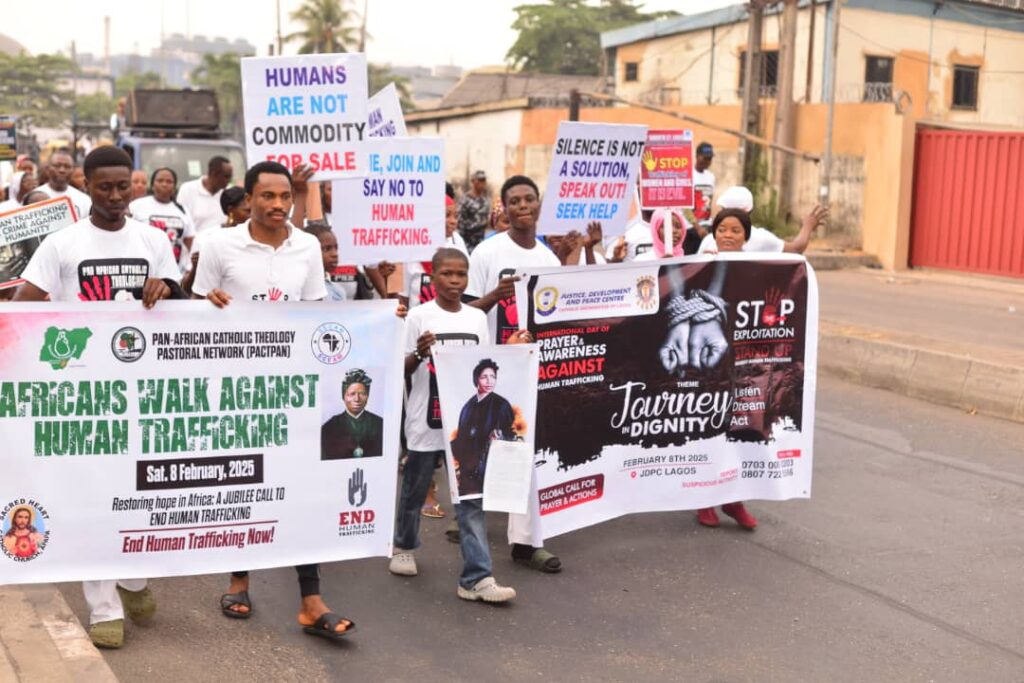
A recent BBC investigation tore open a wound that has long bled in silence: young African women deceived with promises of education or job opportunity, only to be trafficked into darkness, sex slavery, and domestic violence. They leave home as daughters, chasing dreams of light, only to arrive in foreign lands as commodities. What bleeds here is not only the bodies of children, but the very soul of a continent.
I remember 2002 in Perugia, Italy, when I was invited to translate police wiretaps of traffickers. The words still haunt me: Africans laughing as they counted how many young girls they could ship into prostitution. Not far from Assisi—the home of St. Francis—I heard the crucifixion of innocence in cold laughter. One evening, I saw them myself: Nigerian girls used as prostitutes lining the roadside, waiting for strangers. I asked: How can fellow African men and women sell their own sisters and gloat over blood money? How can a people who talk about God all the time become heartless and conscienceless merchants of the bodies of our innocent daughters?
And yet, two decades later, the trade has continued to grow. Today, thousands of African girls—some only 12 or 13—are lured into false scholarships, jobs, and marriages. UNICEF, in its special report marking the 25th anniversary of the Palermo Protocol to Suppress and Punish Trafficking in Persons, especially Women and Children, reports that 79% of trafficking worldwide is sexual exploitation, overwhelmingly of women and girls; one in five victims is a child. The 2024 UNODC Global Report on Trafficking in Persons shows that, in recent years, victims trafficked from African countries have been identified in a growing number of destinations both within the continent and across the world. Africa now accounts for the highest share of trafficking flows globally.
In the Middle East, female migrants are subjected to sexual exploitation— “rented” to specific clients for fixed periods, pressed into domestic servitude, or forced into the hospitality industry. The report further documents patterns of extortion and exploitation, as well as torture and physical and sexual violence, along the trafficking routes through the Horn of Africa and Southern Africa. Smugglers, it notes, often exploit the vulnerability of illegal migrants by coercing them into criminal activities, and increasingly rely on violence, abduction, and the threat of harm to extort money from the victims’ families.
I teach a course on modern-day slavery and the Atlantic slave trade, and I see the haunting parallels today. People will do almost anything to make money. Greed, unregulated capitalism, and the pursuit of profit at all costs have destroyed the souls of so many. The same sentiment of cold-blooded insensitivity and the absence of a shared sense of humanity that drove the trans-Atlantic trade are at play again in our own time.
In February 1992, St. Pope John Paul II stood at the Door of No Return on Gorée Island in Senegal, one of the most symbolic slave ports in history, and asked pardon for the millions of Africans who were captured, sold, and shipped across the Atlantic by Christians who betrayed the Gospel. A few months later, in September 1992, African Catholic bishops also gathered at Gorée and performed a moving ritual of remembrance and repentance. They asked pardon from the ancestors for the complicity of fellow Africans—chiefs, traders, and ordinary people—who collaborated in the capture and selling of their own brothers and sisters into slavery.
We Africans must take responsibility for the many tragedies that continue to befall our people. As the Yoruba proverb says: “The enemy outside cannot kill the child if there is no traitor within.” In other words, external oppressors succeed in exploiting and destroying Africa only when they find internal African collaborators. This was true in the past, and it remains true today.
Human trafficking in the twenty-first century is not simply a crime imposed from the outside. It is as old as human history, but in our time, it has become enmeshed in a toxic and destructive network that includes gender-based violence and sexual exploitation, which affects an estimated 4.8 million people globally, according to the International Labour Organization. It also involves drug trafficking and the narco-trade, where cartels use trafficked persons as couriers or exploit their vulnerabilities. Other disturbing aspects of human trafficking today include: money laundering, with profits from human trafficking estimated at over 150 billion dollars annually worldwide; arms trafficking, as war zones and conflict feed both displacement and vulnerability to trafficking; cybercrime, where online grooming, fraudulent job offers, and dark web markets lure victims. It also includes organ trafficking, where desperate migrants are preyed upon for body parts sold in global black markets; and transnational mafia networks, which link trafficking routes across Africa, the Middle East, Europe, Asia, and the Americas.
In Africa today, human trafficking flourishes in a deadly combination of poverty, unemployment, prolonged conflict, weak governance, and the complicity of some leaders and institutions. Human trafficking in Africa is also worsened by what UNODC reports calls “an abundance of natural resources in areas with weak oversight” and the devastating effects of climate change in Africa. The International Organization for Migration has documented thousands of young Africans lured each year with false promises of jobs or education, only to be trapped in modern slavery across the Middle East, Europe, and even within Africa itself. According to the United Nations Office on Drugs and Crime, West Africa remains one of the global hotspots of trafficking, with women and children disproportionately affected.
The tragedy is compounded by silence and indifference. Just as many Christian leaders, merchants, and chiefs once turned away from the cries of enslaved Africans, so too today do governments, security agencies, airlines, and communities look the other way when our daughters are trafficked through airports and borders.
We cannot heal our present wounds if we fail to confront the complicity of both the past and the present. To remember Gorée is not just to lament history—it is to hear a warning: unless we Africans take responsibility, the chains of yesterday will continue to bind us in new forms today.
Something is broken in Africa today when the crimes exposed by the BBC, the horrors I once saw in Italy, and the daily reports of PACTPAN’s anti-trafficking agents all over Africa still flow like blood from East Africa to the Middle East. How can the Gospel we preach be good news while our daughters are enslaved? How can we stop the domestic enslavement and sexual exploitation of young girls across our continent? How can we recover the values of Ubuntu that compel us to see in every trafficked girl a wound to our own humanity?
The Church must be the voice of these girls and the agent of their liberation. When bishops link hands with survivors, when pastors mobilize youth to protect one another, when seminaries teach migration ethics and trafficking awareness, then the Church becomes vital in resurrecting the broken, damaged, and bleeding flesh of Christ in our trafficked daughters. When the Church cries with one voice, “Not in our name. Not with our children. Not under our watch,” then the trafficker’s trade begins to collapse.
The BBC report is not mere journalism—it is a trumpet blast. It tells us that trafficking is not “elsewhere”; it is here, in Africa, and it involves our parishioners, children, friends and neighbours. Let the African Church be known not for its silence, but for its solidarity with our trafficked girls. May the Gospel come alive in our continent to free our daughters in chains who have been condemned to die through our collective failure to protect them.

7 comments
United we stand against Human Trafficking in Africa!
Is too bad for our African men and women using our young girls for that type of business. We need to educate our young girls about prostitution that’s going on in the whole world now. And inform the parents too. We would continue to pray for almighty God to touch the heart of this evil men and women of our world.
Thank you, Father Stan, for this profound and captivating analysis of the sad situation that is human trafficking, specially the recent BBC investigation.
Inspired by the Gospel and the African values of Ubuntu, our collective action will help to reduce and put an end to this dehumanising situation.
We are doing our best within the Pan-African Catholic Theology and Pastoral Network. May the Holy Spirit make our action fruitful.
#StopHumanTrafficking
Powerful article by an outstanding church servant leader! Let us all respond in every way that we can!
Powerful article by an outstanding church servant leader! Let us all respond in every way that we can!
Is too bad for our African men and women using our young girls for that type of business. We need to educate our young girls about prostitution that’s going on in the whole world now. And inform the parents too. We would continue to pray for almighty God to touch the heart of this evil men and women of our world.
This is an interesting piece. I found it very useful for my research project. I would be delighted if I can have access to the PDF copy of the write-up up. Gender- based violence has remained one of the major challenges to girls and women rights in Africa. In my ongoing research, I have made a proposal that Religion ( as an agent of morality and character formation), should not be underrated in the fight against all forms of abuse on the female gender, and more especially, that against Girl- child education in Africa and in Nigeria. The potential of Religion should be utilized in this war.