
The Footprints of God in Africa
Pope Leo’s Homecoming to Peru: The Beauty of Our Church and the Gift of Tears

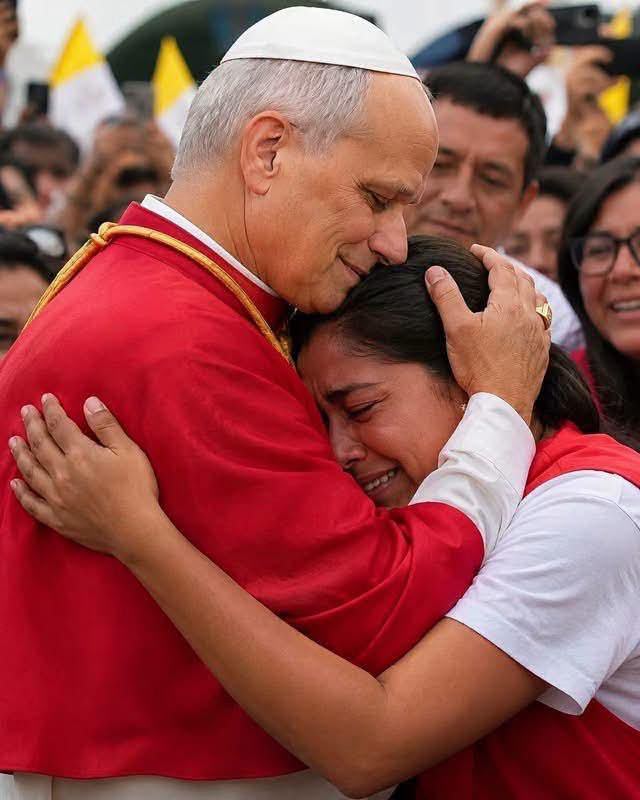
Pope Leo’s visit to his adopted homeland, Peru, has been deeply moving, especially his homecoming to Chiclayo. This is the beauty of the Catholic Church. An American-born cleric and missionary finds a home among a people because they share one love, one faith, one God, and one Church. St. Paul describes this mystery: “There is one body and one Spirit… one Lord, one faith, one baptism, one God and Father of all” (Ephesians 4:4–6). The Pope’s own motto, taken from St. Augustine, says the same thing in four words: In Illo uno unum, “In the One, we are one.”
The people’s love for him is real and moving. His love is just as true and beautiful: for the land that shaped his missionary spirit and pastoral tenderness, and for the people who showed him Christ’s face. In Chiclayo, nobody treats him as a foreigner. Peru made him one of its own long before it gave him citizenship, and he knows it. As he told the nation in Lima on his return, he spoke movingly of how much of this land remains with him and how much of his own story belongs to its people.
Sometimes we as Catholics forget this beautiful heritage of Catholicity that we have received. Our faith can bring out the very best in all of us when we live the fullness of Catholicity: universal love and openness to God and to all people because of God; unity in diversity without uniformity. St. Ignatius of Antioch wrote at the start of the second century, “Wherever Jesus Christ is, there is the Catholic Church” (Letter to the Smyrnaeans, 8:2). Catholicity is a quality of love before it is a measure of size, population growth, or geographical or quantitative extension.
With such a large population worldwide, the Catholic Church, inspired by the missionary gift exchange we see, for instance, between Peru and Pope Leo, can build bridges across cultures and peoples. Through its prophetic voice and its presence among the forgotten, the marginalized, and those who suffer, it can restore hope. In this way, we can show the world a different way of living. Our religion can have a face marked by love, kindness, tears, respect, and tenderness, and by a courageous fight against evil, violence, injustice, and sin. And our way of being Church in this inclusive and Trinitarian key will invite people to come and see. This invitation is not the work of a few specialists in mission; it is the calling of every baptized person. Preaching to some half a million people in Chiclayo, the diocese he once led, Pope Leo put it plainly: “All Christians, whether ordained ministers or lay faithful—regardless of the degree of formation we have received in the faith—are missionary disciples.” Such discipleship begins with an encounter with Christ and reaches out to embrace the whole human family. The Second Vatican Council put this vocation unforgettably in an incarnational key this way: “The joys and the hopes, the griefs and the anxieties of the men of this age, especially those who are poor or in any way afflicted, these are the joys and hopes, the griefs and anxieties of the followers of Christ” (Gaudium et Spes, 1).
With such a large population worldwide, the Catholic Church, inspired by the missionary gift exchange we see, for instance, between Peru and Pope Leo, can build bridges across cultures and peoples. Through its prophetic voice and its presence among the forgotten, the marginalized, and those who suffer, it can restore hope. In this way, we can show the world a different way of living.
As Pope Leo shows on this trip, the heart of Catholicism is a transforming closeness to all people and a clear testimony that everyone counts. By being with God’s people in this simple way, he proclaims the Gospel credibly and convincingly to a world that needs healing and unity around a common purpose. Pope Francis asked for shepherds “living with the smell of the sheep.” Pope Benedict XVI reminded us that “being Christian is not the result of an ethical choice or a lofty idea, but the encounter with an event, a person” (Deus Caritas Est, 1). Pope Leo carries this same conviction across South America. He does not treat closeness as a pastoral strategy; he sees it as the Gospel’s own demand. Speaking to the bishops of Argentina in Buenos Aires, he spoke of the many faces that challenge us and call us to share in the joys and sufferings of our people, inviting us to respond with the closeness and deeds demanded by the Gospel. In Chiclayo, people are meeting the Lord Jesus through the nearness of a shepherd they have known for years.
It moves the heart to see a Pope who cries with the people and smiles with the people. His tears reveal our common humanity and the deep bond of love, faith, and solidarity that unites the Pope with God’s people. In these moments of shared joy and sorrow, he is living out St. Paul’s beautiful instruction to the Christian community: “Rejoice with those who rejoice, weep with those who weep” (Romans 12:15). Tears purify the heart, free the mind, soften our judgments, and bind hearts together. They bring us closer to God and to one another because they open our eyes to the suffering, hopes, and joys of others. Indeed, tears are not a sign of weakness but a profound expression of our shared humanity and our capacity to love, to be moved by the suffering of others, and to enter into communion with them.
Pope Francis expressed this truth beautifully during his pastoral visit to the Philippines in January 2015. At his encounter with young people at the University of Santo Tomas in Manila on January 18, he was deeply moved by the testimony of a young girl, Glyzelle Palomar, who spoke about the suffering of abandoned and exploited children and, through her tears, asked why God allows innocent children to suffer. Pope Francis departed from his prepared remarks to reflect on the meaning of tears, reminding the young people that certain realities of life can be seen only through eyes cleansed by tears. He said compassion requires more than intellectual understanding: we must let the suffering of others touch our hearts. There is a wisdom of tears and a closeness that only tears can bring between people. When people cry together, they learn to see the world through the eyes of those who suffer and to respond not merely with words but with tenderness, solidarity, and love.
Tears are a Christian act of self-surrender to God. God, in Christ, sheds the first tear: at the tomb of his friend Lazarus, “Jesus wept” (John 11:35), and as he approached Jerusalem, “he wept over it” (Luke 19:41). God meets us through our tears and treasures every one of them: “You have kept count of my tossings; put my tears in your bottle” (Psalm 56:8). The Desert tradition saw tears as a second baptism. St. John Climacus went so far as to write that “greater than baptism itself is the fountain of tears after baptism” (The Ladder of Divine Ascent, Step 7).
Our tears are signs of authentic freedom and the radical humility of a heart free to love. Tears are not a sign of weakness or emotional fragility, as many may say. They are an act of self-surrender and self-donation. A heart that cries is free for God and free to embrace the dear neighbour with unrestricted love, free to encounter the other without barriers. Tears show our openness, at the deepest level of our human vulnerability, to a divine caress. They show our longing for a holy intimacy that moves our hearts into transcendence and mystery. Whether one tears up because one is confronted by suffering; because one is confronted by radical evil; because one has received a gift beyond measure; because of a sense of loss; in the presence of God and amidst the splendour of transcendence in a mystical experience; because one is wrapped up in a holy intimacy; or because one is seized by an experience or memory that captures the imagination, tears are a channel through which humans connect to their inner selves, release energy, and bond with one another or with the reality that connects people at that moment—whether good or bad, mystical or puzzling, positive or negative, or a bit in-between.
Tears are not a sign of weakness or emotional fragility, as many may say. They are an act of self-surrender and self-donation. A heart that cries is free for God and free to embrace the dear neighbour with unrestricted love, free to encounter the other without barriers. Tears show our openness, at the deepest level of our human vulnerability, to a divine caress.
As Pope Leo concludes a very successful and deeply significant apostolic visit, may we continue to pray for him. On his flight back to Rome, he acknowledged that he is still recovering from his surgery. This visit shows that when God gives us a mission, he gives us the means and the grace. Pope Leo continues to teach the Church and the world the virtue of good leadership and the sacrifice leaders need today, especially those who put their own needs above others. As the leadership principle associated with Simon Sinek reminds us, “Leaders eat last.” Church leaders and everyone in a position of leadership can also learn from Pope Leo that leadership is not aloofness, emotional detachment, or standing on a height. It is the way of the One who “came not to be served but to serve” (Mark 10:45). That is why the Bishop of Rome has long been called Servus servorum Dei, “servant of the servants of God.”
As Pope Leo concludes a very successful and deeply significant apostolic visit, may we continue to pray for him. On his flight back to Rome, he acknowledged that he is still recovering from his surgery. This visit shows that when God gives us a mission, he gives us the means and the grace. Pope Leo continues to teach the Church and the world the virtue of good leadership and the sacrifice leaders need today, especially those who put their own needs above others.
Pope Leo wears his papacy lightly because it came to him as both a gift and a surprise. Five years ago, he was a faithful and caring pastor among these people before God surprised him, the people of Chiclayo, and the world with the heavy responsibility of the papacy. As St. Paul writes, “What do you have that you did not receive?” (1 Corinthians 4:7). This realization of unmerited gift is what motivates the Pope, and his experience with his health is obviously an added impetus for him to live this way without drawing attention to himself, but pointing us all to God and to love, kindness, unity, friendship, respect, and the joyful embrace of our magnificent humanity. As a son of St. Augustine, he carries his office the way his spiritual father did: “For you I am a bishop; with you I am a Christian” (Sermon 340, 1). He keeps surprising everyone except the Peruvians, who knew him up close for two decades.
Let us pray that all Church leaders follow this example. May they love the people genuinely, care for them tenderly, and accompany them compassionately, rejoicing with them in their joys and weeping with them in their sorrows. Peru has shown the way in the saints it has given the Church: St. Toribio de Mogrovejo, the archbishop who walked the length of his vast diocese to reach his people; St. Martin de Porres, the humble friar of mercy; and St. Rose of Lima, who reminds us that “apart from the cross there is no other ladder by which we may get to heaven” (cf. Catechism of the Catholic Church, 618).
Peru has given us a Pope with the smell of the sheep, who makes it possible for many to believe that something greater than the ordinary exists in our ancient faith. My prayer is that, together with Pope Leo, we may become a Church that is close to its people, humble in its leadership, and unafraid of tears or our magnificent humanity in all its complexities, wonders, and fragility; a Church that is truly Catholic, where love is real.
Peru has given us a Pope with the smell of the sheep, who makes it possible for many to believe that something greater than the ordinary exists in our ancient faith. My prayer is that, together with Pope Leo, we may become a Church that is close to its people, humble in its leadership, and unafraid of tears or our magnificent humanity in all its complexities, wonders, and fragility; a Church that is truly Catholic, where love is real. When we act in this way of love, friendship, and respectful mutual gift exchange, we will, in small ways, make it possible for people to believe in our religion and help in the much-needed resistance against the idols of race, money, power, nation, militarism, and the self, which continue today to wage war against the kingdom of God and are sometimes clothed in religious robes.

CHINEMELU UWANUAKWA Isidore Johnberchmans
This article is unique because it sets out, with rare clarity, the love that a pastor receives from his flock and the love that he gives in return. The growth of our Mother Church is evident in such testimonies, for verba docent, exempla trahunt. Well done, Padre Stan! May the Lord grant you the strength never to stop writing, and the wisdom of discernment in all that you do. Ad majorem Dei gloriam. God bless you.