
The Real Crisis Is Not Burnout. It Is Narrative Collapse

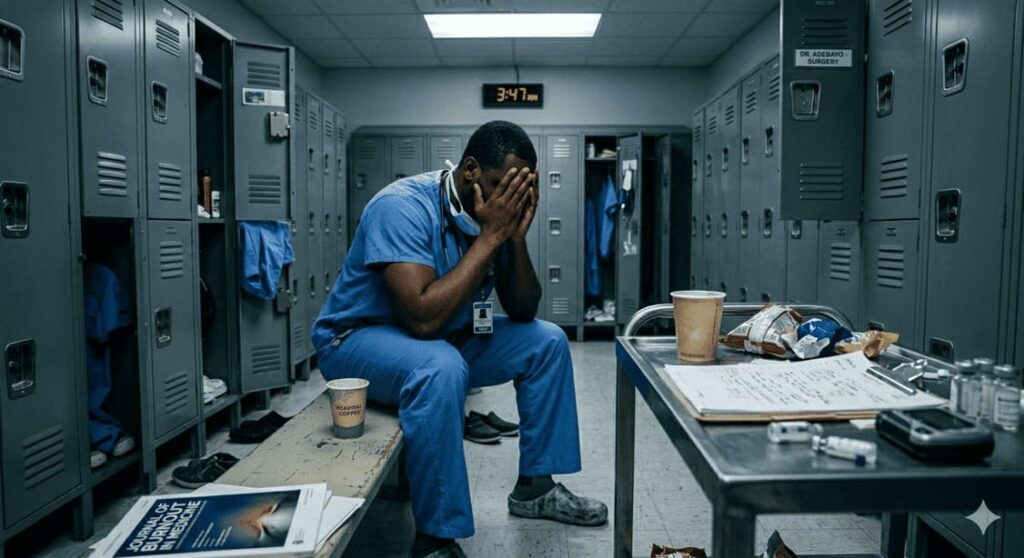
A surgeon pulls into his driveway after a fourteen-hour shift and does not get out of the car.
The engine is off. The house lights are on. His family is inside.
But he sits there in the dark, unable to explain why the life he worked so hard to build no longer feels entirely his.
He is not failing.
Patients trust him. Colleagues rely on him. His evaluations are excellent.
From every outward measure, he is succeeding.
And yet a quiet question rises from somewhere deeper than fatigue:
How did I become so effective at a life that no longer feels like mine?
This question is becoming one of the defining questions of our time.
We have learned to call this burnout.
But burnout is not the deepest diagnosis.
The deeper crisis is narrative collapse.
When the Story Falls Silent
Burnout describes exhaustion.
Narrative collapse describes disorientation.
Burnout says, I have nothing left to give.
Narrative collapse says, I no longer understand who I am inside what I am giving.
That distinction changes everything.
Many accomplished professionals are not simply tired.
They are becoming strangers to themselves.
Their calendars remain full.
Their responsibilities continue.
Their résumés expand.
From the outside, little appears to have changed.
But inwardly, the thread connecting identity, sacrifice, and purpose has begun to fray.
They still know what they do.
They are no longer sure why it matters.
The Hidden Epidemic of Competence
Narrative collapse often hides inside exceptional performance.
The physician still sees patients.
The nurse still manages the unit.
The priest still celebrates Mass.
The teacher still grades papers.
The executive still exceeds expectations.
The chaplain still comforts grieving families.
Everything appears intact.
Only the inner narrator has grown quiet.
Because these individuals continue to function, others assume they are well.
Because they remain dependable, few ask what it costs to remain so.
Because they do not break publicly, their private fracture goes unnoticed.
But functionality is not flourishing.
Performance is not proof of wholeness.
A person can be indispensable to everyone else and increasingly absent from themselves.
Functionality is not flourishing. Performance is not proof of wholeness.
How a Human Story Unravels
Stories rarely collapse in a single dramatic moment.
More often, they erode quietly.
A grief is never fully mourned.
A moral injury is swallowed.
A sacrifice goes unacknowledged.
A cherished hope dies without ceremony.
A season of overextension becomes a way of life.
Years pass.
The outward life expands.
The inward life contracts.
Until one day a person notices, almost in passing:
I am still doing the work, but I no longer feel like the person who began it.
This is not weakness.
It is witness.
It is the soul telling the truth before the body is forced to tell it louder.
Why Burnout Language Is Not Enough
Burnout is a useful concept.
It has helped institutions recognize that relentless demands carry real human costs.
But many people are suffering at a deeper level than exhaustion alone can explain.
They are grieving versions of themselves they can no longer find.
They are carrying responsibilities that no longer fit the story they once believed they were living.
They are asking questions no productivity metric can answer.
Who am I now?
What has this season done to me?
What is all this for?
When the wound concerns identity and meaning, the response must go deeper than stress reduction.
The person does not only need rest.
The person needs remembrance.
The person does not only need rest. The person needs remembrance.
Meaning Is Infrastructure
Every human life rests on an invisible architecture.
Identity.
Purpose.
Belonging.
Moral coherence.
Hope.
Together, these form what I call meaning infrastructure.
This inner structure quietly answers the most important questions of a human life:
Who am I?
Why does my life matter?
To whom do I belong?
What is worth suffering for?
What future still calls me forward?
When this infrastructure is strong, people can endure extraordinary strain.
When it weakens, even success begins to feel hollow.
Organizations invest in buildings, technology, finance, and operations.
Far fewer invest in the meaning systems that sustain the human beings carrying the mission.
Yet no institution can remain healthy if the people entrusted with its purpose can no longer find purpose in themselves.
The Sunward Insight
The deepest threat to many professions is not overwork.
It is suffering without a story large enough to hold what one is carrying.
This is the central insight of Sunward.
Human beings can endure remarkable pressure when their lives remain coherent.
But when identity, values, grief, work, and hope lose their relationship to one another, the self begins to fragment.
This is not merely a wellness issue.
It is a crisis of human coherence.
And coherence is not a luxury.
It is a condition of flourishing.
Burnout is what it feels like. Narrative collapse is what it is.
Burnout is what it feels like. Narrative collapse is what it is.
When people lose the story that holds them together, performance becomes a form of disappearance.
Human Coherence: The Way Back
The antidote to narrative collapse is human coherence.
Coherence is the felt alignment between identity, values, relationships, work, and future.
It does not require a perfect life.
A coherent life may still contain grief, contradiction, and uncertainty.
But its parts remain meaningfully connected.
The person can still say:
This is what has happened to me.
This is what I love.
This is what I carry.
This is why my life still matters.
This is where I am being called next.
That capacity is one of the deepest forms of resilience.
Not the ability to endure indefinitely.
But the ability to remain recognizable to oneself while enduring.
What Institutions Must Learn
If institutions wish to sustain people rather than quietly consume them, they must ask deeper questions.
Do our people still understand the meaning of their work?
Is grief acknowledged?
Is moral distress named?
Are sacrifices honored?
Do leaders create space for truth-telling and reflection?
Are individuals treated as whole persons or merely as functional assets?
Does the mission still carry the people who carry the mission?
Institutions that ignore these questions may preserve productivity for a season.
But they do so by drawing down a hidden human reserve.
No mission can remain holy while quietly hollowing out the people who serve it.
A Catholic Vision of the Human Person
The Catholic tradition begins with a truth that modern systems often forget.
The human person is not a machine.
Each person is a sacred story.
Created in the image of God.
Endowed with irreducible dignity.
Made for communion, truth, love, and hope.
We do not live by output alone.
We live by meaning.
We live by belonging.
We live by the conviction that our lives are held within a story larger than our immediate circumstances.
At her best, the Church becomes a ministry of coherence.
A place where fragmented lives are neither shamed nor hurried.
A place where suffering is witnessed, dignity is reaffirmed, and persons are gently gathered back toward wholeness.
Magnificently Unfinished
Many accomplished people secretly believe they must become flawless to be worthy.
They do not.
Human dignity does not begin when life is fully resolved.
We are unfinished and already beloved.
The cracks in our lives are not merely signs of damage.
They are often the places where deeper meaning enters.
The goal is not to return to an earlier version of ourselves.
The goal is to become more truthful.
More integrated.
More aligned with the life we are now being called to live.
Human flourishing requires coherence.
Toward a More Human Future
The most urgent crisis facing healthcare, ministry, education, and leadership is not simply fatigue.
It is the quiet disintegration of meaning among those entrusted with caring for others.
If we continue to call this only burnout, we will offer partial remedies to a deeper human wound.
But if we recognize narrative collapse, we can begin the more demanding and more hopeful work of restoring human coherence.
That work is not ornamental.
It is essential.
Because the future of our institutions depends on whether the people within them can still recognize themselves in the story they are living.
And perhaps the most hopeful truth is this:
A story can fracture.
A story can fall silent.
A story can lose its way.
And still, with truth, accompaniment, and grace, it can begin again.
Not as it was.
But as something deeper,
wiser,
and more whole.
Human flourishing requires coherence.



Mary Linda
Thank you for this insightful article. We wear burnout like an ornament because we did not ask the fundamental questions or take care of the most important person.- Ourselves-. Therefore our narrative collapses and human flourishing disappears.
Felistas Chiginya
This is powerful, thought provoking and worthy serious reflection. I wish many people would read this.