
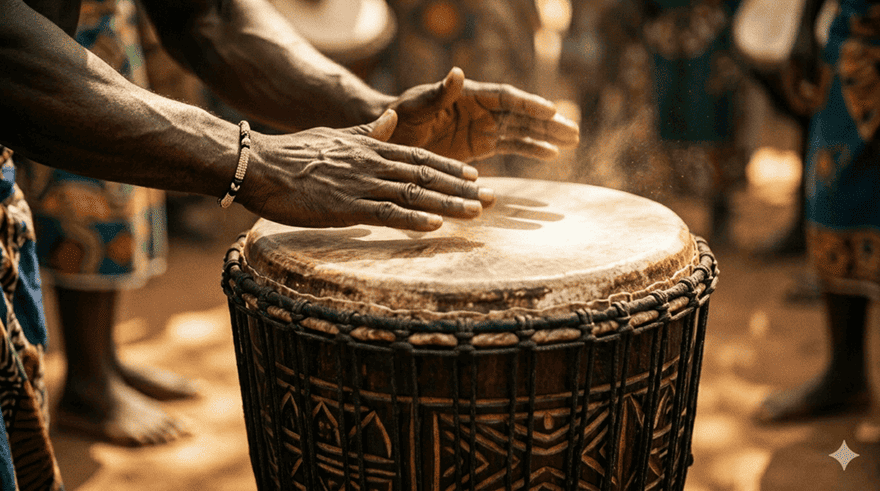
One Sunday, many years ago, I remember standing outside a small church in Africa before Mass began. From a distance, I could already hear the drums speaking. Women wrapped in colorful kangas were walking joyfully toward the church. Children ran ahead, laughing. Young people practiced songs under a tree while elders exchanged greetings filled with warmth and dignity. Before the priest even reached the altar, the entire atmosphere already felt sacred. Worship had already begun in the lives of the people. Then the procession started.
The cross came first, held high above the crowd. The choir followed with powerful harmonies, the drums beating like the heartbeat of the community itself. The whole congregation moved together — singing, clapping, dancing, praying. No one seemed detached. The body prayed. The earth prayed. The community prayed.
As I watched this liturgy unfold, I remember thinking: this is one of Africa’s greatest gifts to the Church. In Africa, worship is not merely recited; it is lived. Prayer is not confined to words alone. It enters the body, memory, rhythm, movement, and relationships. African spirituality instinctively understands what Christianity itself proclaims — that human beings are not souls trapped in bodies but an integrated unity of body, spirit, community, and creation.
Today, while reflecting on the catechesis of Pope Leo XIV on the sacred liturgy, those memories return to me with new depth. The Pope speaks of the liturgy not simply as a ritual or a performance, but as a mysterion — the living encounter between Christ and His people. In the liturgy, we do not merely watch sacred actions; we participate in divine life itself. The liturgy is where heaven touches earth and where humanity is gradually transformed into the Body of Christ.
As I reflect on his teaching, two questions continue to echo in my heart regarding the African Church: What do we think of our liturgy in Africa? And perhaps even more importantly: Do we truly become what we receive in the Eucharist?
These are uncomfortable questions because African liturgy is undeniably vibrant and alive. Anyone who has attended a deeply African celebration knows the energy, joy, beauty, and communal participation present there. In many ways, Africa has protected the universal Church from reducing worship to cold intellectualism or rigid ritualism. African liturgy reminds Christianity that worship involves the whole person.
And yet, beneath the beauty of our celebrations, there is a deeper question waiting for us.
Can dance alone transform society?
Can drums alone heal tribal hatred?
Can beautiful processions alone reconcile divided communities?
Can vibrant worship alone produce justice, honesty, and peace?
“Sometimes I wonder whether we Africans have mastered the art of celebration more than the art of transformation.”
I ask these questions not to criticize African liturgy, but because I love it deeply. I ask them because I believe the liturgy is too sacred to remain only at the level of external celebration.
Every Sunday, our churches are full. We dance beautifully. We sing powerfully. We process joyfully to the altar. Yet outside the church walls, many of our societies continue to struggle with corruption, violence, tribalism, political division, greed, exploitation, ecological destruction, and economic injustice. How can communities so deeply Eucharistic remain so deeply wounded?
This tension forces us to revisit what the Church truly means by active participation in the liturgy. When the Second Vatican Council spoke about participatio actuosa, it did not mean mere external activity. The Council was not simply asking people to sing louder, clap harder, or move more enthusiastically. Authentic participation means entering the mystery of Christ so deeply that one’s entire life is transformed.
The external celebration must flow from interior encounter.
The dance must emerge from discipleship.
The drum must echo conversion.
The procession must symbolize a pilgrim people moving toward the Kingdom of God.
“The external celebration must flow from an interior encounter. The dance must emerge from discipleship.”
I often think of the ancient Christian principle articulated by Prosper of Aquitaine: lex orandi, lex credendi, lex vivendi — the law of prayer is the law of belief, and the law of belief must become the law of life.
What we pray shapes what we believe.
What we believe must shape how we live.
This is where the Eucharist becomes deeply challenging for Africa. The Eucharist is not simply something we receive. It is a mystery that slowly transforms us into what we receive. The words of Augustine of Hippo come to mind: “Become what you receive.”
That sentence alone should disturb us.
If we receive the Body of Christ, then we ourselves must become the Body of Christ in the world. The Eucharist cannot remain inside the church building. It must enter politics, economics, leadership, education, family life, ethnic relations, and care for creation. Otherwise, our liturgy risks becoming disconnected from life.
African anthropology actually prepares us beautifully to understand this mystery. The philosophy of Ubuntu teaches: “I am because we are.” A person becomes human through relationships, community, and shared existence. In many African societies, life is understood communally rather than individualistically. This harmonizes deeply with Eucharistic theology because the Eucharist forms not isolated individuals, but a reconciled community.
To receive the Eucharist while hating one’s neighbor is a contradiction.
To sing beautifully in church while exploiting the poor is a contradiction.
To dance around the altar while destroying communal harmony is a contradiction.
The liturgy demands conversion.
This is why inculturation must go beyond aesthetics. Since Vatican II, African theologians and liturgists have worked hard to integrate African songs, languages, symbols, gestures, drums, and dance into Catholic worship. This has enriched the universal Church immensely. African liturgy now speaks with an authentic African voice.
But Pope Leo’s catechesis reminds us of something crucial: liturgy must remain fundamentally Christological before it becomes cultural. African symbols become truly liturgical only when they deepen participation in the mystery of Christ.
Inculturation is therefore not simply decorating the Roman rite with African elements. It is allowing Christ to encounter African cultures and transform them from within.
The body dances because grace has touched the soul.
The drum sounds because the community has heard the Word.
The procession moves because the Church journeys toward God’s Kingdom.
Authentic African liturgy must therefore hold together both celebration and contemplation, movement and silence, joy and conversion, embodiment and transcendence.
I believe this balance will determine the future of African liturgy.
In many parts of the world, liturgical debates often revolve around rubrics, language, vestments, or aesthetics. But in Africa, the pastoral reality is more existential. People come to church carrying heavy burdens: poverty, displacement, violence, unemployment, political instability, loneliness, and suffering. They are searching not merely for ritual correctness but for encounter, healing, hope, and meaning.
And perhaps this is where Africa has something prophetic to offer the universal Church.
African liturgy, when deeply theological and spiritually grounded, witnesses to the inseparability of worship and life. It reminds the Church that Christianity is incarnational. God enters human history, human culture, human bodies, and human suffering.
But the future of African liturgy cannot rest solely on emotional vitality or external enthusiasm. Neither can it retreat into rigid formalism. The future lies in deeper mystagogical formation — forming Christians who understand the mysteries they celebrate and allow those mysteries to shape their lives.
Africa does not need less celebration.
Africa needs celebration that transforms.
“Africa does not need less celebration. Africa needs celebration that transforms”
“Africa does not need less celebration. Africa needs celebration that transforms”
As I continue reflecting on Pope Leo XIV’s catechesis, I become increasingly convinced that the future of African liturgy depends on whether we allow the Eucharist to move us beyond performance into discipleship.
The movement of the liturgy, as emphasized by Odo Casel, is always dual:
from interior encounter to exterior mission,
from contemplation to action,
from Eucharist to ethics,
from altar to society.
Only then can African liturgy fully become what it is meant to be: not simply beautiful worship, but transformative encounter.
And only then can we honestly answer the Eucharistic question that quietly waits beneath every drumbeat, every procession, every dance, and every Amen:
Do we truly become what we receive?
“Do we truly become what we receive?”
