

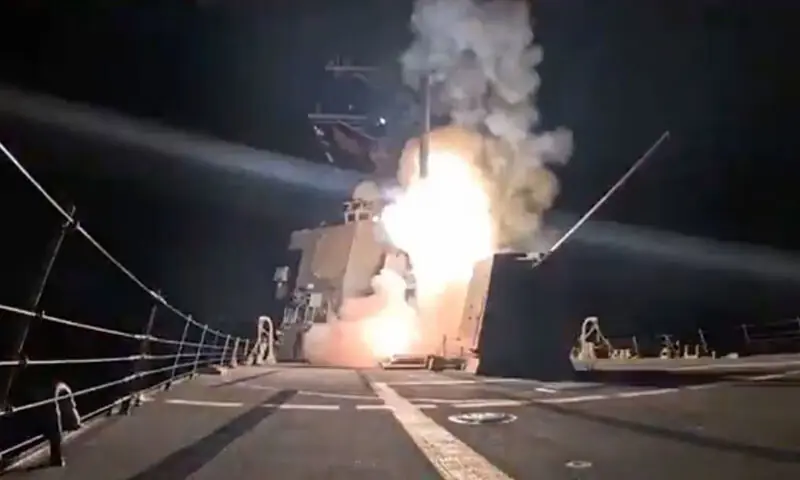
The U.S. Christmas Day airstrike in Nigeria may have been framed as a counter-terrorism success. For Nigerians and Africans, it should instead provoke grief, sober reflection, and an urgent national conversation about sovereignty, violence, and the future of the Nigerian state.”
The U.S. Christmas Day airstrike on Nigeria should worry Nigerians and all Africans. Rather than popping champagne in celebration that a liberator has come to free us from radical Islamic fundamentalists, we should cry. We should cry for the beginning of the loss of Nigeria’s sovereignty and for the erosion of our dream as the giant of Africa and a beacon of hope for the Black race.
As a former Kogi State governorship aspirant, Princess Grace Aye Adejoh, said in an interview with Al Jazeera, “a foreign intervention of this magnitude is not a victory; it is an indictment.” Nigeria today has a government that shamelessly cedes its territories to, and negotiates with, radical Islamic terrorists on the one hand, while on the other hand publicly declares that a foreign entity is permitted to strike its territory.
Nigeria’s foreign minister, Yusuf Tuggar, went on a charm offensive to justify the attack. In multiple interviews, he presented the U.S. Christmas strike as proof of Nigeria’s successful partnership with foreign powers in the fight against terrorism. He refused to engage the reasons President Trump himself gave for the attack. Instead, he adopted a logic of the end justifying the means, dismissing ethical questions surrounding both the conduct and motivation of the strike as irrelevant.
While Nigeria’s foreign ministry described the strike as the outcome of successful bilateral cooperation to protect Nigerians of all faiths, President Trump and U.S. officials framed it differently. They called it a successful targeting of “ISIS terrorist scum in Northwest Nigeria” who had “viciously killed primarily innocent Christians at levels not seen for many years, and even centuries.” These are two dialectically opposed rationales. Yet both parties agree on one thing: that in terms of optics, the attack served as a good statement of purpose—despite the absence of verified evidence about the targets hit or the meaning of “success.”
This attack leaves more questions than answers. President Trump’s stated goal is fundamentally at odds with that of the Nigerian government. The United States has inserted itself into Nigeria’s complex political and religious conundrum from a narrow ideological and pragmatic perspective, rather than from a clearly articulated and coherent strategy to support Nigeria at this critical stage of its national life.
The Nigerian propaganda machine was immediately deployed to claim that Nigeria was “in the know,” that intelligence was shared, and that there was coordination. This suggests that Nigeria’s participation in the planning and execution of the attack was minimal. If Nigeria had actionable intelligence, why did its own forces not strike the targets? Why should a sovereign nation rely on a foreign power to respond to a terrorist cell it claims to have identified? Such public statements function largely as a smokescreen—an attempt by the Nigerian state to save face amid its glaring failures and loss of legitimacy, both domestically and internationally, as a government that has abdicated its primary responsibility of protecting lives and property.
Another unresolved question concerns responsibility for the acceleration of terror attacks in Nigeria, dating back to the suicide car bombing at the Police Headquarters in Abuja on June 16, 2011, and the Boko Haram attack on the UN Headquarters two months later. What motivates these radical Islamists who have grown increasingly brazen and who, like cancer cells, have metastasized within Nigeria’s body politic? Many Nigerian Christians believe they are victims of religious persecution and genocide, while the Nigerian state and some Christian leaders argue that Muslims are also victims. This question is central, because it is the very rationale under which the United States has framed its ongoing military involvement in Nigeria. Effective cooperation is impossible if enemies and victims are not honestly named.
The current Nigerian government, aided by political and religious turncoats, has proven adept at deflecting criticism. It has expended more energy defending itself internationally than developing inclusive social, economic, and political policies capable of healing the land. Power is being centralized in the presidency. Opposition is neutralized through inducement and coercion. Governors are pressured to abandon their parties and join the ruling APC in preparation for the 2027 elections. One must ask whether this administration is genuinely interested in defeating terrorism or merely in securing a second term—at any cost, even if there is no country left to govern.
Nigeria stands at a crossroads. On one side is a corrupt and failed political order sustained by elites who benefit from Nigeria’s dysfunctional institutions, oppressive and unjust political system. On the other hand, are hardworking citizens who simply want to live decently in a richly blessed land. Nigeria is torn between a deeply religious population that desires peaceful coexistence and extremist groups importing a fundamentalist ideology that has turned the nation into a graveyard. At the same time, those with power have retreated from the idealism that once inspired hope, replacing it with survival pragmatism and narrow self-interest. The result is a fragmented nation with no transcending national value capable of guiding conduct or uniting aspirations.
I am not a pacifist. But I am convinced that Gospel non-violence is the golden route to the future of any nation, and that justice—embodied in servant and selfless transformational leadership—is what Nigeria, like any other nation, truly needs.”
Into this atmosphere of helplessness and the search for a savior, President Trump has inserted himself as a supposed liberator of Nigeria, especially of Christians. This is another false hope. Nigeria’s problems are complex, historical, and structural. They cannot be reduced to or resolved by bombs and missiles either by the U.S. or by Nigeria’s inefficient and ineffective armed forces. The United States has not demonstrated the capacity to stay the course in Africa and may well open a Pandora’s box, leaving Nigeria worse off if its interests shift. Any military cooperation must be transparent, debated nationally, and sanctioned by parliament. But even then, Nigeria’s salvation, in my judgement, cannot come through violence—whether domestic or foreign.
I am not a pacifist. But I am convinced that Gospel non-violence is the golden route to the future of any nation, and that justice—embodied in servant and selfless transformational leadership—is what Nigeria, like any other nation, truly needs. Violence is not the answer to the moral collapse of the state, to the corruption and prodigalization of our institutions, or to the exploitation and manipulation of the masses of our people, especially our young people. Nor is violence the answer to the weaponization of religion that has spun this suffocating yarn now yanking Nigeria toward the precipice.
Conclusion: Five Hard Truths Nigeria Must Confront
First, Nigeria’s crisis demands a more complex moral and political diagnosis. What we are witnessing is not merely terrorism but the consequence of prolonged failures of governance, justice, and national meaning. A nation exists as a daily act of consent, a shared decision to live together. Nigeria is failing to renew that moral commitment.
Second, violence grows where anger, poverty, injustice, and powerlessness have become structural. Terrorists are not ethnic champions or religious vanguards. They are products of a culture of hatred and despair.
Third, the Nigerian state is failing its people at the level of legitimacy. A government that cannot protect lives, ensure dignity, or inspire trust creates the conditions in which extremist violence flourishes.
Fourth, foreign military intervention will not heal Nigeria’s wounds. Bombs and missiles cannot rebuild institutions or restore trust. Without genuine political participation and alignment between the people and the state, external force only deepens alienation and dependency.
The current political system—and many of its actors—has failed, not in minor or reparable ways, but in fundamental terms. What Nigeria requires is not another round of therapeutic adjustment, cosmetic reform, or elite bargaining, but a surgical intervention that confronts the roots of our moral, political, and institutional collapse.”
Finally, Nigeria urgently needs a national dialogue toward a new social compact on how we can live together as one people in justice and dignity. Peace, prosperity, justice, and the promotion and preservation of the common good for the long-suffering citizens of Nigeria will not come through violence, propaganda, or saviors—foreign or local. They will come through justice and inclusion, through honesty in public life, and through a renewed and uncompromising commitment to the common good.
American bombs and missiles cannot help Nigeria achieve this urgent goal. Only a people-led movement—rooted in conscience, sustained by courage, and animated by a clear vision of the future—can bring it about. If not now, then certainly later. For, as Dele Giwa wrote with prescient courage and conviction, “the triumph of evil in Nigeria over good is only but temporary.”


4 comments
Nigeria’s leaders/government’s have allowed violence by terrorists masterminded by foreign and local powers to go on for about twelve years now. Can the more complex moral and political diagnosis, and national dialogue/conference take place when terrorism reigns supreme? USA’s strike is only an extension of the twelve-year old violence, which the Nigerian government not only allowed but also “licensed” to operate. The Boko Haram and kidnappers are not of Nigeria origin. When government failed to deal with them decisively, idle, poor and hungry Nigerian youths joined. The USA/Trump strike may not be a long-term solution to Nigeria’s problem but it will do two things: force government to do the right thing; second, it will also serve as a warning signal to terrorists who have long taken over the Nigeria state. If Nigeria was a sovereign nation this past twelve years, she would not have allowed Boko Haram and kidnappers to go on unchallenged. Professor Ilo has indeed done a balanced analysis but the government is not interested in any suggestions that will help to build the “giant of Africa”.
Prof., your assessment is truly commendable, however in my view the persistent absence of the rule of law has long condemned Nigeria to a cycle of underdevelopment, effectively trapping the nation in a perpetual “third-world” condition. This systemic failure has deeply eroded the moral, institutional, and social fabric of the country, creating fertile ground for the emergence and normalization of violent extremism, terrorism, and other destabilising forces.
At the core of this crisis lies the absence of accountability. From the lowest levels of governance to the highest ranks of power, consequences for wrongdoing have been largely nonexistent. This culture of impunity has precipitated a profound decline in societal values and a corresponding surge in corruption, where survival increasingly depends on strength, influence, or financial power rather than merit or justice. Nigeria has thus evolved into a nation effectively auctioned to the highest bidders.
In this environment, human life and dignity have been rendered insignificant unless they intersect with the interests of the powerful. Illiteracy is not only tolerated but, in some cases, implicitly rewarded, while individuals lacking competence or moral standing occupy positions of authority. Without a clear sense of direction, vision, or ethical compass, a nation inevitably drifts toward decline and instability.
While societies can endure adversity, prolonged insecurity is far more corrosive. When a state demonstrates little regard for the welfare, safety, and advancement of its citizens, it becomes inevitable that people will seek relief wherever it appears available even if such solace is temporary, misguided, or offered by actors whose interests do not align with national or democratic ideals. In such circumstances, allegiance is shaped not by ideology or loyalty, but by desperation and the instinct to survive.
Professor llo, your assessment is truly commendable, however in my view the persistent absence of the rule of law has long condemned Nigeria to a cycle of underdevelopment, effectively trapping the nation in a perpetual “third-world” condition. This systemic failure has deeply eroded the moral, institutional, and social fabric of the country, creating fertile ground for the emergence and normalization of violent extremism, terrorism, and other destabilising forces.
At the core of this crisis lies the absence of accountability. From the lowest levels of governance to the highest ranks of power, consequences for wrongdoing have been largely nonexistent. This culture of impunity has precipitated a profound decline in societal values and a corresponding surge in corruption, where survival increasingly depends on strength, influence, or financial power rather than merit or justice. Nigeria has thus evolved into a nation effectively auctioned to the highest bidders.
In this environment, human life and dignity have been rendered insignificant unless they intersect with the interests of the powerful. Illiteracy is not only tolerated but, in some cases, implicitly rewarded, while individuals lacking competence or moral standing occupy positions of authority. Without a clear sense of direction, vision, or ethical compass, a nation inevitably drifts toward decline and instability.
While societies can endure adversity, prolonged insecurity is far more corrosive. When a state demonstrates little regard for the welfare, safety, and advancement of its citizens, it becomes inevitable that people will seek relief wherever it appears available even if such solace is temporary, misguided, or offered by actors whose interests do not align with national or democratic ideals. In such circumstances, allegiance is shaped not by ideology or loyalty, but by desperation and the instinct to survive.
This brilliant article written by Prof Stan Chu raises a profoundly important question that moves beyond politics into the very neurobiology of safety, does an external military strike truly restore a felt sense of safety to traumatized communities?
From a Polyvagal Theory perspective which explains how our nervous systems detect safety, the answer is sobering. Safety is not merely the absence of threat; it is the presence of relational cues, Including warm voices, trustworthy faces, predictability and co-regulation. An airstrike delivers the opposite: sudden explosions, invisible force and a narrative of danger from above. While it may temporarily satisfy a cognitive desire for justice, it does little to calm the nervous systems of those on the ground, whose bodies remain in survival mode; hypervigilant or shut down.
What Nigeria’s traumatized regions need is not just security from above but safety from within, the kind built by local protectors, restored community rhythms and the return of social trust. Bombs cannot rebuild ventral vagal pathways; only people, presence and participatory healing can.
True sovereignty is not just controlling territory but co-regulating citizens. Until our state can offer not just protection from violence but the embodied experience of safety, we will remain a nation stuck in sympathetic arousal waiting for the next explosion, foreign or domestic.
Thank you Prof Stan for this critical and insightful reflection.