
The Diocese of Dori, at the heart of Burkina Faso’s Sahel region, was once a land of vibrant faith. From the parish of Sebba to Gorom-Gorom and Gorgadji, the sound of church bells mingled with the songs of the faithful, and priests travelled freely to serve their communities. Today, that same land bears the wounds of violence and fear. The rise of insecurity has profoundly affected pastoral life, closing parishes, displacing communities, and testing the resilience of both shepherds and flock. “We left at night with only what we could carry,” recalls Pauline, a catechist’s wife now living as a displaced person in Dori town. “We miss our parish, our community, our way of life. But we thank God we are still alive to pray.”
A Diocese Under Siege
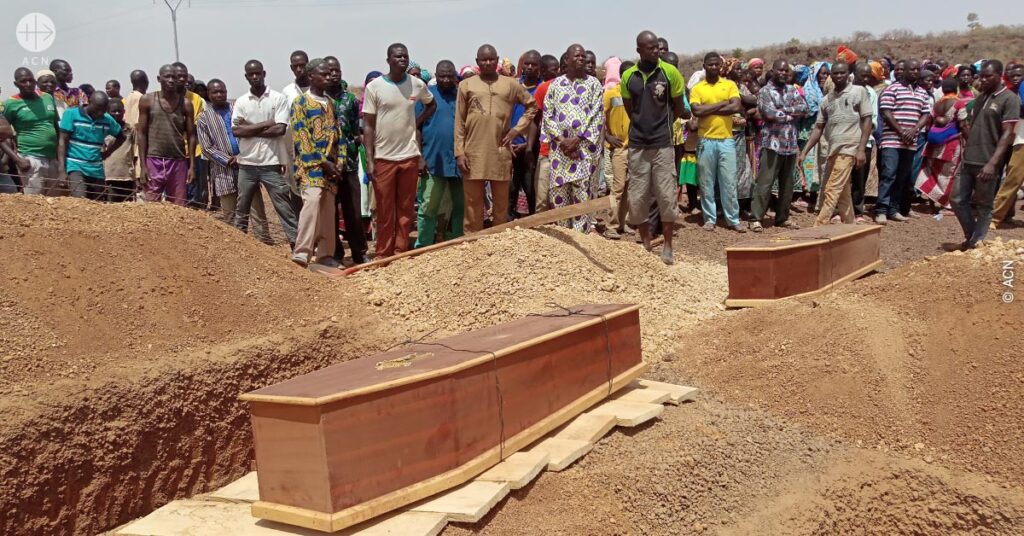
In these last years, armed attacks and extremist violence have swept across the Sahel, forcing thousands to flee their homes. The Diocese of Dori, located in one of the hardest-hit regions, has not been spared. Pastoral work that once flourished with catechesis, youth gatherings, and liturgical celebrations is now marked by displacement, loss, and uncertainty.
In the parish of Sebba, for example, where the faithful once gathered joyfully every Sunday, the presbytery and church now stand empty. Repeated attacks and threats forced the priest and parishioners to leave in 2022.
Similarly, the Gorgadji parish was closed after sustained violence in the area made pastoral visits impossible. Many parishioners fled to Gorom-Gorom or even as far as Ouagadougou. The church compound was looted, and the mission school shut down. “It was heartbreaking to abandon the tabernacle, to walk away from a place that had been our spiritual home. Yet we believe that God continues to dwell among His people wherever they are,” the priest who served there shared.
In Falangoutou, one of the oldest Christian communities in the region, pastoral activities have also been severely disrupted. Families that once lived side by side in peace are now scattered in camps for internally displaced persons (IDPs). Sunday Mass is now celebrated in makeshift chapels or under trees when security allows.
The Pain of Distance
For priests and religious, the insecurity has completely disrupted and, at the same time, challenged pastoral ministry. Where once it was possible to visit every outstation monthly, many villages have now become inaccessible. Some priests live in Dori but serve communities far away, reachable only through messages carried by parishioners or through radio broadcasts.
“We used to organize retreats, youth encounters, and visits to the sick,” explained Fr. Nikiema Jules, the former parish priest of Sebba and also the first incardinated priest of the diocese. “Now, each journey is dangerous. We live with uncertainty every day. But our mission continues; we must be present, even if only through prayer, radio, and small gatherings.”
For the faithful, this absence of regular pastoral presence is deeply felt. Awa, a young woman from Falangoutou, shares, “The last time we had Mass in our village was more than a year ago. But we still gather every Sunday to pray the Rosary. We know that God hears us even in silence.”
Faith Amid Fear
Despite the suffering, faith has not died; it has deepened. Many displaced Catholics have brought their faith with them into camps and host communities. Improvised chapels, built with straw and wooden poles, have become places of consolation and a beacon of hope. Priests who cannot return to their parishes now minister to displaced families and communities in Dori and other safer areas.
For two or three years now, during Holy Week, hundreds of displaced parishioners have joined the Chrism Mass in Dori. Their faces told stories of pain, but also of unshakable trust. “Even though our churches are closed, the Church lives in us,” said Thomas, a displaced parishioner from Sebba. “We believe that one day we will go back home and rebuild.”
The Diocese of Dori has also witnessed a beautiful spirit of solidarity. Neighboring dioceses, religious communities, and international partners have offered moral and material support. Food, medical aid, and pastoral care are shared wherever possible. The Church’s Caritas network continues to stand beside the suffering, reflecting the mercy of Christ in concrete ways.
It is true that the situation remains grave, but the Diocese of Dori has not lost hope. In the midst of violence and displacement, there is a growing awareness that the Church’s mission is not confined to buildings. The experience of loss has purified our faith, reminding us that Christ Himself walked a path of suffering before glory.
“We are a Church on the move, just like the Holy Family who fled into Egypt,” says Bishop Laurent Dabiré, Emeritus Bishop of Dori. “We carry the tabernacle of our faith wherever we go. The Lord walks with us in this desert, and we will rise again by His mercy.”
The people of Dori continue to pray for peace, peace for their land, their neighbors, and even their enemies. In their prayer, there is no bitterness, only trust. “Our suffering is not the end,” says Pauline, the displaced catechist. “We believe that after the storm, the sun will rise again. God has not forgotten us.”
As we look at the future, our eyes turn to the Cross, the ultimate sign of both suffering and victory. The Diocese of Dori remains wounded, standing firm in faith and hope. The faith of our people endures like the Sahelian sun, harsh, relentless, but full of light.
Insecurity may have scattered the flock, but the Good Shepherd has not abandoned His sheep. With hearts lifted in hope, we continue our mission, trusting wholly in God’s Divine Mercy and intervention.
One day, the bells of Sebba, Falangoutou, and Gorgadji will ring again. When that day comes, the Diocese of Dori will stand as a witness to a faith that never died, only deepened through the fire.


