
The world has been quite fascinated by what is emerging as the prophetic political theology of Pope Leo. Forbes, for instance, calls Pope Leo’s proclamation of the social gospel “a masterclass in moral courage.” CNN’s Christopher Lamb writes that Pope Leo is “reclaiming Christian values from the Trump administration.” The Financial Times similarly observes that Leo’s early interventions suggest a return to a morally assertive papacy in global affairs, while The Economist interprets his voice as part of a renewed Catholic willingness to offer a moral critique of political and economic power. The New York Times has described Leo as reasserting the moral voice of the papacy in an age of political fragmentation, and The Guardian highlights his readiness to challenge power across ideological divides in the name of human dignity and justice. Even the BBC notes the distinctive character of his leadership: a pastoral voice that speaks with unusual directness into the political crises of our time.
“These positive affirmations of the Pope’s message and courageous moral voice reveal that, despite its own weaknesses and limitations, the Catholic Church, represented by the papacy, remains the world’s most visible moral authority today.”
In the face of the moral and spiritual bankruptcy of many political leaders across the globe, and the crisis of history unfolding in the epidemic of war and violence in our world, there is a pressing need. As Pope Leo says, there is a need for someone to speak out against these evils. There must also be a convincing message of an alternative path to a peaceful world, one that spreads love, prosperity, and happiness rather than hate, violence, and suffering among the majority of God’s people.
“Pope Leo’s message offers an alternative path through what I call his prophetic political theology, which transcends his person. He speaks from within a deep and living tradition, with both Augustinian and Gospel roots, as articulated in Catholic Social Teaching.”
This tradition has consistently upheld the ordering of society toward the promotion of the common good, understood not merely as social stability or the absence of war, but as a moral and spiritual horizon oriented toward justice, the good life, and the flourishing of all. In this vision, the dignity, rights, and vocation of every person are safeguarded and advanced, so that society may foster sustainable and integral human development, and the ordination of all things toward the fulfillment of history in acts of love and solidarity. As I argue in my book on Pope Leo, Dilexi Te: A Church Formed by Love, he is quietly reinventing Catholic social teaching to meet the fragmented post-liberal world of today, where the erstwhile global institutions designed after World War II are exhausted and fraying under the weight of the inner contradictions of modernity’s lies about a convergent trajectory of history.
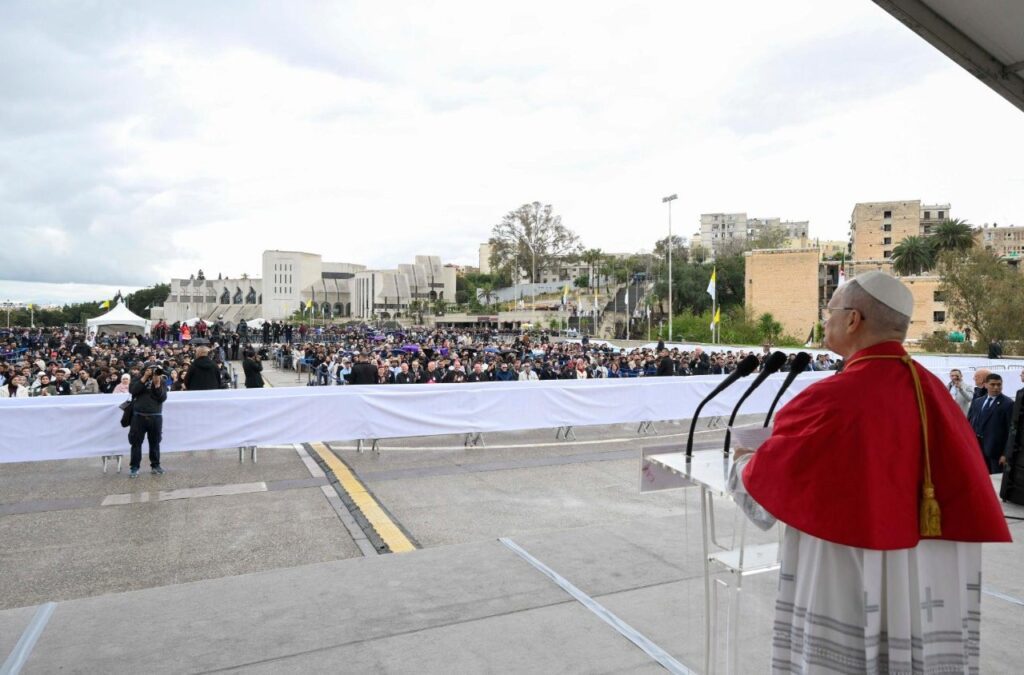
“In Pope Leo’s speeches in Africa, we see a direct and unambiguous retrieval and application of Catholic Social Teaching to concrete historical realities, and, more importantly, the courageous naming of the actors whose invisible hands weave the tangled yarn of structural violence, spinning, knotting, and tightening the threads of injustice into rough fabrics of exclusion, exploitation, and suffering.”
These are the architects and custodians of structures of sin, who stitch together systems that bind, entrap, and hold a majority of God’s people in conditions of quiet bondage. Leo does not allow these structures to remain faceless or abstract; he exposes the patterns, unmasks the agents, and calls them to account, even as he summons the whole human community to the harder work of unweaving these fabrics of injustice and reweaving the social order according to the demands of justice, truth, and the dignity of all.
Leo’s denunciation of leaders who invoke God in the service of domination is deeply Augustinian. It recalls Augustine’s critique of the libido dominandi as the root of political disorder and the great threat to the tranquility of order. Yet Leo is not naïve about the nature of political life. Like Augustine’s vision of the two cities interwoven in history, his approach acknowledges the persistence of conflict between competing values and visions of the good.
“In this sense, his political theology resonates with what contemporary theory describes as an agonistic understanding of democracy: the recognition that conflict is enduring. However, Leo refuses to absolutize conflict. His insistence on dialogue is a call to transform antagonism into a space where differences can be expressed, contested, and discerned within an ethical horizon ordered to the common good, to the love of God and others, to the dignity of the human person, and to the flourishing of all.”
What is this prophetic political theology and how did Pope Leo capture it so far in his messages in Algeria and Cameroon?
I will address this question in the second part of this essay.



