
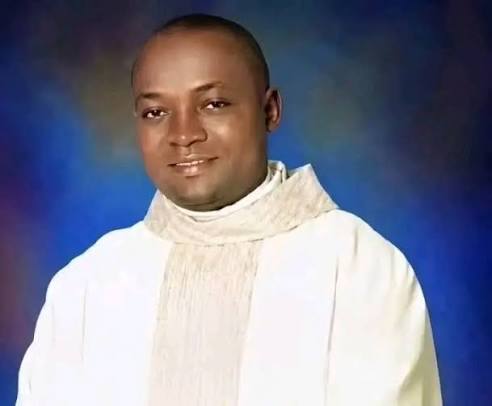
When I received the sad news of Fr. Benjamin Madu’s death, my heart sank. Fr. Ben was someone I knew very well. He was my junior at the Seat of Wisdom Seminary, Owerri, Nigeria, with whom I played tennis—a joyful soul whose laughter and warmth made him easy to love. When news began to trickle in that he had died by suicide, I was shaken to the marrow.
The priest who broke the devastating news to Fr. Ben’s parents, one of his closest friends and classmates, poured out his pain to me and said that this was the hardest news he had ever had to share. No parent should lose a child this way. Indeed, no parent should have to bury a child at all. In the ordinary rhythm of life, it is the children who bury their parents, not the other way around. But no one should die this way.
In an ideal world—and especially within our African tradition—we hope that everyone will live a fruitful life, grow old surrounded by family and friends, and die peacefully. The siblings and parents of Fr. Madu cannot make sense of his death. Neither can his parishioners nor his many friends. It has been a Calvary walk for all who loved him, a descent into darkness.
One of the most beautiful messages I received after this tragedy came from a dear friend. She sent a voice message to several priests she knows here in the United States. She first expressed her sympathy to me that a fellow Nigerian priest had died, but then she gently reminded me that priests are human beings. They, too, can become broken. They, too, can struggle with depression, emotional exhaustion, loneliness, overwhelming burdens, and moments when life itself appears meaningless. She promised that if I ever found myself drowning beneath life’s weight, she would be there for me. “Don’t forget,” she said, “that I am here for you.”
Rather than blaming Fr. Ben or expressing the kind of outrage that many have voiced—”How could a priest take his own life? What are we supposed to believe now?”—she simply reminded me of my own vulnerability, my own human fragility. She helped me recognize that any one of us can find ourselves in dark places. Even the strongest can break.
Priests belong to what psychologists often describe as the “helping professions.” They spend their lives carrying the burdens of others. Yet those who constantly help others often find it difficult to ask for help themselves. They can feel compelled always to appear strong, composed, and spiritually secure, even when they have reached the limits of their own humanity. Beneath the cassock, there is still a fragile human heart longing for understanding, divine grace, and the healing presence of those who genuinely care. Like all Christians, celibate Catholic priests are sometimes bleeding inside and longing for help at the deepest level of their human fragility and in dire need of divine transcendence and communal support.
Beneath the cassock, there is still a fragile human heart longing for understanding, divine grace, and the healing presence of those who genuinely care.”
Here I remember the wisdom of my late mentor and friend, Fr. Mario de Souza, who died of pancreatic cancer less than three months after his diagnosis, in the letter he wrote before his own untimely death. I return to that profound reflection whenever I confront realities that I cannot fully explain. It concerns the mystery of God’s freedom and our own human freedom. Why did God not intervene to stop Fr. Ben? Was he truly free in those final moments?
Fr. Mario invites us to think more deeply about God’s action in history, beyond simplistic notions of divine intervention. God created the universe freely, and because creation is genuinely free, it is also contingent and unfinished. When some look at life, suffering, and the reality of evil, they may conclude that it is not fair or perhaps unequal or that God is not all good and all powerful if God cannot stop such evils like suicide, depression, and terminal diseases from happening.
The problem of evil, suffering, and death, and of God’s freedom vis-à-vis human freedom, is one that theodicy struggles to address every day, and I have addressed this question in my book, Where Is God? An African Theology of Suffering and Smiling.
But the truth, or rather the mystery, of life, as I reflect on Fr Mario’s letter, is that we human beings do not all travel through life along the same path. We are born into different circumstances, with different gifts, different wounds, different temperaments, different opportunities, and different capacities for resilience.
We do not all experience suffering in the same way, nor do we all possess the same psychological resources to withstand it. That is not a defect in creation but one of the consequences of a world that is genuinely free rather than mechanically predetermined. As Fr. Mario wrote: “As far as I understand it, the order of creation is marked by an intrinsic and necessary inequality as a result of being created in freedom, for anything different would render the freedom of creation meaningless.”
Within this created order of freedom and contingency, people die in many different ways—through old age, accidents, chronic illness, violence, natural disasters, and, tragically, suicide. This does not mean that God wills these deaths. Rather, it means that God accompanies us within a world marked by finitude, vulnerability, and the unfinished work of redemption.
Every death—and perhaps especially death by suicide—forces us to confront our own mortality and the fragility of human life. We are here today and gone tomorrow. Yet death never has the final word. Christ himself is the boundary beyond which death cannot pass. The Resurrection proclaims that the forces of evil and despair have limits. They are real, but they are not ultimate.
Contemporary psychology has also taught us something profoundly important. Suicide is rarely the result of a single decision made in complete freedom. Rather, it often emerges from unbearable psychological pain, profound hopelessness, severe depression, trauma, or other mental illnesses that can significantly impair judgment and diminish one’s capacity to perceive alternatives.
The person no longer sees the world as others see it. The darkness becomes so overwhelming that death appears to be the only escape from suffering.
The Catholic Church has come to recognize this reality with greater pastoral sensitivity. The Catechism of the Catholic Church reminds us that “grave psychological disturbances, anguish, or grave fear of hardship, suffering, or torture can diminish the responsibility of the one committing suicide” (§2282).
For this reason, the Church entrusts those who die by suicide to the infinite mercy of God, “who can provide the opportunity for salutary repentance” (§2283).
I therefore resist interpreting Fr. Ben’s death as a failure of faith or character. I prefer to think that he died from a sickness that he could not overcome—a sickness hidden from many of us who loved him. We, his friends, his brother priests, his parishioners, and those who shared life with him could not detect the depth of his suffering. Just as many die from cancer, heart disease, or other illnesses despite receiving care, so too some die from illnesses of the mind and spirit whose wounds remain largely invisible.
We should never interpret death by suicide as a failure of faith or character.”
Should we, the survivors, blame ourselves?
There may be moments when we wonder whether we missed warning signs or failed to ask one more question. Such questions are natural. They are expressions of love. Yet guilt is rarely a truthful companion. Death is not of God, nor is it God’s desire that people perish in this way.
The mystery of why one person dies at a particular moment and another lives remains beyond human calculation. We do not blame those who die from cancer because their bodies could no longer resist the disease. Neither should we rush to condemn those whose minds and spirits became overwhelmed by unbearable suffering. Life continually confronts us with mysteries that cannot be solved. Why do babies die before birth? Why do some live to be one hundred while others die in the prime of life? Why are some born with extraordinary resilience while others carry hidden wounds that few can see? Life and death are mysteries to be reverenced more than problems to be solved. What matters is how we live the time entrusted to us.
Certainly, human responsibility matters. We must build communities where people are seen, heard, loved, and accompanied. We must learn to recognize signs of depression, despair, and emotional exhaustion. We must remove the stigma surrounding mental illness, especially among clergy, who often feel enormous pressure to appear spiritually invulnerable.
Research consistently shows that compassionate listening, timely mental health care, strong social relationships, and communities of belonging significantly reduce suicide risk. None of us can foresee every tragedy. But all of us can become more attentive to one another.
Asking for help is not a failure of faith.”
As the saying goes, we are only as sick as our secrets. Clear your heart each evening of resentment, shame, and despair. Do not allow hidden wounds to become permanent prisons. However deep your wounds may be, there is still a healing balm in Gilead. Wake up each morning with open hands, an open heart, and an open spirit, ready both to give and to receive love.
You are not trapped forever. When one door closes, another may yet open. Your mistakes are not your destiny. Your failures are not the end of your story. Even betrayal and disappointment can become unexpected instruments of grace, provided we make room for hope. In other words, when shame or despair becomes too heavy to carry, speaking with someone trustworthy and seeking professional care can be a beginning. Asking for help is not a failure of faith.
As my friend reminded me, we all need one another if we are to become more resilient against despair, negativity, and the subtle forces that slowly erode hope. That resilience grows when we learn to listen to the quiet voice of God, who continually speaks hope into our darkness and gives blessed assurance to those who trust in him. It grows when faith, friendship, professional care, and the love of community come together to sustain us.
Resilience grows when faith, friendship, professional care, and the love of community come together to sustain us.”
As for Fr. Benjamin, my prayer is simple. May the God whose mercy is infinitely greater than our understanding receive him into eternal peace. May he celebrate the silver jubilee of his priesthood in the communion of saints. And may the light of the Risen Christ, which now surrounds him, become a light for his grieving parents, his family, his parishioners, and all who loved him, so that one day they may begin to find meaning where today there seems only sorrow, and hope where today there appears only an unmitigated tragedy.
If you are thinking about suicide or are concerned about someone, help is available.
Canada: call or text 9-8-8.
United States: call or text 988.
Lagos, Nigeria: call 080 5882 0777 or 090 3000 0741.
In Kenya, Cameroon, the Democratic Republic of the Congo or elsewhere, contact a local hospital or emergency service, or find a verified helpline at findahelpline.com.
If you or someone else is in immediate danger, contact local emergency services immediately.
Have any thoughts?
Share your reaction or leave a quick response — we’d love to hear what you think!
-
 0
0
-
 0
0
-
 0
0
-
 0
0
-
 0
0
-
 0
0
5 comments
You have spoken to my heart and l believe to many others. This article on suicide is informative and moreover,educative. Having walked that road not so Long ago, l agree with every expression in there. May God continue using you, Fr. Stan.
Condoléances.
Merci pour cette Belle réflexion papa Stan
Fr. Satan, thanks very much for this article! It’s until I have read this article that my attitude is changing on how to handle the phenomenon of suicide. I no longer hold it as a stigma, but to implore the Spirit to guide me and others in handling such a condition against the worst of it.
Fr. Stan, thank you for this elaborate outlook on the reality of Suicide among priests. Our communities are usually so hard on us as if we are angels. Perhaps more catechesis is required to enable those we minister to know that we too need to be understood and ministered to especially during our weakest point and crisis in life.
This is deep Padre Stan. Thank you so much, I have read this over and over again. I need to digest it again, I need to get the book you mentioned above about …suffering and smiling… Alot of questions to ask. I encourage men and women of good will to be keen to pain. Sometimes we neglect thos that seem to be strong. They suffer the most interiorly. Sometimes we need to force them to accept love and care. Alot of things to be said but it could be too long. May His Soul receive mercy of God and rest in Peace Amen. Momiento mei et invicem.