
Through the Formless Night: A Spirituality of New Creation

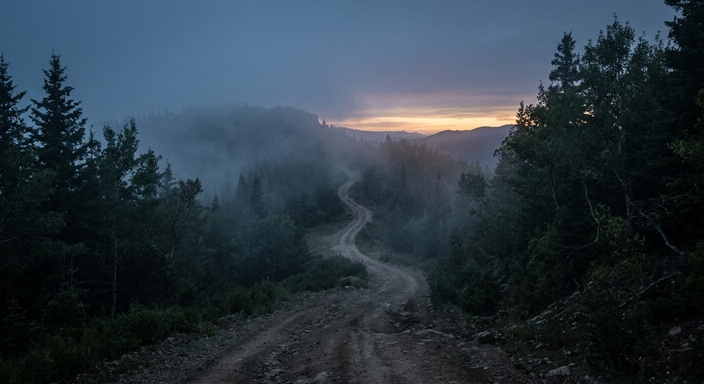
But the void need not have the final word. The pastoral gift of the creation story is this: if God brought order and life from the formless deep, then God can be trusted to work creatively amid the disorder of our lives. The act of creation is not simply repeated in personal experience; it becomes the ground of our hope in God’s continuing work of renewal.
We live in a broken world, and the story of the void makes us conscious of our tenuous hold on reality, on life, on happiness. When we confront loss, illness, personal tragedy, or the limits of our humanity, our faith-vision can blur. We lose sight of God’s redeeming presence. When the human adventure passes through the dark valley, and faith faces crisis or a mystery that defies definition, it is time to reach for the ever-creative hands of God.
Human sin inflicts real harm on our lives and on our world. Many Christians carry wounds, failures or memories that leave them ashamed. The biblical mark of Cain, however, should not be treated simply as a stigma: in Genesis 4:15 it also protects Cain from vengeance.
But no Christian experiencing life at its raw edges should despair of God’s power to transform emptiness into fullness, lack into completeness, death into life. The formless void is less a story about the world’s origins than about how human life can thrive in a present order of confusion.
This is not to romanticise suffering. The void may become a place of transformation, but suffering is not automatically creative or divinely required. Loss and tragedy are genuine evils. Yet for those who find themselves in such places, the creation story offers hope: God works even there.
The void need not have the final word. God can be trusted to work creatively amid the disorder of our lives.
There are practical lessons here. We must recognise that human life remains unfinished. There is much room for improvement across many realms of experience – an opening in which our inventive powers can reorganise what is indeterminate and incomplete, helping to realise new forms, new patterns, new possibilities of becoming. This requires long periods of vigilance and discernment.
We are often impatient, protesting at the surface of existence. We hesitate to enter depths we have not measured. The superficial and conventional attract our immediate attention. We stick to what is within range, inspect only what light falls on, and refuse to give attention to the unfathomable deep. It is easy to dismiss what makes no immediate appeal, to overlook its importance – sometimes discarding experiences whose value is unclear, distorting their meaning.
Yet how often have events manifested a logic independent of our judgment? How often have experiences shaped us in ways broader than our knowing capacity? Perhaps the void possesses a secret wisdom unknown to ordinary understanding – acquired only by those ready to live not from the shallows but from the depths, ready to enter recesses of the heart they have not measured and allow God himself to fill the abysmal void.
When we face the void, active engagement in shaping our world remains possible. If anything determinate is to be brought out of the indeterminate, men and women must learn to co-operate with God’s grace in navigating life’s challenges. Such encounters can become occasions for new spiritual choices – moments to choose between fear and faith, darkness and light.
As believers, we can trust that no encounter with the void places us beyond God’s presence or redeeming work. This does not make tragedy holy or meaningful in itself. Yet openness to grace can help us discern possibilities for healing and growth.
No encounter with the void places us beyond God’s presence or redeeming work. This does not make tragedy holy or meaningful in itself.
God continually utters the cry of creation into the void around us, and new forms of growth emerge from that cry. Such moments of awakening reveal God’s continuing creative presence and the resilience of the human spirit, which can endure chaos and participate in new life.
The spiritual journey is an adventure into growth and creativity, necessarily involving confrontation with the formless. It cannot be contained forever within any enclosed order. The itinerary of the spirit ventures out into formless darkness.
Thus, all genuine wayfarers speak of the “dark night of the soul” – a phrase associated with St John of the Cross – a time of spiritual struggle and introspection when purpose and meaning are challenged. Every believer must learn to walk this path.
It is here that creativity and faith make meaning. Creativity is a venture of faith: coming into our own spiritually, growing out of fear, shedding the morbidness that enchains us. Only faith rooted deep in our lives can introduce us to the void and give us integral access to its vicissitudes. We must break through the void and establish ourselves in the safety of divine palms.
Here, however, we must distinguish spiritual accompaniment from mental-health care. Prayer, ritual and community are vital, but some forms of trauma, depression and disorientation require professional support. The dark night is a spiritual condition, not a substitute for clinical care.
We must accept human limitation in a spirit of faith and allow grace to draw growth from it. We cannot destroy the void or avoid all its effects, but we can resist its sting. Today’s void and its distress matter – they may become birth-pangs of a new world, though we must be cautious: not every tragedy produces renewal.
The mechanism of creation demands struggle, and we shall all participate, however modestly, in the creation of new heavens and a new earth. We shall be called to do something new, to leap into the unknown, to push into territory without well-worn paths. We shall often face despair; we shall be confronted with nothingness all the way. New forms arise from struggle with that which limits us.
The void remains the door that opens on to creation. Despite its seeds of diminishment, it remains a creative matrix – no less true today than in the proto-world of God’s creative exercise. We need the reality of the void to begin the enterprise of creation, which is the transcending of set patterns and beliefs.
The void’s value lies in the freedom it offers from pre-conceptions, pre-determinations, obstinacy and egoism. By its namelessness and limitlessness, it intimates something of God’s infinite capacity to shape, to bring order, to call being from nothing. The wisdom of the void consists in love for emptiness, liberation from worldliness – broad-mindedness. The mind filled with the formless void is disentangled from preconceptions, unconfined by prejudice. It offers space for innovation, growth and transformation.
Human discovery and growth often bring us to the edge of what we do not know. In every important attempt to extend knowledge, in every fruitful intuition, in every progress, the mysterious void may confront us.
This is one pastoral implication of creation: God is close to us even in our encounter with the formless void; God’s unfathomable presence, pervading all things, can draw us toward creative transformation – even when we must spend our lives on surfaces no longer tangible and solid. Facing the void without surrendering to it can facilitate spiritual growth, self-discovery and transformation.
Human life will ever remain fragile. Only God is the sure foundation of our meaningfulness. The Psalmist highlights the dependence of all living things on God’s presence: “When you hide your face, they are lost. When you take away their breath, they perish and return to the dust” (Ps 104:29).
Life remains vulnerable without God’s support. But with God’s enabling grace there is sufficient hope for effective action, through the vocation and responsibility entrusted to humanity (Gen 1:27–30).
The voids in our own lives—the broken relationships, the shattered dreams, the scrambled eggs of our mistakes—are not the end. They are the beginning of a new act of creation.
The void of Genesis is not creation’s failure – it is the canvas upon which the Creator painted his masterpiece. And the voids in our own lives – the broken relationships, the shattered dreams, the scrambled eggs of our mistakes – are not the end. They are the beginning of a new act of creation.[NA1]
[NA1]eremiah 18:4 has been added as the apparent source of the potter image. Please confirm that this is the biblical story intended

philomina ezeanyika
Reassuring words of God
Thank you Padre and more unction to function in the Lord’s vineyard 🙏
IGWILO ONYEKACHI
God Bless You Abundantly Padre Prof Gilbert Alaribe.