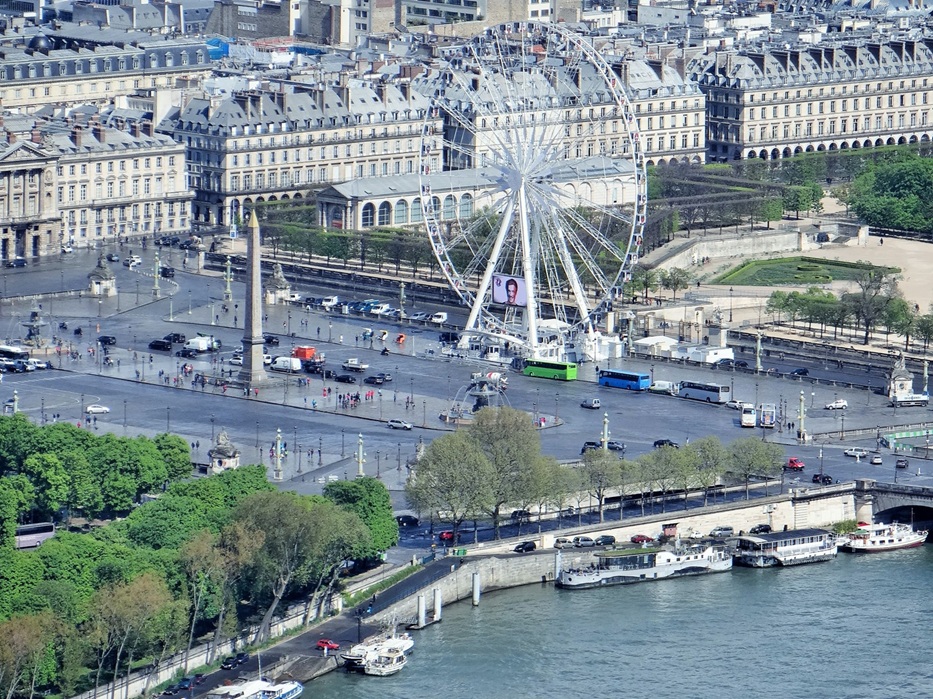
When I saw the crowds filling the Champs-Élysées to greet Pope Leo XIV, I thought of history’s irony. The Mass itself was held at the Place de la Concorde, the very square where, under its earlier name, Place de la Révolution, King Louis XVI was guillotined, and where many Catholic clergy were executed during the anti-Catholic terror that swept France.
In my live interview with France24, I pointed to this irony: more than two centuries later, an estimated 700,000 to 800,000 people — some reports put the figure closer to a million — gathered on that same ground to welcome a Catholic pope.
Catholicism has a way of reinventing itself, and Pope Leo XIV, in his gentle but deliberate manner, is leading that reinvention in France and beyond.
New converts are joining the Church in numbers not seen in decades: the French Bishops’ Conference reported an estimated 21,000 adult and teen baptisms in France this past Easter alone. A survey of 71 dioceses in the United States carried out by National Catholic Register found that 66 expected increases in people becoming Catholics in 2026. NCR put the average increase at 38% in 2026 compared to 2025. In the Archdiocese of Detroit, for example, 1,428 catechumens and candidates entered the Church at Easter of 2026.
Catholicism has a way of reinventing itself, and Pope Leo XIV, in his gentle but deliberate manner, is leading that reinvention in France and beyond.”
This one visit will not erase two centuries of anti-religious sentiment, culminating in the 1905 law separating Church and state, through which France institutionalized laïcité as a principle that governs the relationship between religion and public authority.
But it also points to something enduring in Catholicism: in its long history of accommodating and resisting secular power in turn, it seems to be learning, slowly, how to live alongside it without surrendering to it.
Pope Leo XIV did not soften his message for a French audience shaped by the tensions and contradictions of secularism. Warning that technology risks becoming “yet another instrument of domination and injustice” that leaves relationships “impoverished by a process of dehumanization,” he called France back to its Christian roots, tracing them to the fifth century and the baptism of King Clovis, whose conversion helped bind the emerging Frankish kingdom to orthodox Catholicism.
French Catholicism has had its share of highs and lows. It became entangled with French imperial expansion across the Global South, at times lending religious sanction to conquests that inflicted immense damage and suffering on peoples and cultures.
It also tried more than once to remake the universal Church in its own image. This impulse produced Gallicanism, with its distinctive fusion of ecclesial independence and national sovereignty, which sought to limit papal authority in favor of the French bishops and the political leadership.
Yet France became embroiled in the complex politics of church and state when seven successive popes lived in Avignon, and again during the French Revolutionary wars, when French troops who occupied the papal states took Pope Pius VI captive and demanded that he renounce his temporal authority. Pius later died in captivity at Valence in 1799.
It was ressourcement, and the French worker-priest movement, that left French Catholicism’s most lasting mark on the Second Vatican Council. Yves Congar—arguably the most consequential French theologian before the Council—along with Marie-Dominique Chenu, Henri de Lubac, and Jean Daniélou, built the intellectual foundation on which the Council’s reforms would rest.
But ressourcement was something larger than a theological movement; it was also a flowering of art, culture, and politics, proof that the hunger for beauty and transcendence can find its home in faith, and that art joined to faith can answer both the spiritual thirst of a people and their search for identity.
But ressourcement was something larger than a theological movement; it was also a flowering of art, culture, and politics, proof that the hunger for beauty and transcendence can find its home in faith.”
Pope Leo XIV now stands at a strikingly similar inflection point in Church history.
It seems the crises from the end of the nineteenth into the twentieth century, when European politics convulsed under wars and nationalism, and powers bent on dominating the world, amid the Industrial and Scientific Revolutions, including the rise of atheism, positivism, and modernism, have resurfaced.
Compare those times with the current resurgent autocracy, illiberal democracy, racism, casteism, tribalism, regionalism, protectionism, and narrowing definitions of identity and history, and it could be repeating itself.
When Pius VI died at Valence in 1799, a captive of the armies of the French Revolution, many assumed his papacy would be the last.
As the historian John McGreevy recounts, the machinery of the papacy lay in disarray: most Catholic universities and centers of learning had closed, missionary work outside Europe had stalled, and monasteries and convents were emptying.
The Congress of Vienna (1814–1815) restored the Papal States and returned Pius VII to Rome, where he proved a shrewd negotiator with Napoleon and a firm defender of Catholic doctrine.
But Pope Gregory XVI laid the deeper groundwork for the century’s decisive redefinition of papal power. Before his election, Gregory had published Il Trionfo della Santa Sede e della Chiesa contro gli Assalti dei Novatori (“The Triumph of the Holy See against the Attacks of the Innovators”), a defense of papal infallibility and primacy that declared the Church “dependent on the Pope” and exalted the papacy’s “immutable, infallible, and invincible character.”
By the mid-nineteenth century, Europe was convulsed by unrest, industrialization, and war. In the absence of settled authority, many Catholics turned to Gregory’s vision of supreme papal authority as a bulwark of order, a longing to reinforce Christendom itself.
At the same time, another current ran in the opposite direction toward modernity, liberalism, and the nation-state, and the corresponding retreat of papal power.
During the First Vatican Council (1869–1870), the ultramontanes carried the day with the dogmatic constitution Pastor Aeternus, just four chapters of an original fifteen-chapter draft, focused narrowly on the hierarchical and juridical powers of the pope, before the Council was cut short by the Franco-Prussian War and the Piedmontese occupation of the Papal States.
The document proved decisive in affirming papal primacy and infallibility, but the anti-modern teaching built on it, hostile to democracy and the liberal state, rested on a fiction: that the Church stood outside history altogether, a perfect society untouched by any earthly power or social compact, closed to diversity in Europe and everywhere else.
Into this climate Leo XIII was elected in 1878. He inherited a Catholicism that was deeply shaped by the ultramontanism of the previous half-century. When political institutions became incapable of defending either social order or the Church, Rome offered Catholics an alternative center of unity and authority.
The theologian Joseph Komonchak calls the mood of the age “Catholic catastrophism”: the conviction that the modern world was a valley of tears resistant to God, a fear that pushed the Church to resist science, technology, and liberal democracy alike.
Yet Leo XIII also condemned slavery in its lingering and disguised forms in In Plurimis (1888) and Catholicae Ecclesiae (1890), and named Cardinal Charles Lavigerie his anti-slavery legate to Europe, instituting an annual Epiphany collection for Africa.
Lavigerie, founder of the White Fathers and later Archbishop of Algiers, carried that campaign across Europe, moving audiences with his denunciations of “the continuing plague of slavery in Africa” and winning Leo XIII’s personal support for the African missions.
Thus, with Leo XIII a different Catholic response to Modernity began. It was to be a Catholicism that neither capitulated to the modern world nor retreated, but one which would try to bring the moral authority of the Church to bear on the social transformations of the age.
It was to be a Catholicism that neither capitulated to the modern world nor retreated, but one which would try to bring the moral authority of the Church to bear on the social transformations of the age.”
The century that followed brought little relief. As Pius IX through Pius XII worked to centralize authority in the papacy, Europe descended into totalitarianism, two world wars, and the Cold War — Stalin’s Soviet Union, Franco’s Spain, Mussolini’s Italy, Hitler’s Germany — even as European empires perfected the machinery of colonial brutality across Latin America, Africa, and the Middle East.
Alongside these came a subtler totalitarianism of ideas: a scientism that claimed to explain the world by its own fabled laws, and an economic determinism, sharpened by the Great Depression, through which the Western powers set out to redraw the world’s political and economic map in their own image.
By the time John XXIII became pope in 1958, the Church’s long confrontation with modernity had reached exhaustion. He was determined to lead the Church away from perpetual opposition to the modern world and toward becoming, in fact, a world Church rather than a European one.
He warned against the “prophets of doom”: the belief that modernity was one long apostasy from a medieval Christendom once perfectly achieved, a repudiation of Christ’s reign that began with the Reformation, spread through the Enlightenment, and by revolution after revolution stripped Christ’s influence from economics, politics, and culture.
Against that despair, John XXIII prayed for hope and, against nostalgia for a vanished Christendom, renewal. He prayed that the Council should be a new Pentecost.
Amid AI, war, and a pervasive unease about the future, Pope Leo XIV’s visit to France shows how the Church can become more relevant, not less.
It is reinventing itself, and recovering its distinctiveness, not through isolation or an endless culture war fought on the secularists’ own terms, but by holding open the Church’s oldest conviction: that the human person is capable of infinite perfection, and that culture becomes an instrument of grace once purified of the idols — power, race, nation, money — that shrink human identity into a narrow prison.
In moments of civilizational crisis, Catholicism’s calling is not to become the spokesman for any culture’s ideals, but to stand as a sentinel, inviting humanity to lift its gaze toward the transcendent values that bind us in love and carry us toward a better world still being made.
In moments of civilizational crisis, Catholicism’s calling is not to become the spokesman for any culture’s ideals, but to stand as a sentinel, inviting humanity to lift its gaze toward the transcendent values that bind us in love and carry us toward a better world still being made.”
Pope Leo XIV’s triumphal return to the Champs-Élysées is, in that sense, a great reversal, a reminder that Catholicism’s fidelity belongs to the poor man of Galilee and his priorities, not to the passing politics of a world bound by time and contingency.
Have any thoughts?
Share your reaction or leave a quick response — we’d love to hear what you think!
-
 0
0
-
 0
0
-
 0
0
-
 0
0
-
 0
0
-
 0
0