
Borders Without Visas: What Ruto’s War on Hawkers Reveals About Africa’s Unfinished Business
Here is a question I cannot stop turning over in my mind. When the British sailed into the Gulf of Guinea, up the Nile, and into the Great Lakes; when the French marched into the Sahel and the Congo Basin—whose visa did they present at the border? Whose immigration officer stamped their papers before they cleared forests, redrew kingdoms into colonies, and renamed our ancestors’ rivers after their queens and generals?
They needed no passport to take our land, no work permit to extract our gold, cocoa, rubber, and blood. They arrived by gunboat, not by visa application. And a century later, their descendants sit in Paris and London deciding which Africans may enter their countries, under what conditions, and for how long.
I ask this not to relitigate history for its own sake, but because history has a way of returning to the table when we least expect it. This month, in Nairobi, it returned wearing a very different face: an African president expelling African hawkers from African streets, using the very language of “protecting our own” that colonial administrators once used to justify keeping us out of our own economies.
Before we go to Nairobi, let us pause in Paris in 1789. For generations, French peasants had watched their king and his nobles feast while the granaries emptied and taxes climbed. The people were not first angry at foreigners. They were angry at misrule—at a court that spent lavishly while bread prices crushed ordinary families, at a system that punished the poor for problems the powerful had created.
When the masses finally rose, they did not storm the borders looking for immigrants to blame. They stormed the Bastille. They went for the palace, not the peasant next door. That distinction matters enormously for what is happening in Kenya today.
On September 2, 2026, Kenya’s President William Ruto stood before small-business owners at State House and delivered a directive that would upend thousands of lives within days. He declared that foreign nationals operating hawking stalls, small kiosks, and informal businesses—many of them Burundians, Congolese, Rwandans, and Ugandans—would no longer be permitted to engage in certain small-scale trading activities, with enforcement beginning September 7. Ruto’s stated reason was that Kenya would welcome investors who create jobs, rather than foreign hawkers competing directly with citizens. The government subsequently introduced a 90-day window for undocumented East Africans to regularize their status. Citizen.digital
The human cost was immediate. Hundreds of Burundian nationals rushed to their embassy in Nairobi seeking travel documents after the crackdown began, with long queues forming outside the embassy, where mostly young men carried suitcases and mattresses while waiting for emergency papers. Reuters
The traders’ comments needed no translation. One Burundian trader, Eric Niyonkur, said simply, “We feel unwanted here.” Another, Habonimana Jacques, put it more starkly still: the president, he said, had treated them as though they were not human beings.
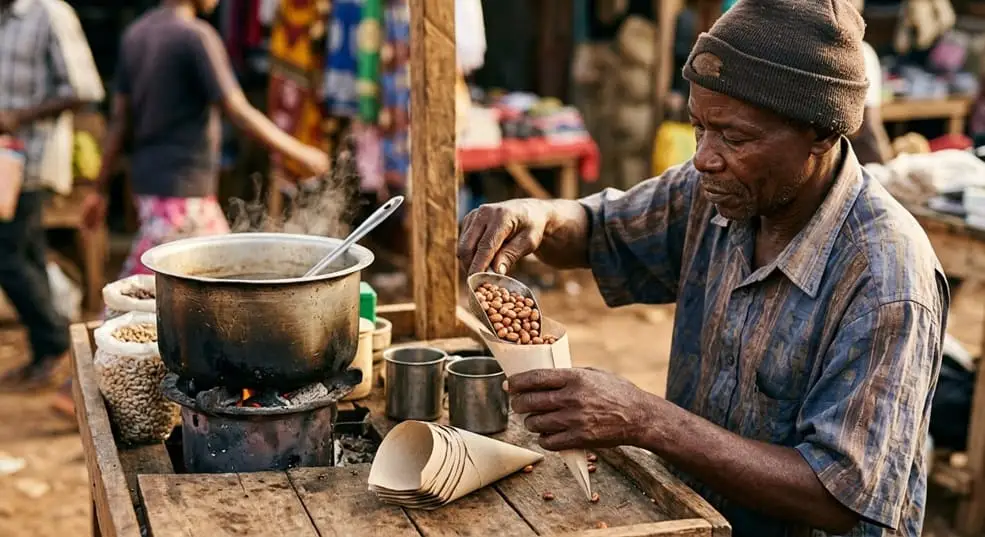
These were not smugglers or criminals. Many sold peanuts, coffee, tea, and doughnuts—the small, dignified trades of people trying to survive. Kenyans who bought from them every morning noticed the emptiness where the vendors used to stand.
These were not smugglers or criminals. Many sold peanuts, coffee, tea, and doughnuts—the small, dignified trades of people trying to survive.”
What happened next is the part of this story that deserves to be told loudly across the continent, because it complicates assumptions about xenophobia in Africa. Kenyans did not, in large numbers, turn on their foreign neighbours. Instead, many turned their anger toward their own government.
Activists, commentators, and ordinary citizens began speaking out, warning that Burundians and other foreigners must not become targets of harassment or collective punishment.
Former Chief Justice David Maraga voiced what many were already thinking. He accused Ruto of pursuing a “scapegoat policy,” arguing that Kenya’s economic hardship could not reasonably be pinned on small foreign traders. He went further, criticizing government debt, corruption, and waste, and describing the executive as a major contributor to Kenyans’ economic difficulties. People Daily
The Kenya National Commission on Human Rights (KNCHR) did not stay silent either. It warned that the crackdown could trigger serious rights violations if enforcement continued without lawfulness, due process, and nondiscrimination, noting that it had received complaints of threats, intimidation, and discriminatory treatment from migrant and refugee communities. Knchr
Rights groups and diaspora associations echoed the same message: do not let joblessness curdle into hatred of your neighbour.
This is the truth the hawkers’ story keeps trying to tell, if we are willing to listen: the problem was never the woman selling groundnuts on a Nairobi pavement. The problem is a government that has chosen to ignore the elephant in the room: mismanagement of borrowed trillions. Sadly, immigrants, as usual, are blamed for the shortcomings of government.
The problem was never the woman selling groundnuts on a Nairobi pavement.”
Let us juxtapose Kenya’s story with South Africa’s. South Africa has, for two decades, carried the scars of xenophobic violence—waves of attacks in 2008, again in 2015, and recurring flashpoints during which ordinary citizens turned on their fellow Africans.
Migrants from Zimbabwe, Mozambique, Malawi, Nigeria, and beyond have sometimes been killed or injured while authorities struggled to contain the violence. Movements have also organized activities opposing the government’s stance.
It is precisely this history that made Kenyans in the diaspora flinch when they saw their own government reach for similar language. Kenyans living in South Africa, through their lobby group KEDASA, urged Ruto to handle the crackdown carefully, warning from their own painful experiences of xenophobia and Afrophobia that “individual unlawful conduct can quickly become collective blame,” a trajectory they said Kenya must avoid at all costs.
So here is the mirror: in South Africa, it was often locals who turned on migrants while the state struggled to protect them. In Kenya, the state initiated restrictions on migrant traders, while ordinary citizens—traders, riders, churchgoers, and human-rights defenders—pushed back and said, in effect: not in our name.
Neither script is one Africa should be proud of. But only one of them shows a public capable of separating its economic pain from its neighbour’s face. That is no small feat. That is the raw material of solidarity.
Neither script is one Africa should be proud of. But only one of them shows a public capable of separating its economic pain from its neighbour’s face.”
There is a second danger embedded in this story—one that rarely receives the same attention as the embassy queues. When people are forced to leave abruptly, without savings, adequate preparation, or even enough time to gather their documents, they do not simply travel home; they travel in a state of acute vulnerability.
Panic, uncertainty, and unplanned border crossings can create conditions that traffickers exploit. A frightened eighteen-year-old with a suitcase, little money, and no reliable transportation can easily become a target for someone offering a “shortcut,” a “connection,” or a ride across the border—an offer that can quickly become a pathway to debt bondage, forced labour, trafficking, or worse.
This is neither unique to the Great Lakes region nor hypothetical. People displaced abruptly by xenophobic attacks and expulsions elsewhere have faced similar patterns: sudden displacement, empty pockets, and border crossings nobody planned for, creating fertile ground for predators offering “help.”
A 90-day grace window on paper is welcome, but it does not feed a family, fund a bus fare, or walk an unaccompanied teenager safely through a border town after dark. This is where bad governance compounds into a second harm: exploitation.
A policy announced without adequate transitional support can uproot livelihoods and manufacture the very desperation that traffickers are trained to recognize and exploit. Every rushed repatriation movement potentially increases vulnerability to exploitation unless we, as a continent, choose to change our ways and collaborate as brothers and sisters.
I return, then, to where I began.
If a Congolese mother selling tomatoes in Nairobi needs a permit to stay, what permit did the colonial officer carry when he arrived to draw the borders that split her ancestors’ land among European countries without asking a single African who lived there?
If a Burundian hawker must prove his papers are “in order” before he is allowed to sell doughnuts on a Kenyan street, what papers did the missionaries and merchants carry when they arrived uninvited, stayed for a century, and left only after extracting the best from Africa?
The above statement is not to excuse any government—Kenyan, South African, or otherwise—from the basic duties of protecting its citizens’ livelihoods and regulating migration. Countries have that right.
But there is a difference between governing and scapegoating, between regulation and spectacle. A leader who has failed to create jobs does not gain moral standing merely by expelling the person selling peanuts for a living.
As a theologian, I keep returning to the simple, ancient instruction: “You shall not oppress a stranger” (Exodus 23:9), for you were once strangers yourselves.
So, too, do I return to Scripture’s oldest question about what we owe one another. When God asked Cain about his brother’s whereabouts, Cain answered with a question meant to close the matter, not open it: “Am I my brother’s keeper?” (Genesis 4:9).
It was the first recorded attempt by a human being to disown responsibility for another’s suffering, and it has echoed down every century since.
The concept of Ubuntu is a rebuttal to Cain’s rhetorical question, gently but firmly: umuntu ngumuntu ngabantu—a person is a person through other persons. I am because we are.
Ubuntu does not ask whether hawkers on pavements possess the right passports before deciding whether their needs matter. Ubuntu insists that their wellbeing and ours are bound together, that our humanity is incomplete if we attempt to place ours above that of others, whether they are Kenyan, Burundian, Congolese, or South African. This is not a foreign, imported idea we are borrowing from theology or philosophy. It is an African answer to Cain’s question, rooted deeply in our communal understanding of what it means to be human.
Ubuntu insists that their wellbeing and ours are bound together, that our humanity is incomplete if we attempt to place ours above that of others.”
So, am I my brother’s keeper? Am I my sister’s keeper when she is rushed onto a bus with a mattress on her back and no money in her pocket, walking straight into the reach of traffickers who are counting on our silence and her desperation?
Ubuntu says the answer was never in doubt. Either we are each other’s keepers, or we are not fully human at all.
The French masses of 1789 did not go looking for foreigners to blame for their hunger. They sought out the royals they held responsible for their suffering.
Perhaps that is the revolution Africa still owes itself: not against each other, hawker against hawker, neighbour against neighbour, but against systems of government that fail their people and then direct their frustration elsewhere.
Kenya’s hawkers did not colonize Kenya. They did not borrow the trillions of shillings now weighing on the public purse. They only wanted to sell their tea and go home safely at night, much like the rest of us.
Let us be their keepers, as Ubuntu has always asked us to be, long before any border ever needed a visa or work permit to cross it.
