
Why does the Shadow of Colonialism still determine how Africa is understood – and how Africans understand themselves?

Discussions of Africa’s contemporary challenges often return to the legacy of colonialism. Persistent poverty, political instability, weak institutions, economic dependency, and social fragmentation are frequently traced to colonial rule and its aftermath.
This interpretation has merit: colonialism reshaped Africa’s political, economic, social, and cultural structures, disrupted indigenous systems, and established patterns that continue to influence postcolonial realities.
Yet while colonialism remains essential to understanding Africa’s present condition, treating it as the sole explanation risks obscuring an equally important factor: African agency.
Why should colonialism become the single story of Africa? Is it to elicit sympathy, or does it risk absolving Africans of responsibility for the continent’s challenges? At what point does legitimate recognition of historical injustice begin to hinder responsibility and self-determination? These questions are urgent as Africa seeks to define its place in a rapidly changing global order.
At what point does legitimate recognition of historical injustice begin to hinder responsibility and self-determination?
The urgency of these questions hit me during a recent discussion about Nigeria’s future ahead of the 2027 national elections. The conversation took place in a modest meeting room in Lagos, where a group of professionals had gathered to reflect on their country’s trajectory.
As we grappled with the continent’s persistent struggles, one participant leaned forward and posed a question that seemed to hang in the air long after the words had faded: “What wrong have we done to the West to keep us where we are?” The room fell silent.
It was not a rhetorical question; it was an expression of genuine bewilderment, a cry from a people who felt themselves trapped in a history not of their making. The question reflects a profound sense of historical disempowerment and powerlessness.
While acknowledging the realities of colonial exploitation and foreign intervention, I worried that such a perspective could inadvertently reinforce a view of Africa as a passive victim of history rather than an active participant in its own transformation.
Perhaps one of colonialism’s most enduring consequences is not economic exploitation or political domination alone, but the erosion of collective self-agency. Colonial rule did not merely occupy territories; it reordered identities, reshaped institutions, and narrowed political imagination. Colonial education systems, for instance, deliberately limited Africans’ exposure to ideas of self-governance and emphasized obedience and subservience.
Administrative structures systematically excluded Africans from decision-making, creating governance templates that proved difficult to dismantle after independence. These were not incidental features of colonial rule; they were deliberate strategies designed to produce subjects rather than citizens.
By systematically subordinating African peoples and cultures, colonial systems fostered patterns of dependency and inferiority that survived political independence. In this sense, colonialism can be understood not only as a historical event but also, cautiously, as a form of collective trauma whose effects continue to influence political imagination and social consciousness.
Trauma is often associated with overwhelming experiences that disrupt an individual’s or community’s sense of meaning, security, and identity.
The colonial encounter involved many of these elements: violence, dispossession, cultural dislocation, social fragmentation, and the denigration of indigenous ways of life.
To grasp the depth of this trauma is to recognize how thoroughly it infiltrated African societies, reshaping not only political and economic structures but also the intimate terrain of identity, self-worth, and collective aspiration.
The effects did not end with the formal dismantling of colonial empires; they continued to shape collective memory and social consciousness. Yet trauma does not dictate destiny. The central question is not whether harm occurred—that is beyond dispute—but how societies choose to respond to that harm.
This is where the psychological concept of post-traumatic growth (PTG) offers a constructive lens.
Trauma does not dictate destiny. The central question is not whether harm occurred—that is beyond dispute—but how societies choose to respond to that harm.
Developed by psychologists Richard Tedeschi and Lawrence Calhoun, post-traumatic growth refers to positive psychological change that can emerge through the struggle to cope with highly challenging life circumstances.
The metaphor they employ—rebuilding after an earthquake—is instructive. Just as damaged structures require new foundations, trauma can force people to reassess assumptions that once gave coherence to their lives.
Growth occurs when those assumptions are reconstructed on more resilient foundations. PTG neither treats trauma as desirable nor romanticizes suffering; rather, it suggests that individuals who struggle to make sense of traumatic experiences may develop greater resilience, deeper self-understanding, stronger relationships, and renewed purpose (Tedeschi, R.G. & Calhoun, L.G. (2004). 15(1), 1-18).
Although post-traumatic growth was originally developed as a theory of individual psychological development, its insights can be applied, with appropriate caution, to collective experience. Communities, nations, and cultures also face traumatic disruptions that challenge their identities and social structures.
Scholars of collective memory and cultural trauma—including Jeffrey Alexander and Ron Eyerman—have explored how societies respond to historical suffering. Some communities remain trapped in narratives of grievance and victimhood, while others transform adversity into sources of social renewal and collective resilience. Societies are, of course, more complex than individuals, but the conceptual parallels are illuminating.
Viewed through this lens, Africa’s postcolonial experience becomes not only a narrative of suffering but also a story of resilience and possibility.
The decades following independence reveal numerous examples of societies seeking to transform colonial wounds into opportunities for renewal. The Negritude movement mobilized writers and intellectuals across the continent and diaspora to reclaim African cultural identity and pride.
Chinua Achebe’s novels offered powerful counternarratives to colonial depictions of Africa. The early Pan-African congresses, from Manchester to Accra, represented deliberate efforts to build solidarity and articulate a shared vision of liberation. These were creative acts of reclamation, efforts to imagine a future on African terms.
The promise of independence, however, encountered serious challenges. In many countries, hopes for liberation gave way to authoritarian rule, corruption, economic hardship, ethnic tension, military intervention, and weak institutions.
These post-independence struggles can be understood across three interconnected dimensions: governance failures, including the authoritarian turn and suppression of democratic institutions; economic missteps, such as the persistence of extractive economic models and policy dependency; and social conflicts, often exacerbated by arbitrary colonial borders that forced disparate ethnic groups into fragile nation-states.
While colonial legacies contributed to these difficulties, blaming colonialism alone is insufficient. Post-independence leadership choices, policy failures, and internal conflicts also played significant roles.
Ghana’s trajectory under Kwame Nkrumah illustrates this tension: the promise of liberation eventually gave way to authoritarian rule and economic mismanagement. Similarly, Kenya after independence saw the consolidation of power by a narrow elite, perpetuating inequalities that colonialism had established.
These examples show how inherited constraints intersected with domestic choices to produce divergent outcomes. Recognizing this highlights the importance of self-agency: the capacity of individuals and societies to make meaningful choices and shape their future. Self-agency acknowledges historical and structural constraints while affirming that circumstances influence, but do not necessarily determine, outcomes.
Africa’s future will therefore depend significantly on its capacity to embrace a culture of self-agency. Such a transformation requires a shift from viewing history primarily as a source of limitations to seeing it as a source of lessons and opportunities.
Historical memory remains indispensable. Societies that forget their past risk repeating its mistakes. Yet, “memory should not become a prison.”
Africa’s future will therefore depend significantly on its capacity to embrace a culture of self-agency.
This observation captures the delicate balance that postcolonial societies must strike: honoring the past without being paralyzed by it.
The case for African agency, however, must not minimize existing constraints. Many African countries still operate within global systems shaped by neocolonial economic and political dependencies, including the influence of international financial institutions such as the IMF and World Bank on national economic policy, the power of multinational corporations in extractive industries, and unequal trade relations that disadvantage African producers.
These mechanisms are not abstract; they concretely shape the choices available to African governments and citizens. Acknowledging these realities need not lead to helplessness. While structural conditions can constrain opportunities, they do not determine every outcome. A balanced perspective recognizes both the enduring impact of external constraints and African societies’ capacity to shape their own futures.
One of the most important expressions of transformative agency is responsible political leadership. Africa’s development challenges cannot be addressed without leaders committed to integrity, accountability, transparency and long-term vision.
Yet leadership alone is insufficient. Nigeria’s transition from military rule in 1999 was driven not only by political elites but also by grassroots movements and civic organizations that demanded democratic reform. More recently, citizens’ movements across the continent—from Sudan to Senegal—have demonstrated that ordinary people can hold power to account when they organize and insist on their rights.
These moments offer hope, but they also remind us that political transformation is won through sustained collective effort, not granted from above. Citizens must sustain democratic culture, demand accountability, and participate actively in public life. Political transformation is ultimately a shared enterprise.
Education constitutes another essential foundation of self-agency. Educational systems that encourage critical thinking, scientific inquiry, technological innovation, ethical leadership, and civic responsibility are indispensable.
Education must move beyond what Paulo Freire, in Pedagogy of the Oppressed, called the “banking model”—a system that treats students as passive recipients of knowledge. Freire argued that such an approach reinforces oppressive structures by discouraging critical inquiry. Education that promotes self-agency empowers citizens not only to consume knowledge but also to create it.
This requires educational institutions to engage seriously with African intellectual traditions and indigenous knowledge systems. Genuine development demands confidence in local capacities alongside openness to global learning.
Economic transformation also requires a renewed commitment to African agency. For too long, development discussions have focused on aid and dependency, sometimes reinforcing expectations of external intervention.
While international partnerships remain valuable, lasting progress also depends on strong domestic initiatives. Investment in entrepreneurship, industrialization, technology, agriculture, research and regional trade can contribute to greater economic independence.
Africa’s youthful population is a source of optimism, with innovators across the continent developing solutions in finance, digital technology, renewable energy and agriculture. Kenya’s M-Pesa, a mobile money platform born from local necessity, has transformed financial inclusion for millions previously excluded from formal banking.
Nigeria’s fintech sector has attracted substantial investment and is reshaping how Africans save, invest, and transact. Rwanda’s digital governance initiatives—spanning e-government services and digital identification systems—have positioned the country as a continental leader in technology-enabled public service delivery.
These are not isolated successes; they reflect a broader pattern of African innovation that deserves greater recognition.
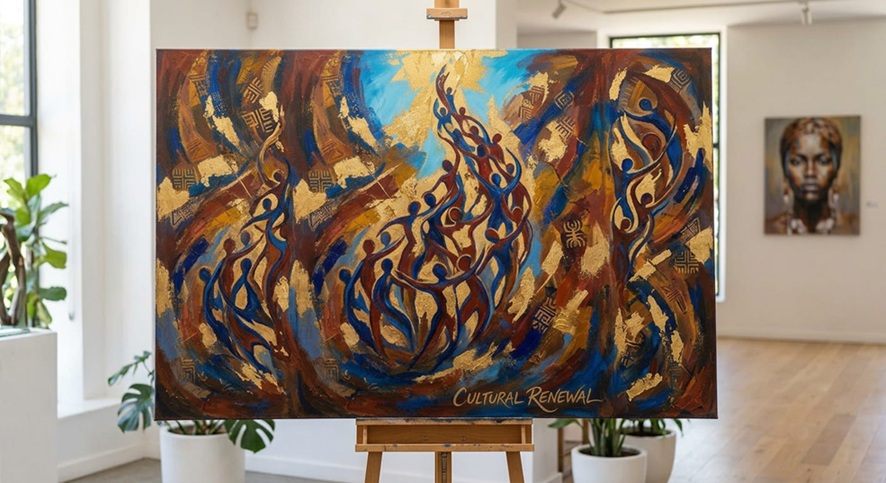
Cultural renewal is another important dimension of post-traumatic growth. Colonial ideologies frequently portrayed African cultures as inferior, primitive, or dependent. Although such perspectives have been challenged, remnants of these assumptions sometimes persist.
The appropriate response is neither cultural isolation nor hostility toward the outside world. Rather, it is a confident affirmation of African identities, traditions, and contributions within a global context.
The global influence of Afrobeats, the rise of contemporary African art in international markets—where artists like El Anatsui and Yinka Shonibare command global attention—and the flourishing of African fashion, film, and literature reflect not only artistic vitality but also a broader cultural reclamation.
These expressions represent a refusal to accept colonial verdicts of African cultural inferiority. Literature, philosophy, theology, art, and scholarship all play crucial roles in strengthening cultural self-confidence and nurturing a healthy sense of collective identity.
Returning to the question raised during that conversation about Nigeria—”What wrong have we done to the West to keep us where we are?”—the framework of post-traumatic growth demands a different response.
The more transformative question is this: ‘What shall we do with what we have inherited?
The question assumes passivity, an expectation that history owes us an explanation for our predicament. But history owes us nothing. The more transformative question is this: “What shall we do with what we have inherited?”
Africa’s future will be shaped not by colonialism’s legacy alone, but by how we choose to respond to that legacy. The task of the twenty-first century is therefore not merely to remember the past, but to transform that memory into a foundation for renewal.



Join the conversation