
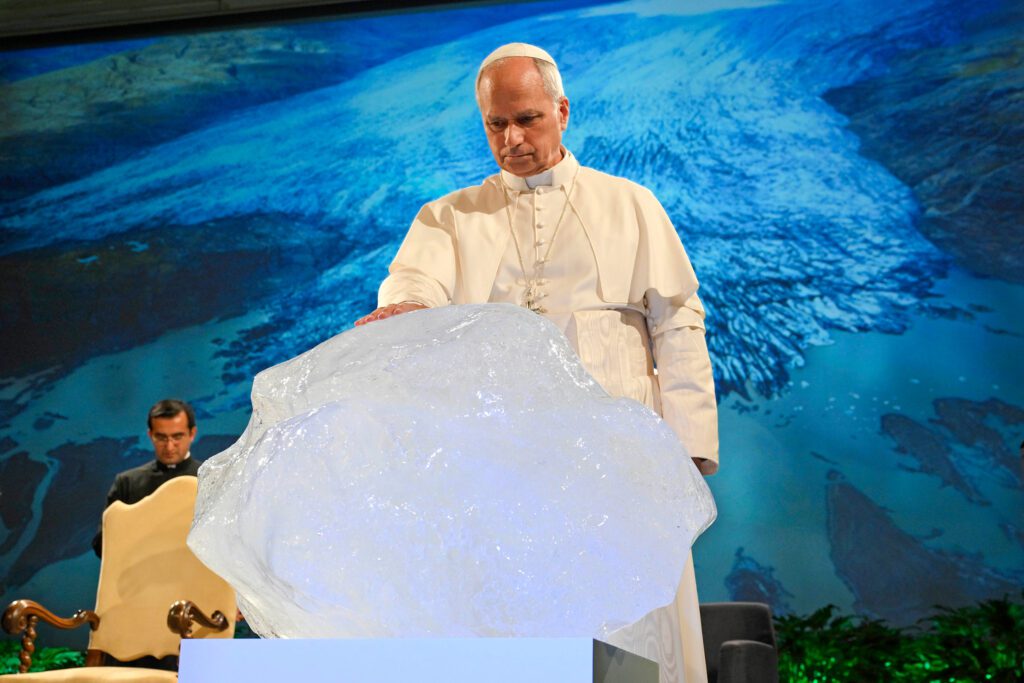
On October 1st, 2025, Pope Leo XIV warned a global audience that “God will ask us if we have cared for our common home.” The Pope was speaking at the Raising Hope Conference, an international gathering on climate justice organized by the Laudato Si’ Movement to mark the tenth anniversary of Pope Francis’ landmark ecological encyclical.
How has Pope Leo decisively shifted the climate debate today? Is he carrying forward the legacy of Pope Francis in Laudato Si’, or are we seeing a new urgency to the message of his predecessor? With this address, delivered just months into his papacy, he has redefined the terms of the climate debate. His words cut through the rhetoric of global summits and the complexities of climate models with a single, uncompromising question. This is not merely a call to action—it is a moral ultimatum, redefining the climate crisis as a non-negotiable matter of conscience and eternal accountability. The challenge, as framed by the Pope, is no longer merely scientific; it is fundamentally spiritual.
The gap between discourse and disaster
Pope Leo XIV rightly celebrated the penetration of Laudato Si’, noting how the phrase “care for our common home” has moved from the sacristy into boardrooms and university curricula. Yet, his acknowledgment that the environmental challenges identified a decade ago are now “even more relevant today” lands like an alarm bell. It reveals the tragic disconnect between our profound discourse and our insufficient deeds.
Global watchdogs sadly affirm this pessimism. A recent, sobering analysis from the World Resources Institute (WRI) confirms that the current pace of climate action remains “dangerously insufficient” to meet the critical 1.5^\circ\text{C} target of the Paris Agreement. This scientific consensus underscores the Pope’s warning: we have spent a decade talking about the map while accelerating toward the edge of the cliff. The time for congratulatory reflection is over; the time for decisive repentance is now.
The necessary “Conversion of Heart”
We join Pope Leo in calling for “a conversion of heart.” We believe, as African Church leaders, that Pope Leo correctly identifies the crisis. He insists that the heart “is where the deepest searching takes place,” and that it is only from this inner transformation that a “true ecological conversion can take place,” shifting from “collecting data to caring.”
This ethical imperative is powerfully echoed in the secular sphere. Influential economist and leading climate justice advocate Jeffrey Sachs consistently argues that solving the crisis is predicated on an “ethical awakening” that must precede technological fixes. Sachs compellingly connects our failure to systemic moral flaws—a global economy predicated on endless extraction rather than responsible stewardship and equity. Pope Leo’s appeal to the “heart” is, therefore, a universal demand for a global moral reset, rejecting the destructive impulse of consumerism in favour of the humility of coexistence.
An inseparable justice: The ultimate test
The Pope’s reminder that ecological concern, justice for the poor, social commitment, and inner peace are inseparable crystallizes the core of Catholic Social Teaching. He links the fate of the planet directly to the fate of the vulnerable, urging leaders ahead of crucial gatherings like COP30 to heed the “cries of the Earth and the poor.”
This unified vision transcends denominations. It finds its starkest articulation in the Global South, where the crisis is a daily reality. The Catholic Bishops of Africa (SECAM, or the Symposium of Episcopal Conferences of Africa and Madagascar), speaking for a continent bearing the brunt of historical emissions, made their position clear in October 2022: climate change, they asserted, is “a tragic and striking example of structural sin.” In a decisive move from diagnosis to action, the care of the environment was subsequently voted on by SECAM at its 30th Assembly as one of the 12 pillars that will guide the church’s life, ministry, and advocacy for the next 25 years.
Reinforcing this, the former Archbishop of Canterbury Justin Welby powerfully articulated this shared moral landscape during his tenure, describing climate change as the “greatest moral crisis of our time,” specifically because its worst impacts fall disproportionately on the world’s most marginalized. This consensus confirms the central ethical argument: to fail the environment is to betray our human family. Our collective inaction is not just poor politics—it is systemic sin.
The unforgiving answer
Pope Leo XIV’s concluding question, “God will ask us if we have cultivated and cared for the world… and if we have taken care of our brothers and sisters. What will be our answer?”—leaves no room for evasion.
This is the uncomfortable question every government, corporation, and citizen must face. It demands that we stop debating the reality of the crisis and start embodying the transformation required. The combined moral authority of the Vatican, intensified by the irrefutable consensus of science, global justice advocates, and the prophetic voices of Africa, leaves us with a stark choice: to continue down the path of extractive self-interest, or finally, fully embrace the spiritual mandate of care. Our answer must be forged in immediate, sacrificial action that proves our stewardship was more than just a phrase.
Anything less is a moral and spiritual failure that will be judged as unforgivable by both future generations and the ultimate arbiter of our common home.
