
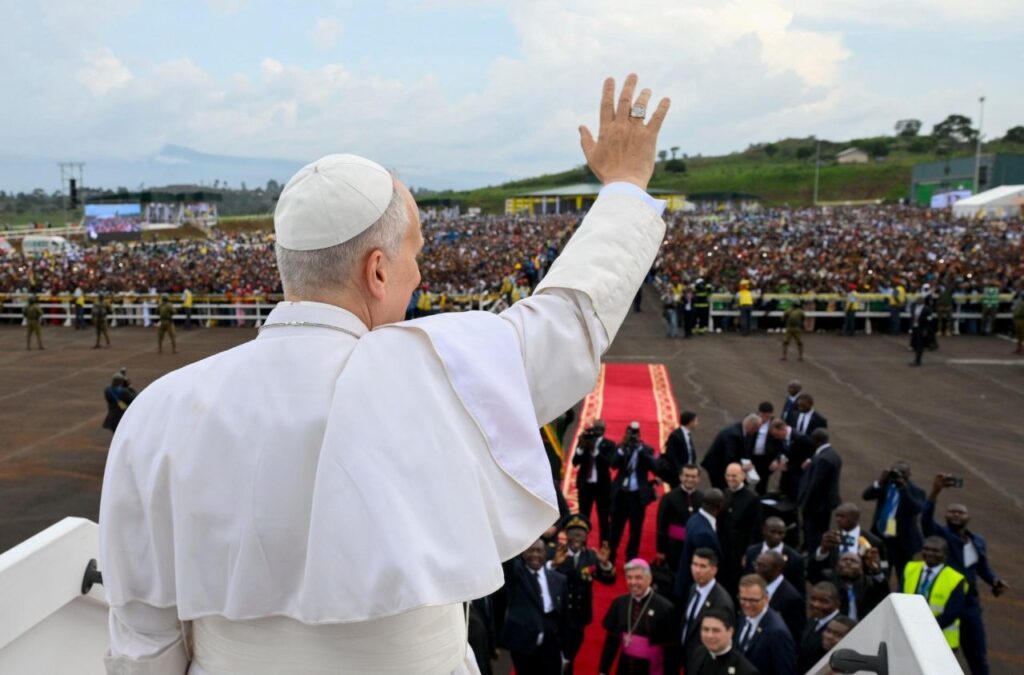
During his address to students at the Catholic University of Central Africa in Yaoundé, the capital of Cameroon, Pope Leo XIV delivered a sweeping message, challenging young Africans to stay and build their country rather than abandon it for Europe and other developed countries. The Pope’s message comes at a crossroads of the growing mindsets among young Africans who see migration to these countries as a solution to their economic, social and security plights, which, to them, means a transition from hell to paradise. Thinking of this nature contributes to the form of unconscious ‘internalised oppression’ whereby many young Africans absorb negative stereotypes about their country, identity, race, culture, politics, and economy – believing everything Western is better than theirs. A mindset that is further reinforced by the ugly experiences of dirty politics, oppression and injustice, economic depression, corruption, insecurity and instability fraying the continent. In his landmark speech, the Pope said that migration is not an option and called young Africans not to run away from their land but to see themselves as agents of change capable of transforming the continent and as solutions, not as victims. True dignity, according to the Pope, comes from contributing to nation-building and the development of their societies, insisting that the future of the continent depends on educated young people staying engaged: creating businesses, improving governance, and strengthening communities, rather than fleeing abroad.
A Prophetic and Timely Voice at the Crossroad with African Second Exodus
The Pope didn’t just make a statement; he proclaimed a prophecy. The timing was accurate. The rendering came at a time when Africa is facing what, in one of my poems, I called ‘The Second Exodus’. The first exodus is the trans-Atlantic slavery, when millions of our forebears were forcefully sold and carted away across the Atlantic Ocean to the Americas. This second Exodus is the desperation of our young people to flee to the West and Asia in search of better opportunities. The first Exodus was forced and imposed. The second Exodus oscillates between choice and uncanny socio-political and economic conditions that compel young people to seek greener pastures abroad. Words like ‘relocation’, ‘Jappa’, ‘soft-life-abroad’, and ‘burger’ are not just flowery words that describe migration; they picture the perceived status symbol attached to them. Behind this paradisiac image of abroad lies a price and some dark sides. Young Africans become victims of a cycle of abuse and exploitation, while some die in the hot Sahara Desert or are drowned in the Atlantic Ocean trying to cross to Europe. Many countries are tightening immigration policy, making life complicated for African migrants. The recent growth of xenophobia and anti-migrant groups from fringes to mainstream politics, where it is being woven into popular culture, identity politics, and social fabrics, often targeting African migrants, is a pattern that should worry everyone, calling on young Africans to reflect on whether they are not fleeing the wind into the storm.
A Tension Between Departure and Development
The African migrant nightmare often reflects a mentality of ‘stay vs leave syndrome’ – creating a tension between the urgency for development and reform, and the streaming youth departing the continent in droves. In 2024, after suffering an acute shortage of health workers, the Nigerian government weighed in by curbing health worker migration, claiming it wanted to stem the brain drain. Such an unrealistic solution creates more problems; young Africans don’t choose to leave; the conditions compel them to do so. This is why the call to stay must be matched by realistic conditions that restrain them from departing. Government, institutions and stakeholders must create an environment where young people can thrive – where they are valued, their merit is rewarded, innovation is supported, and justice prevails.
A Dream Hunted by Shadows
Africa has everything it needs to become one of the greatest continents. It’s sitting on minerals worth trillions of dollars. Added to this is a teeming young population with a vast reservoir of energy, creativity and possibility. A new Africa is possible with governance founded on accountability, responsibility, justice and equity. Again, immigration will remain a contested global issue as long as there are economic inequality and political instability. The UN reports that thousands of Africans are trafficked across the globe annually. Developed nations should be more transparent and more committed to strengthening democracy in their foreign policy toward Africa. African solid and rare earth minerals cannot power the great industries of Asia and the West while her soul lies in ruins. If developing countries continue to take from Africa while it lies in desolation and ruin, the urge to flock towards the end product in developed countries will continue to persist. Again, Pope Leo’s speech is a call for collective responsibility, for both internal and external matters, in line with the church’s social teaching to build a society of justice, peace and human flourishing, and African youths should see this as a challenge to take on head-on.
