
Pope Leo XIV’s visit to the North-West Region of Cameroon, a region deeply scarred by conflict since 2016 and designated a “red zone” for most government officials and international bodies, was a prophetic event that bridged the heart-wrenching realities of the Anglophone crisis and the profound mysteries of the Christian faith.
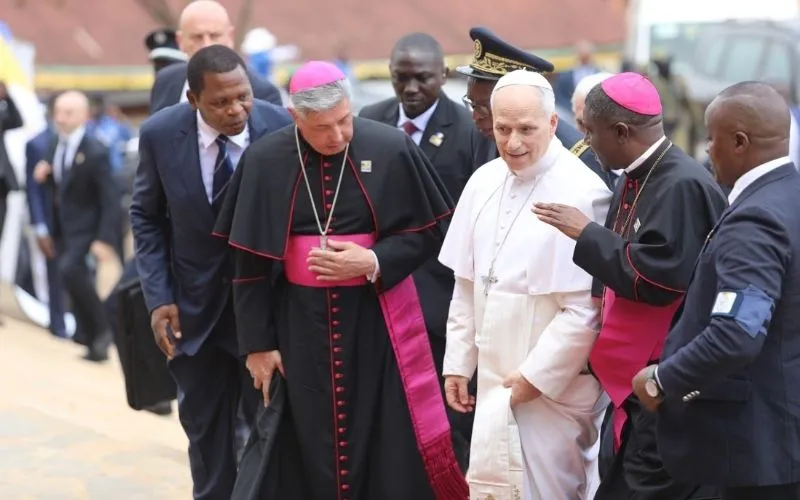
The anxious crowd flooding the courtyard of St. Joseph’s Metropolitan Cathedral in Bamenda listened eagerly as Pope Leo called for “an unarmed and disarming peace” rooted in justice, reconciliation, and the rejection of violence. The April 16, 2026, event was marked by a symbolic invocation of the gifts of the Holy Spirit. After an ardent prayer for peace and reconciliation, Pope Leo, alongside six local representatives, released seven white doves into the air, each bearing a ring labelled with one of the gifts of the Holy Spirit.
By random selection, Pope Leo received the dove labelled “Piety.” What happened next left many participants deeply moved. While six doves flew toward the horizon and were not seen again, the Pope’s dove reportedly made its way back to the cage from which it had been released, some 14 kilometres away.
“While six doves flew toward the horizon, the dove marked ‘Piety’ found its way back home.”
In a region where a decade of unrest has displaced families and hardened hearts, many interpreted the event as a striking spiritual metaphor. For some observers, the return of the dove became a powerful symbol of hope and reconciliation. The event lends itself to a rich spiritual reflection on the often-misunderstood gift of piety and its significance as a pathway toward peace in a wounded land.
Piety as the Hidden Gift: A Scriptural Reflection
In contemporary discourse, piety is often dismissed as a passive or sentimental trait associated with outward religiosity or withdrawal from worldly concerns. Christian tradition, however, regards piety as a supernatural gift that heals the human heart of hardness, instilling a deep filial love for God as Father and a fraternal affection for others as brothers and sisters. It affirms the underlying family bond of all humanity and strips away political, linguistic, and tribal divisions.
Similarly, the return of the “Piety” dove during the Bamenda event invites reflection on a renewed filial love—one that encourages people to transcend political, linguistic, and tribal divisions in order to build a community where everyone feels welcome and accepted, and where peace can flourish once again. As Pope Leo XIV noted in his address at Bamenda Cathedral, true peace in this context is not merely a political construct to be invented, but a divine reality to be received through mutual recognition.
“Piety affirms the underlying family bond of all humanity and strips away political, linguistic, and tribal divisions.”
Contextualizing Piety in a Land of Unrest
Prolonged exposure to trauma and instability—as in Bamenda—can breed bitterness, hardened hearts, and deep mistrust. In this context, piety becomes an act of spiritual resistance. It is the grace that prevents a traumatized people from surrendering to hatred. True piety does not ignore injustice; rather, it provides the emotional and spiritual fortitude to recognize human dignity even in an adversary.
It fuels the quiet heroism of local mothers, religious leaders, and ordinary citizens who continue to feed the displaced and comfort the grieving despite great personal risk. For many who witnessed the event, the return of the dove labeled “Piety” served as a reminder that faith remains anchored in a deeper reality than conflict. Piety, firmly rooted in God, possesses an inner compass that continually points toward justice, mercy, and fraternity. Healing for the North-West Region, therefore, may well depend upon a collective return to our shared humanity.
The Science of the “Homing Instinct” and the Prophetic Compass
While it is scientifically normal for homing birds to fly several kilometres back to their homes, guided by a combination of magnetoreception and environmental imprinting, the event also invited many participants to reflect on its spiritual significance. The convergence of science and faith in this scenario offers a beautiful synthesis. What science identifies as an advanced biological navigation system, theology can appreciate as part of the wonder of creation. Both point to the same truth: the human need for orientation and direction.
Out of the seven doves, only the dove labelled “Piety,” the one held by Pope Leo XIV, reportedly returned home after the release. Whether this was the result of physical resilience, instinctual capacity, or simple chance, the event resonated deeply with many who were present. For some observers, it became a living parable for a people weary of unrest.
While human strategies for peace often falter and scatter like the missing birds, the gift of piety points toward an enduring path through the storm. It reminds us that even in a land marked by years of conflict, faith can provide an inner compass capable of guiding individuals and communities toward the lasting sanctuary of peace, justice, and reconciliation.
“Even in a land marked by conflict, the internal compass of faith can guide a people back to peace, justice, and reconciliation.”
“Piety affirms the underlying family bond of all humanity and strips away political, linguistic, and tribal divisions.”



