
When the Void Enters the Village: Chaos and the Loss of Moral Order

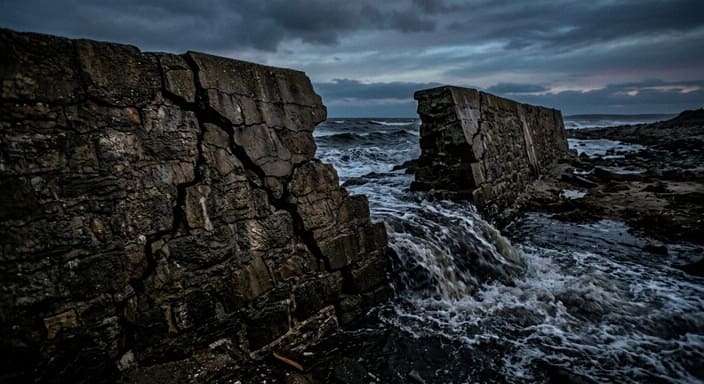
The Presence of the Void
We must learn to recognize the reality of the void at the growing edges of our human experience. For the void slips into peoples, events and life-situations, and again slips out of them. Sometimes it comes like a roar, sometimes like a whisper, but always threatening to dismantle the fixed points of our socio-political cosmos and to make it a fabrication of chance.
So, we must look for the reality of the void at the level of experience where we all have to live; we must discover its essence to resolve some of the great crises of our own world. For the void can present enormous threats to the order and structure of our lives. It can undermine our sense of control and security, forcing us to re-evaluate our assumptions and values.
Most days – it is true – the void looms offstage, lurking somewhere in the background of our individual and collective awareness, an ominous presence waiting for its moment in the spotlight to come once more. But even if we believed the void to be an illusion of our sensory perception, its consequences are nonetheless visible in our habitable world. There comes a time when we have visions of ourselves falling apart and disintegrating into an indeterminate unreality.
There comes a time when we hear the void sizzling dangerously in the very heart of society and rending it asunder with outbreaks of violence, riots, social unrest and turbulence. At such times even the very pillars of faith no longer seem to offer us sufficient protection. The confusion around us threatens to swallow up the outlines of our ordered world. We strive for some clarity. But lo, more confusion! And we are left in the lurch, huddling around in the amorphous darkness surrounding us.
Agents of the Formless
Often we are ourselves the agents of the formless and the chaotic in human affairs. When poverty and desperation leave people vulnerable to exchanging political freedom for immediate survival, and unjust systems exploit that vulnerability, they plant the seed of the formless and chaotic in our common life. When we look at the world and see only divisions, the formless void enters into our eyes and comes to colour our judgment and action.
When we fail to work together to achieve a truly human way of life in justice, freedom and solidarity, we are acquiescing to the spread of the formless and the chaotic in human affairs. When we allow ourselves to be seduced by false needs and manipulated by illusory power and propaganda, we create opportunities for the spread of the chaotic – and we become accomplices of the formless void.
But the void does not only enter through our passive complicity. It is also actively unleashed through institutions and individuals who hold power. The suppression of human rights and free speech is not merely a political failure; it is the void assuming institutional form.
When a government systematically silences its critics, imprisons journalists, and dissolves civil society, it is not simply exercising authority – it is carving out space for the formless to flourish. The void enters through the erosion of the rule of law, through the corruption that turns public office into private plunder, through the inequality that condemns millions to exist on the margins of their own societies.
In the moment when violence and fury are unleashed on a community, the formless void borrows the garb of the angel of death that strikes homes and ravages hopes. But we must be precise: the void is a theological metaphor for what is, in concrete terms, the result of political choices, systemic corruption, ethnic manipulation, and institutional decay. The void is not a supernatural force that descends upon us from above; it is what emerges when human beings abandon their responsibility to one another.
The void is not a supernatural force that descends upon us from above; it is what emerges when human beings abandon their responsibility to one another.
The parent or guardian who abuses a child is guilty of planting seeds whose full harvest they cannot now foresee. The void enters through the violation of trust, through the betrayal of the most basic human obligation – to protect the vulnerable. In later years, that child may struggle with the long shadow of trauma: difficulties in forming trusting relationships, heightened vigilance, a fractured sense of self-worth.
These are not inevitabilities, but they are real possibilities that emerge from the wreckage of abuse. The void does not determine the survivor’s future, but it does create a landscape of heightened risk – a terrain where healing requires extraordinary effort and communal support. This parent or guardian is an agent of the formless void.
When individuals or societies give way to the forces named by the metaphor of the void, destruction and chaos can follow – violence, fury, and harm unleashed on individuals and communities; a loss of hope and potential that ravages opportunities for growth, development and positive change.
The Void in History
Most of us have experienced the void only in its negative aspect – as a formless power of war and destruction which brings ruin to cities and slavery to peoples; as a savage force which upsets the equilibrium in individual lives and leaves many vulnerable. All periods of history reveal the perversity of the chaotic and formless in human affairs, the constant struggle of disorder to take the upper hand in history.
Consider Rwanda in 1994. In about one hundred days, more than 800,000 people were murdered in the genocide against the Tutsi, moderate Hutus and others who opposed the killings were also targeted. The void did not arrive from nowhere. It was cultivated through decades of colonial and post-colonial division, political manipulation and propaganda.
Leaders taught people to see neighbours as enemies. Government forces and militias organized mass killings, while radio broadcasts incited violence and disclosed where victims were hiding. What followed was not a mysterious eruption of evil but a humanly produced catastrophe – the deliberate dismantling of the moral order.
Consider Biafra (1967 – 1970), where the void entered through the politics of exclusion and the failure of the Nigerian federation to protect its citizens. The war that followed claimed over a million lives, many of them children who starved to death while much of the world looked away. The void entered through the blockade, through the indifference of international powers, through the refusal to recognize the humanity of those who were different. Biafra teaches us that the void is not merely the absence of food; it is the absence of moral imagination – the failure to see the suffering of others as our own concern.
And consider the villages and towns across Africa where the void manifests in quieter forms – where young people travel dangerous overland routes across the Sahara and later board overcrowded boats to cross the Mediterranean because there is no future at home; where women walk miles for water that is never clean enough; where children sit in classrooms without teachers, without books, without hope.
This is the void in its slow, grinding form – not the spectacular violence of war, but the daily erosion of human dignity. It enters through corruption that diverts school fees into politicians’ pockets, through policies that favour the connected over the vulnerable, through the silence of those who could speak but choose not to.
This is the void in its slow, grinding form—not the spectacular violence of war, but the daily erosion of human dignity.
The parent or guardian who abuses a child is guilty of planting seeds whose full harvest they cannot now foresee. The void enters through the violation of trust, through the betrayal of the most basic human obligation – to protect the vulnerable. In later years, that child may struggle with the long shadow of trauma: difficulties in forming trusting relationships, heightened vigilance, a fractured sense of self-worth.
These are not inevitabilities, but they are real possibilities that emerge from the wreckage of abuse. The void does not determine the survivor’s future, but it does create a landscape of heightened risk – a terrain where healing requires extraordinary effort and communal support. This parent or guardian is an agent of the formless void.
When individuals or societies give way to the forces named by the metaphor of the void, destruction and chaos can follow – violence, fury, and harm unleashed on individuals and communities; a loss of hope and potential that ravages opportunities for growth, development and positive change.
The Void in History
Most of us have experienced the void only in its negative aspect – as a formless power of war and destruction which brings ruin to cities and slavery to peoples; as a savage force which upsets the equilibrium in individual lives and leaves many vulnerable. All periods of history reveal the perversity of the chaotic and formless in human affairs, the constant struggle of disorder to take the upper hand in history.
Consider Rwanda in 1994. In about one hundred days, more than 800,000 people were murdered in the genocide against the Tutsi, moderate Hutus and others who opposed the killings were also targeted. The void did not arrive from nowhere. It was cultivated through decades of colonial and post-colonial division, political manipulation and propaganda.
Leaders taught people to see neighbours as enemies. Government forces and militias organized mass killings, while radio broadcasts incited violence and disclosed where victims were hiding. What followed was not a mysterious eruption of evil but a humanly produced catastrophe – the deliberate dismantling of the moral order.
Consider Biafra (1967 – 1970), where the void entered through the politics of exclusion and the failure of the Nigerian federation to protect its citizens. The war that followed claimed over a million lives, many of them children who starved to death while much of the world looked away. The void entered through the blockade, through the indifference of international powers, through the refusal to recognize the humanity of those who were different. Biafra teaches us that the void is not merely the absence of food; it is the absence of moral imagination – the failure to see the suffering of others as our own concern.
And consider the villages and towns across Africa where the void manifests in quieter forms – where young people travel dangerous overland routes across the Sahara and later board overcrowded boats to cross the Mediterranean because there is no future at home; where women walk miles for water that is never clean enough; where children sit in classrooms without teachers, without books, without hope.
This is the void in its slow, grinding form – not the spectacular violence of war, but the daily erosion of human dignity. It enters through corruption that diverts school fees into politicians’ pockets, through policies that favour the connected over the vulnerable, through the silence of those who could speak but choose not to.
This is the void in its slow, grinding form—not the spectacular violence of war, but the daily erosion of human dignity.
The Biblical Image
For us, therefore, the formless void acquires a new significance. Our historical experience can help us recognize more concretely the desperate efforts of humanity in every generation to maintain its higher values and rights under the pressure of war and abuse. We can also understand the existential fears evoked by the biblical flood narrative (Gen. 6 – 9), in which the earth was described as corrupt and full of violence before the waters overwhelmed the inhabited world.
Such is the way the Bible pictures a world returned to the embrace of the chaotic and amorphous – a world where the boundaries that separate civilization from chaos collapse and the waters of the deep reclaim what human beings have built.
The flood is not simply an ancient story. It is a recurring possibility. Whenever the moral authority of a civilization loses its control, the void may erupt with shattering force in our living world.
The barriers that separate human civilization from the chaotic forces of destruction are fragile and unsubstantial – a constant pressure that tests humanity’s commitment to justice, compassion, and higher values. We are being forced to learn that the formless void is not a fairy-tale invented to explain away the mystery of our origins, but an ugly underlying reality.
Building the Dikes to Hold the Void at Bay
The void is real. Its presence in our societies is undeniable. But the void is not invincible. It can be confronted, contained, and transformed – not by denying its reality, but by addressing the concrete conditions that allow it to flourish.
First, we must protect human dignity and civic freedom. The void enters when people are stripped of their humanity – when they are reduced to categories, to threats, to problems to be managed rather than persons to be honoured.
Protecting dignity means recognizing that every person, regardless of ethnicity, religion, or status, bears the image of the divine and possesses inalienable worth. Civic freedom means the right to speak, to assemble, to question power without fear. Where these are absent, the void has already taken root. Where they are defended, the void is held at bay.
The social realities named by the metaphor of the void are real. But they are not invincible.
Second, we must strengthen accountable institutions. The void flourishes in the absence of the rule of law. It thrives where courts can be bought, where police serve the powerful rather than the public, where elections are rituals rather than genuine expressions of popular will.
Accountable institutions – an independent judiciary, a free press, a civil service that serves the public rather than politicians – are the dikes that hold back the flood. They are not glamorous. They do not inspire poetry. But they are the difference between order and chaos, between a society that coheres and one that crumbles.
Accountable institutions are the dikes that hold back the flood. They are the difference between order and chaos.
Third, we must rebuild social trust through truth, justice and communal responsibility. The void enters when lies become normal, when truth is treated as optional, when communities no longer trust one another.
Rebuilding trust requires truth-telling – the courage to acknowledge what has been done, even when it is painful. It requires justice – not revenge, but accountability that restores broken relationships. And it requires communal responsibility – the recognition that we are one another’s keepers, that no one is safe until everyone is safe, that the well-being of the village depends on the well-being of every person in it.
These are not abstract ideals. They are the practical foundations of a society that can resist the void. They are what we must build, day by day, institution by institution, relationship by relationship. The void is ancient, but the work of building is older still. The void is formless, but the shape of a just society is not. We know what it looks like. The question is whether we have the will to build it.

Join the conversation