
“Remove the Rubbish, Not the People”: Celebrating the Season of Creation Amidst the Ruins of a Landfill Disaster
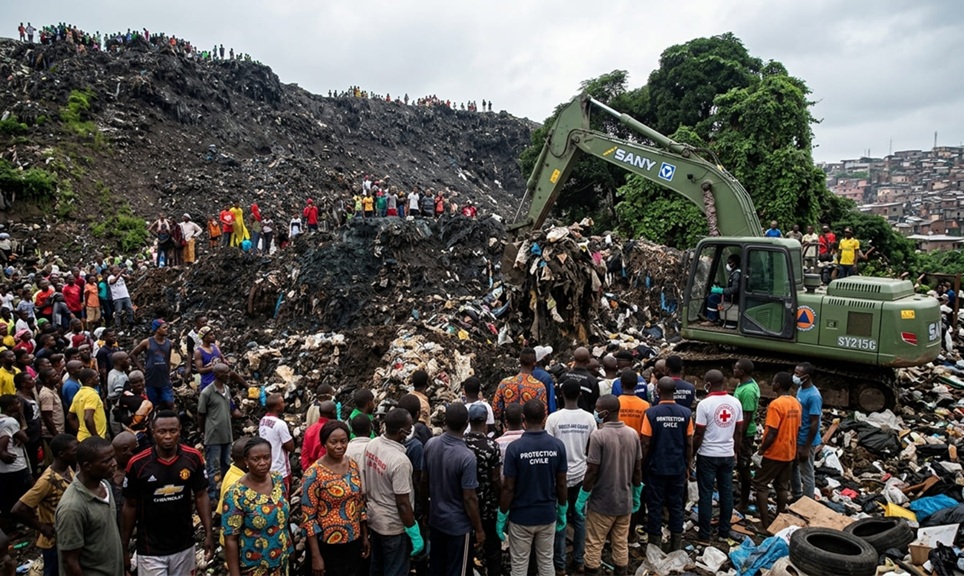
Catholics in Dar-es-Salam, a suburb of Conakry in Guinea’s Gbessia district, will not be celebrating the Season of Creation this year. This annual observance, promoted by Pope Francis and opened this year with a special Mass by Pope Leo XIV at the Laudato Si’ Village in Castel Gandolfo, celebrates the gift of creation. But for the people of Dar-es-Salam, the creation they know today is the devastation of a landslide that struck their neighborhood’s garbage dump after heavy overnight rains. Several people have been buried alive in their homes, and many have sustained serious injuries. Search-and-rescue teams have continued digging through the debris, hoping to find residents.
As excavators work through the garbage, amid tears of pain and anguish, survivors face not only uncertainty about the fate of loved ones still buried in the rubbish, but also the question of relocation since the government intends to demolish what remains of their homes. In an interview with Al Jazeera, one resident put the injustice plainly: the government should remove the rubbish, not the people.
The government should remove the rubbish, not the people.”
Governmental bodies show up in the face of such preventable disasters under the pretext of concern. When Prime Minister Amadou Oury Bah visited the site, he said the government would take all necessary measures “to ensure medical care for the wounded” and “assistance for those affected by this tragedy.” He noted that the site had already been designated for closure. But the truth is starker: the government of Guinea should have addressed this precarious situation years ago instead of ignoring the plight of the less fortunate in its society. Where was the prime minister when the deterioration of social conditions set in, to the point of citizens finding haven atop a dumpster? The same indifference is shown toward others who live on the fringes of the capital, rummaging through waste as “rag pickers” in search of anything recyclable they can sell to survive. For a country with the world’s largest bauxite reserves, along with significant gold, diamond, and iron ore deposits, it is outrageous to imagine the waste, mismanagement, and squandering of public funds. Coups d’état and countercoups have depleted Guinea’s resources to the point that 43.7 percent of Guineans live below the national poverty line, and 52 percent live on less than $3.65 a day, according to the World Bank.
The Dar-es-Salam disaster is, sadly, becoming all too familiar across Africa. On March 11, 2017, when one of the continent’s worst landfill disasters occurred at the Koshe dump in Addis Ababa, Ethiopia, Vijay Kolinjivadi, a reporter for the New Internationalist, captured an image that received strikingly little local or international attention. He warned that while Addis Ababa was rapidly being showcased as Ethiopia’s jewel, several activities within the city were precariously laying a foundation for disaster. He noted that, “… as debt-inducing mega infrastructure projects mushroom around the city to project an outward image of development, the basis of human well-being—such as health, education, housing, sanitation, water supply, nutrition, and human rights—remains among the very poorest in the world. But disaster lurks just beneath the country’s thin decorative veneer of modernism.”
Koshe, like Dar-es-Salam, symbolizes the contradictions of modernity, progress, and development that so many African cities face. It is also a metaphor for the devastation and decay that humans have brought upon the environment, and particularly the world’s poor. Most of the people who lived around Koshe survived by “treasure hunting” in the landfill; some lived amid this toxic filth simply because such an indecent, unsafe, and polluted environment was the only “home” their meager resources could afford. As Girma Seifu, a former member of the Ethiopian parliament, said after the collapse: “The idea that they died buried in dirt, just like they lived in dirt, is heartbreaking.” Perhaps the most heart-wrenching words came from a resident named Hannah, who, pointing to the stench-filled wreckage, said, “This was our home. We don’t know how this could happen. Hopefully, someone can tell us and find a solution for the future.”
Koshe, like Dar-es-Salam, symbolizes the contradictions of modernity, progress, and development that so many African cities face.”
According to the World Bank’s What a Waste 2.0 report, 69 percent of Africa’s solid waste is dumped on open land, in unmanaged landfills, and in canals, and nearly 20 percent of the world’s fifty biggest dumpsites are on the continent. Only 7 percent of Africa’s waste is recycled; the rest is burned or left to accumulate, contributing to climate change through greenhouse gas emissions and exposing millions to serious health risks from scavenging, lead exposure, and black carbon. As the report notes: “When waste is burned, the resulting toxins and particulate matter in the air can cause respiratory and neurological diseases, among others. Piles of waste produce toxic liquid runoff called leachate, which can drain into rivers, groundwater, and soil. Organic waste entering waterways reduces the amount of oxygen available and promotes the growth of harmful organisms.”
As the world celebrates the Season of Creation, the Church in Africa must confront the waste crisis and the painful reality that many of our brothers and sisters live and work on toxic dumpsites. The continent continues to bear the disproportionate burden of pollution, environmental degradation, resource depletion, substandard goods, high-emission secondhand vehicles, toxic waste, and harmful processed foods. E-waste and other hazardous materials shipped from wealthier nations often expose Africans to chemicals and emissions that would not be tolerated in the countries of origin. In oil-rich nations, particularly Nigeria, this environmental injustice is compounded by oil exploration and spills, gas flaring, fracking, and other extractive practices that have devastating consequences for communities and creation.
The continent continues to bear the disproportionate burden of pollution, environmental degradation, resource depletion, substandard goods, high-emission secondhand vehicles, toxic waste, and harmful processed foods.”
Thinking of a comparable site in my own country, Nigeria, and the Olusosun dumpsite in Lagos, spread across one hundred acres and reputed to be the world’s largest, I wonder how African leaders have allowed such places to exist. Olusosun generates millions of dollars for a small circle of businesspeople who export recyclable materials to China, a trade sustained by thousands of young “pickers” exposed daily to health hazards that shorten their lives. According to a 2017 Washington Post investigative report, locals see the dumpsite as a goldmine because it provides jobs for over 4,000 people. But for environmentalists, Olusosun is, like Koshe in Ethiopia, the Kiteezi landfill in Kampala, and the collapsed site in Dar-es-Salam, an unmitigated environmental disaster. As the Post reported: “Africa, the fastest-urbanizing continent, is full of cities struggling to balance their extraordinary growth with sustainable waste management. Every year, improper garbage disposal contributes to devastating epidemics of mosquito-borne malaria, yellow fever, and other potentially fatal diseases. This year, Lagos has had two outbreaks of Lassa fever, a sometimes deadly virus, spread by rodent urine or feces, that has been linked to poor sanitation.”
When I read of Lagos State’s Commissioner for the Environment describing the Olusosun dumpsite as “an eyesore,” and of a Koshe resident who lost his friend and everything he owned saying, “no one cares about us because we are invisible,” I feel the full weight of Pope Francis’s call to “ecological conversion” and to turn away from what he has named “an economy that kills.” Africa marks the Season of Creation this year against the backdrop of a disaster that exposes the power differentials underlying the structural injustice of our ecological crisis. We might also think of Nepal, where people have recently been buried not in garbage but in a mudslide triggered by melting mountain glaciers, a different disaster with the same signature of a warming world. The cry of the earth, and the cry of the thousands of our brothers and sisters who live in and around garbage from Dar-es-Salam to Koshe, from the Zabaleen of Manshiyat Nasser in Cairo to the waste-pickers of Kiteezi in Kampala, calls us to the systemic and structural change that a genuine integral ecology demands: one that benefits everybody, not a privileged few.
The Season of Creation in Africa cannot be only a beautiful and symbolic liturgy. It must become a cry for conversion and action.”
The Season of Creation in Africa cannot be only a beautiful and symbolic liturgy. It must become a cry for conversion and action. Perhaps we should mark it as the Vincentians do in Payatas, Quezon City, in the Philippines, at the dumpsite where creation itself has been crucified and buried, and where our prayer is not simply for creation’s remembrance, but for its resurrection. There, the Season of Creation becomes what it is meant to be: a summons to confront what is killing creation and to collectively work for its resurrection.
