
“Take and Eat”: A Theological Reflection on Same-Mass Reception of the Eucharist and the Meaning of Eucharistic Reservation
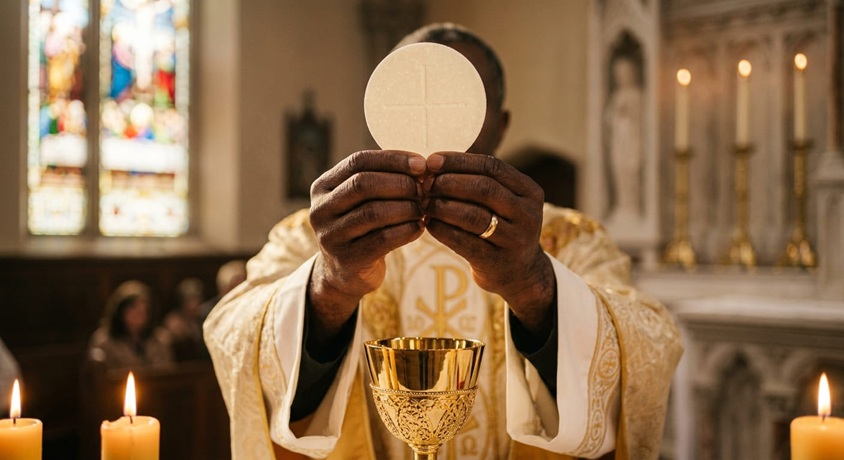
The Holy Eucharist is the heart of the Church’s life. From the earliest Christian communities, believers gathered on the Lord’s Day to listen to the Word of God, celebrate the Eucharistic sacrifice, and receive Christ’s Body and Blood.
The Eucharist was understood not primarily as something to be stored, but as Christ’s living action among his people, offered to the Father and shared as the Bread of Life to nourish the Church.
The Catholic Church has always preserved the Eucharist in the tabernacle with profound reverence and faith. The reservation of the Blessed Sacrament is a precious tradition that enables the faithful to adore Christ present in the Eucharistic species, provides Communion to the sick and dying, and extends the fruits of the Eucharistic celebration beyond the Mass itself.
The tabernacle is therefore a sign of Christ’s abiding presence among his people. As the Catechism of the Catholic Church teaches, “The tabernacle was originally intended for the worthy reservation of the Eucharist outside of Mass” (CCC 1379).
However, we must always understand the tabernacle within the greater mystery of the Eucharistic celebration. Christ instituted the Eucharist not primarily to be preserved but to be celebrated and received. At the Last Supper, Jesus did not say, “Take and adore,” but rather, “Take and eat; this is my body” (Mt 26:26). The Eucharist’s fundamental movement is therefore communion: Christ gives himself so that his people may receive him and become one with him.
Christ instituted the Eucharist not primarily to be preserved but to be celebrated and received.”
The Second Vatican Council recovered this essential understanding by emphasising that the Eucharistic sacrifice is the “source and summit of the Christian life” (Lumen Gentium 11; Sacrosanctum Concilium 10). The Eucharist is the action of the whole Church gathered around Christ, in which the faithful participate fully, consciously, and actively in the mystery being celebrated.
For this reason, the Church encourages the faithful, whenever possible, to receive Holy Communion from hosts consecrated at the same Eucharistic celebration in which they participate. The General Instruction of the Roman Missal states: “It is most desirable that the faithful, just as the Priest himself is bound to do, receive the Lord’s Body from hosts consecrated at the same Mass” (GIRM 85).
This principle expresses an important theological truth: Holy Communion is not an isolated act of receiving a sacred object; it is participation in Christ’s sacrifice offered at that very moment. The faithful receive the Body of Christ who has just been offered for and with them. The communion procession completes the Eucharistic action.
The theological significance of receiving from the same Mass is understood in the unity of sacrifice and banquet. The Eucharist contains both dimensions: Christ offers himself to the Father and gives himself to his people. The altar and the table are inseparable. The Church gathers around the altar to participate in Christ’s sacrifice and then receives its fruits in Holy Communion.
The altar and the table are inseparable.”
Saint Augustine beautifully expressed this mystery when he told the faithful: “Behold what you are, and become what you receive” (Sermon 272). For Augustine, receiving the Eucharist is not merely receiving Christ as an individual; it is being transformed into the Body of Christ, the Church.
The Eucharistic celebration fosters communion among believers because they receive from Christ’s one sacrifice. The practice of always distributing hosts reserved in the tabernacle, even when the faithful are participating in a new Eucharistic celebration, can sometimes weaken this important theological connection between the sacrifice being celebrated and the Communion being received. It may unintentionally suggest that the Eucharist is simply something already completed and stored, rather than the living action of Christ occurring in the present celebration.
The Church therefore encourages a proper balance. The tabernacle remains a place of profound reverence because Christ is truly present there. The reservation of the Blessed Sacrament enables the Church to bring Communion to those unable to attend Mass, especially the sick and the dying. It also gives the faithful a place to come before the Eucharistic Lord in prayer and adoration.
Nevertheless, Eucharistic adoration must always lead back to Eucharistic celebration, because the Mass is the source from which the Church’s Eucharistic life flows. Pope Benedict XVI explained this relationship clearly: “The act of adoration outside Mass prolongs and intensifies all that takes place during the liturgical celebration itself” (Sacramentum Caritatis, 66).
The tabernacle is therefore not a substitute for the altar. The reserved Eucharist points back to the Eucharistic sacrifice from which it comes. The celebration of Mass remains the primary context in which the Eucharistic mystery reaches its fullest expression.
The tabernacle is therefore not a substitute for the altar. The reserved Eucharist points back to the Eucharistic sacrifice from which it comes.”
This theological understanding also raises an important pastoral question: should the Church continue to distribute older reserved hosts when fresh hosts have been consecrated at the same Mass? The answer must respect both liturgical theology and pastoral reality.
The ordinary preference of the Church is that the faithful receive from hosts consecrated at the Mass they are attending. Older hosts reserved in the tabernacle should be used appropriately, especially for Communion to the sick, emergencies, or when pastoral circumstances require it. They should never be treated as though they are inferior, because Christ is truly present in every validly consecrated Eucharistic species.
However, the Eucharistic mystery also teaches the importance of avoiding unnecessary accumulation of consecrated hosts. The reservation of the Blessed Sacrament is ordered to a purpose: communion for those unable to attend Mass and Eucharistic devotion. It is not intended to create a situation in which large quantities of hosts are stored indefinitely without pastoral necessity.
The Eucharistic Lord deserves not only reverence but also reception. Christ’s words remain the foundation of Eucharistic spirituality: “Take and eat.” The Eucharist is given as food. Food is not merely displayed; it is received. The mystery of Christ’s self-giving reaches its purpose when his people are nourished and transformed by him.
Saint Thomas Aquinas reflects this reality in his Eucharistic theology by emphasising that the sacrament’s principal effect is communion with Christ. The Eucharist is ordered toward the union of the faithful with Christ, because the sacrament is not only Christ’s presence among us but also Christ’s gift to us.
The Church must therefore preserve a healthy Eucharistic balance: deep reverence for Christ reserved in the tabernacle and a renewed appreciation for receiving Communion from the Eucharistic sacrifice being celebrated. The tabernacle invites us to adore the Christ who remains with his Church; the altar invites us to participate in the sacrifice through which Christ gives himself.
The faithful should be taught that the Eucharist is not merely something kept but someone encountered; not merely something preserved but someone received; not only something adored but someone who transforms the Church into his Body.”
For priests and pastoral ministers, this requires careful Eucharistic formation. The faithful should be taught that the Eucharist is not merely something kept but someone encountered; not merely something preserved but someone received; not only something adored but someone who transforms the Church into his Body.
The renewal of Eucharistic practice calls the Church back to Christ’s words at the Last Supper: “Take and eat.” These words reveal the Eucharist’s deepest intention. Christ does not give himself to remain distant from humanity but to enter into communion with his people.
Therefore, while the tabernacle remains a sacred place of Christ’s abiding presence, the Eucharistic celebration remains the privileged moment in which the Church receives the gift Christ offers. Whenever possible, the faithful should receive from the hosts consecrated at the Mass in which they participate, because this expresses most fully the unity between Christ’s sacrifice, the Church’s communion, and the mission of the Eucharistic people.
