
When the Headlines Fade, the Mission Remains

If one member suffers, all suffer together.
When news breaks of an Ebola outbreak, an earthquake, flooding, or famine, our attention naturally turns to the immediate emergency. We pray for those affected. Governments mobilize resources. Healthcare workers place themselves on the front lines. Humanitarian organizations respond with remarkable courage.
Yet when the headlines fade and the cameras move on, the Church remains.
Children still need to go to school. Parents still need to earn a living. Young people still need opportunities to build a future. Communities still need hope.
In fact, epidemics and natural disasters often deepen the very conditions that make people vulnerable in the first place. Poverty becomes more severe. Families lose their livelihoods. Education is interrupted. Access to healthcare becomes more difficult. As desperation grows, so too does the risk of exploitation, including human trafficking and other forms of abuse.
This is why the Church’s mission cannot end when the emergency subsides.
Catholic Social Teaching reminds us that we are one human family. The principle of Solidarity calls us not only to respond to crises but to accompany one another through them and beyond them. We are called to restore not only health, but dignity; not only lives, but hope.
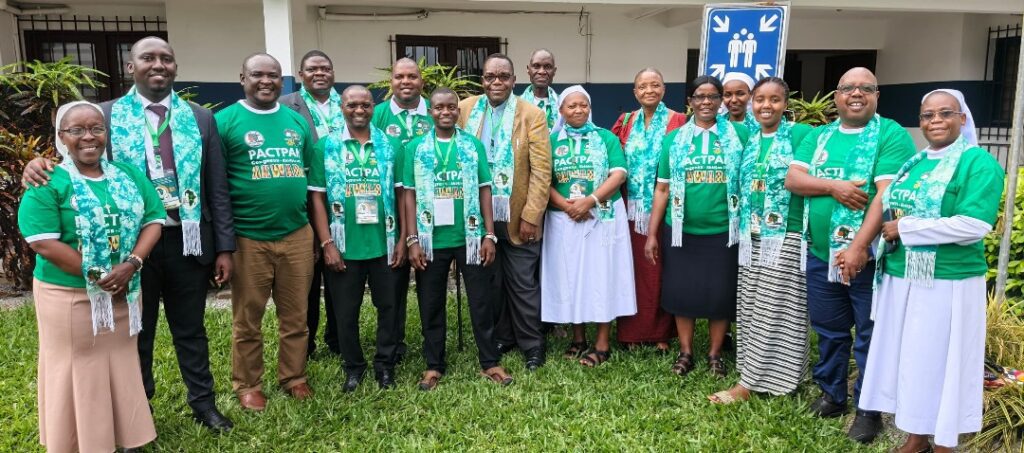
When I began writing this month’s reflection, I wanted to understand what life looked like beyond the headlines. Rather than relying solely on international news reports, I reached out to Davis Ampereza, who coordinates PACTPAN’s work in Uganda.
His response reminded me that while the world often focuses on the crisis itself, the real work begins after the headlines.
Following the confirmation of Ebola outbreaks in the Democratic Republic of the Congo and Uganda, governments, healthcare providers, and the Church responded quickly to contain the spread of the disease and protect vulnerable communities.
Working through PACTPAN’s Health and Healing Unit, Davis helped coordinate a webinar that brought together healthcare professionals and frontline medical workers caring for Ebola patients. Rather than relying only on statistics or media coverage, participants heard firsthand accounts from those responding to the outbreak, learned practical prevention measures, and explored how faith communities could support public health efforts.
The webinar was exceptionally well received. Participants expressed gratitude for the practical information, the honest conversations from those on the front lines, and the opportunity to better understand how they could protect their communities while standing in solidarity with those most affected.
Education has always been one of the Church’s most powerful ministries. Accurate information not only saves lives—it calms fears, dispels misinformation, and enables communities to care for one another with confidence and compassion.
But PACTPAN’s work did not end with the webinar.
Listening to Davis, I realized something profound. It would have been easy to pause every other ministry until the Ebola outbreak was over. Instead, PACTPAN continued investing in young people. Because hunger does not wait for epidemics to end. Poverty does not pause during a public health emergency. Young people still need opportunities. Families still need hope.
In Uganda, one such initiative is our Youth Skilling Program in Bakery and Pastry, where young adults are learning practical vocational skills that provide confidence, income, and hope.
At first glance, a bakery program may seem unrelated to an Ebola outbreak. In reality, they are deeply connected.
Communities recover not only when the disease is contained but when families regain stability, young people can find meaningful work, and vulnerability to exploitation is reduced. Every young person who gains employable skills becomes less susceptible to trafficking, more capable of supporting a family, and better equipped to strengthen their community in times of crisis.
In many ways, this is what accompaniment looks like. We respond to the crisis before us while never losing sight of the people who will still be there after the crisis has passed.
Davis also shared another encouraging milestone. PACTPAN Uganda is in the final stages of registering its national chapter. This important step will strengthen our ability to serve local communities, build partnerships, and expand programs that respond to both immediate needs and long-term challenges.
When Jesus called His first disciples, He met them in the middle of their ordinary work and invited them into something greater:
“Follow me, and I will make you fishers of people.” (Matthew 4:19)
He transformed their daily work into a lifelong mission of bringing hope to others.
That invitation continues today.
Some of us are called to care for the sick. Others educate young people, advocate for justice, mentor future leaders, pray faithfully, volunteer our time, or support the mission through generous giving. Each vocation is a different way of casting Christ’s net into the world.
At PACTPAN, we believe every act of accompaniment matters.
Every community educated.
Every healthcare worker encouraged.
Every young person equipped with new skills.
Every life protected from exploitation.
Every donor who chooses to stand with us.
Together, these become signs of God’s healing presence in our world.
The headlines will fade.
The cameras will leave.
The emergency will eventually pass.
But Christ’s call to accompany one another remains.
Thank you for walking alongside PACTPAN as we continue responding to today’s needs while helping communities across Africa build a future rooted in dignity, hope, and opportunity.
Because when the headlines fade… the mission remains.
Pam Matambanadzo
Friends of PactPAN Board Member

Join the conversation