
When the Sacred Becomes a Playground
A few weeks ago, after hours of study, I stepped out for a walk around our cottage on a beautiful morning. The path led me to a nearby Buddhist monastery in Val-des-Monts, Quebec. At its entrance stood statues of the Buddha and bodhisattvas.
While I contemplated the beauty of this sacred garden, an idea slowly crept into my mind: every religious tradition bears testimony to the sacred in its own distinctive way. A visit to a temple, church, synagogue or shrine reveals how each tradition interprets the manifestation of the divine.
Yet no single tradition exhausts the depths of the religious experience of entire humanity. Sometimes, we must cross over to another milieu and stand before the sacred images of another tradition to recognize something that has always been present, though perhaps neglected, within our own.
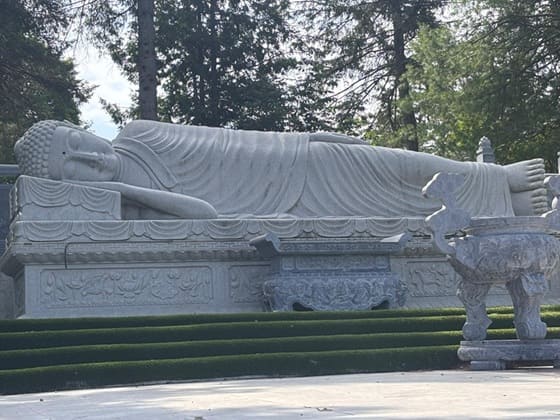
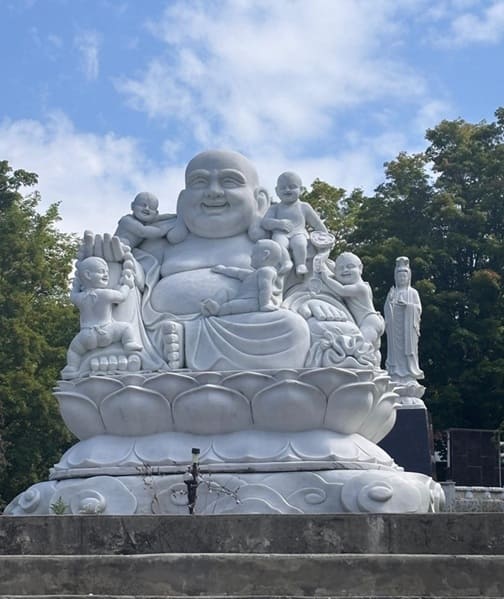
Among the statues scattered across the monastery grounds in Val-des-Monts, two held my attention. One showed the reclining Buddha resting peacefully at the end of his earthly life. The other depicted a large-bellied, laughing figure surrounded by children.
At first, the two scenes seemed to contradict each other, for while one was still and solemn, the other was noisy and playful. One suggested a sacredness capable of receiving life’s ending; the other, a sacredness open to its noise, movement and new beginnings.
The reclining figure appears to represent Śākyamuni—Siddhartha Gautama, the historical Buddha—approaching parinirvana. He lies peacefully on his right side, his hand gently supporting his head. His face is composed, almost meditative. His elongated body is relaxed, and his robes fall quietly around him. There is no visible struggle; his robe is not ruffled, and there is no sign of fear in his face.
In Buddhism, parinirvana is not simply death, nor is it a passage from this world into another in the Christian sense of resurrection. It is the final nirvana of one who has already attained enlightenment: complete liberation from attachment, suffering and the continuing cycle of death and rebirth.
Then there was the other curious statue.
It was the smiling, large-bellied statue of Budai, the cheerful Chinese monk popularly known as the Laughing Buddha and later associated with Maitreya, the Buddha of the future. Historically, Budai and Maitreya were not originally the same figure. Over time, however, Budai, a tenth-century Chinese Chan monk, came to be regarded as a manifestation of Maitreya, the bodhisattva expected to become the Buddha of a future age, when the Dharma has faded and must be renewed.
But what drew my attention was neither his large belly nor his enormous smile, but the children.
They climbed all over him, with some sitting on his shoulders, while others touched his belly, leaned against him, or pulled at the objects in his hands. Yet he neither pushed them away nor appeared disturbed by their noise. This holy figure had allowed himself to become their playground.
What an image!
This holy figure had allowed himself to become their playground”
For a long time, many outsiders have imagined Buddhism simply as a religion of silent meditation, withdrawn monks, and detachment from the world. Yet this image suggests something more: holiness is not necessarily an escape from life. It can also mean being fully present within it—welcoming, accessible, and capable of laughter.
Budai—associated in the Buddhist imagination with the future Buddha—is surrounded not by rulers, religious dignitaries, or guardians of orthodoxy, but by children.
Perhaps that is where the future begins.
As I continued contemplating the scene of children climbing over Budai, I remembered a story about Saint Francis of Assisi. Francis was preparing to pray and reportedly instructed his brothers not to interrupt him, no matter who came—a king, a ruler, or anyone else. Then, after a second thought, he reportedly added that if a child came, the brothers should let him know.
Whether or not the story can be traced directly to Francis, it expresses something profoundly Franciscan: no prayer that closes its ears to life can claim to bring us closer to the God of life.
It also resonates with the Gospel.
In the Gospel of Mark, with parallels in Matthew and Luke, people bring children to Jesus so that he might touch them. The disciples rebuke them, perhaps thinking that the children are disturbing him. But Jesus becomes indignant.
“Let the little children come to me; do not stop them,” he told the disciples. Then he took them into his arms, laid his hands upon them, and blessed them (Mark 10:13–16; see also Matthew 19:13–15 and Luke 18:15–17).
He went even further: “Whoever does not receive the kingdom of God as a little child will never enter it.” For him, a child was no longer simply someone to be admitted into sacred space. The child became the teacher through whom adults must learn how to enter it.
The child was no longer simply someone to be admitted into sacred space. The child became the teacher through whom adults must learn how to enter it”
The scene is remarkably close to what I encountered in Val-des-Monts: two different traditions—Budai, traditionally associated with Maitreya, surrounded by children, and Jesus taking children into his arms—yet one unsettling question:
What kind of holiness are we building if children are afraid to approach it?
As I admired the serenity of the garden, I pictured an evening that could unfold in many African communities.
It might be under a tree, in a family courtyard, beside a church or around an evening fire. Adults talk while children play freely around them. A mother prepares food. A grandfather tells stories of earlier generations.
Some children gather close to listen; others, too restless to remain in one place, continue their games. Yet even those who appear distracted are listening. Through stories, gestures, laughter and silence, they learn the relationships and memories through which the community understands itself.
The details differ from one African culture to another, but the sacred is not always separated from ordinary life. A courtyard can become a place of prayer. A family meal can become a sign of communion. A story told by an elder can bind the living to those who came before them. Children do not have to abandon their play before entering this sacred world. Their laughter, movement and curiosity already belong within it.
The children surrounding Budai helped me recognize this truth: holiness does not always announce itself by withdrawing from ordinary life. Sometimes, it sits in the middle of the courtyard and allows life to gather around it.
Yet nearness to the sacred must also mean safety. Children welcomed into sacred spaces must be protected there. A religious community cannot claim to welcome children while shielding those who harm them. If holiness allows children to come near, it must make their dignity and protection non-negotiable.
Only then can the sacred truly become a playground—not a place without boundaries, but a place where trust makes freedom, wonder and joy possible.
Perhaps the child is not interrupting the sacred but is revealing it.
