
THUS SAYS ART
An Artist’s Creed
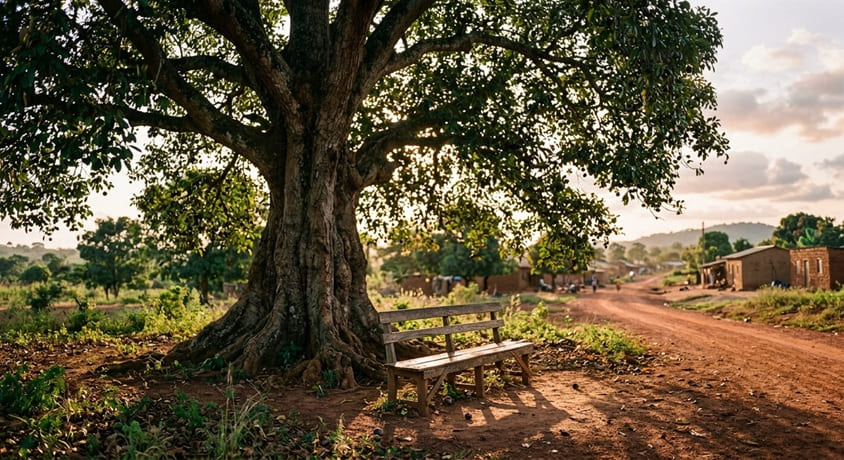
At first light,
a woman sweeps the red dust
from the front of her shop.
By noon, the dust will return.
She knows.
Still, she sweeps.
Perhaps art begins here:
not in applause,
but in the care we give
to what will not remain.
Thus says Art:
Observe.
Hurry is always
leaving someone behind:
the face at the edge
of the gathering,
the hand passing food
before filling its own plate,
the chair no one has moved
since its owner died.
Ponder.
Stay where the easy answer ends.
Not every silence is empty.
Not every wound
wants to become a lesson.
Some things ask only
that we sit beside them
without turning away.
Imagine.
Make room for what
has not yet found a name,
for the life waiting beyond
what fear has called impossible.
Remember.
No river begins with you.
Name the wells
from which you drank,
the hands that steadied yours,
the ancestors whose unfinished songs
still breathe inside your own.
Practice.
Return when inspiration does not.
The hand learns
what longing alone cannot teach.
Risk.
Do not polish the truth
until no one recognizes it.
Let the work carry
the scar of its honesty.
Protect.
Every story belongs first
to the life that bore it.
Another person’s wound
is not your stage.
Come near
with reverence.
Transform.
Receive what came before you.
Learn its weight
in your hands.
Carry it farther—
but do not erase
the fingerprints.
Release.
Open your hand.
The work cannot meet the world
while you are still clutching it.
Let it go.
Begin again.
And again.
Above all,
remain astonished.
Look again at what others
have learned not to see:
the market woman rebuilding
her fallen pyramid of tomatoes,
one bruised fruit
set gently aside;
the child on the red-earth road,
guiding a bicycle rim
with a crooked stick,
laughing each time
the wheel nearly falls;
the nurse at the end of her shift,
resting her forehead
against a closed door
before going home
to be strong for someone else;
the old man beneath the udala tree,
beginning a story
everyone thinks they know,
still hoping someone will stay
until the end;
the bird crossing an ordinary sky
as though no bird
had ever flown before.
Listen again to what the world
has grown too noisy to hear:
pestle meeting mortar
before sunrise;
a bus conductor
striking coin against metal,
calling one more passenger
into the day;
a church bell
and the muezzin’s voice
crossing above
the same awakening roofs;
the generator falling silent
in the middle of a story,
and someone in the darkness saying,
Continue. I am listening.
Perhaps this is what the artist knows:
a face is not scenery.
A wound is not material.
A life does not become small
because the world
has failed to notice it.
The artist is not called
to make ordinary life impressive,
but to keep the person inside it
from disappearing—
to see the overlooked,
hear the unspoken,
remember the forgotten,
and give form
to what might otherwise
leave no trace.
Thus says Art:
Look again.
Come near.
Stay until
the human being appears.
Tomorrow, at first light,
the woman will sweep
the red dust again.
The dust will return.
So will she.
Broom in hand,
she will make a small clearing
before her door.
And there—
where nothing
was meant to last—
the morning light will find
what care
has made visible.
