
What Direction Is Your Life Turning?
A Sunward Journey Toward Wholeness
Most people do not lose their lives all at once.
They lose their direction first.
The change is usually quiet. The house is still standing. The work gets done. The children are cared for. Sunday Mass remains part of the week. From the outside, life appears intact.
Yet something within us no longer feels at home.
It rarely begins with catastrophe. More often, it begins with small departures that seem harmless at the time: a grief we never faced, a friendship surrendered to busyness, a dream postponed until we forgot it had once been ours, a prayer still spoken but no longer expected to change anything.
We continue showing up for our lives while, little by little, ceasing to be fully present within them.
For many years as a hospital chaplain, I learned that the deepest questions people carry are seldom the first ones they ask.
Patients wanted to understand the diagnosis. Families searched the faces of physicians for some sign of hope. Treatment plans were discussed, risks explained, decisions weighed.
Then the room would grow quiet.
And beneath all the medical questions, another question would often appear:
Will my life still make sense after this?
Illness did not create that question. It uncovered it.
I sat beside people whose achievements filled résumés but whose suffering revealed a deeper unease. Success had given them recognition, but not always direction. I met devoted parents who had spent years caring for everyone else and had slowly become strangers to their own hearts. I listened to faithful Christians who still prayed, worshipped, and served, yet privately wondered why God seemed so far away.
Their circumstances were different.
Their longing was not.
We are often too quick to name such experiences as stress, burnout, or exhaustion. Sometimes that is exactly what they are. But sometimes something more serious is taking place.
We rarely lose ourselves through one dramatic decision.
We drift through a thousand ordinary ones.
One neglected relationship.
One truth left unspoken.
One compromise we promised would be temporary.
One sorrow we kept postponing.
Until, perhaps on a silent drive home, a question rises with unexpected force:
What direction is my life turning?
This may be the more important question.
Not merely, What have I accomplished?
Not, How successful do I appear?
But, What kind of person am I becoming?
Direction shapes a life, long before the destination becomes visible.
Jesus understood this.
When He called His first disciples, He did not begin with an explanation of everything that lay ahead. He did not offer them a complete map.
He said simply:
Follow me.
His invitation was not first about understanding.
It was about turning.
Before discipleship becomes a way of thinking, it becomes a way of facing.
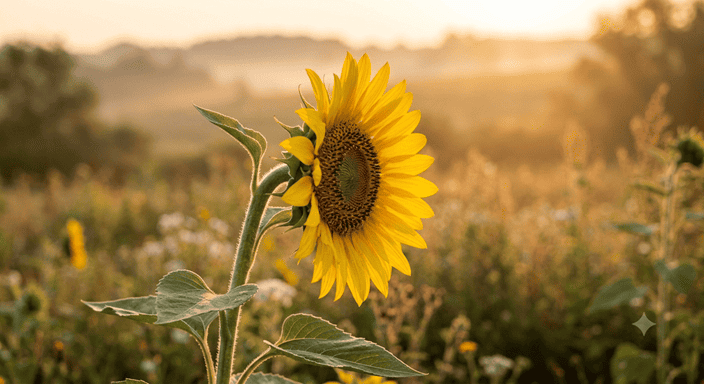
The sunflower has long seemed to me a fitting image of this human vocation.
The sunflower does not create the light. It cannot hurry the dawn or shorten the night. It simply turns toward the source of life.
Human beings were made to do the same.
Every day, our lives turn toward something.
Toward fear or trust.
Toward resentment or forgiveness.
Toward control or surrender.
Toward recognition or love.
Toward ourselves or toward God.
Over time, we become shaped by what we repeatedly turn toward.
Long before I served in hospitals, I was formed in Africa, where becoming a person was never understood as a solitary achievement.
A child belonged not only to parents, but also to grandparents, neighbors, teachers, catechists, elders, and the wider community. These people did more than help carry life’s burdens. They helped give life direction.
There was usually someone to remind you who you were becoming when you were tempted to forget. Before we achieved anything, we belonged. Before we succeeded, we were known. Character was formed through shared responsibility, correction, example, memory, and love.
This remains one of Africa’s enduring gifts to the modern world.
It reminds us that identity is not simply invented within the self. It is also received through relationships that summon us beyond ourselves.
Modern life has enlarged human freedom in remarkable ways. It has also introduced new forms of solitude. We can speak across continents in seconds, yet many people carry alone the questions that communities once helped them carry and interpret.
Perhaps this is one reason so many people now possess more choices than previous generations and yet feel less certain about what their lives are for.
Public health taught me that illness is never merely biological. It is shaped by relationships, environments, institutions, opportunities, exclusions, and the conditions in which people live.
Human flourishing is formed in much the same way.
Hope, trust, belonging, dignity, and compassion are not merely private possessions. They are strengthened or weakened within families, workplaces, neighbourhoods, churches, hospitals, schools, and societies.
A healthy society is not simply one that treats disease well.
A healthy society is one that helps its people become more fully human.
Our deepest crisis, may not be a shortage of information.
It may be a loss of orientation.
The oldest human questions remain with us:
Who am I?
To whom do I belong?
What kind of person am I becoming?
No technology can answer these questions for us. Neither wealth nor achievement can settle them.
They are answered, slowly, by the direction in which we give our lives.
The good news is that we do not have to repair everything before we begin again.
Pilgrimages rarely begin with certainty.
They begin with one honest step.
One truthful conversation.
One act of forgiveness.
One prayer whispered when words are difficult.
One decision to stop pretending that everything is fine.
Grace seldom arrives with applause.
It comes quietly, patiently, often before we recognize it.
Long before our circumstances change, God begins to change the direction of our hearts.
Perhaps this is what conversion has always meant.
Not becoming someone else.
Not escaping our history.
But turning again toward the One who has never turned away from us.
Saint Paul writes that in Christ “all things hold together” (Colossians 1:17).
These words are not only a statement about the created order. They raise a deeply personal question:
Who stands at the center of my life?
Every heart has a center.
Every life has a true north.
Whatever occupies that place quietly orders everything else.
Christian conversion is not simply adopting better habits or becoming more religious. It is allowing Christ to become the One around whom our ambitions, relationships, wounds, loyalties, hopes, and decisions find their rightful place.
The Resurrection reveals what this can mean.
The risen Christ still bears His wounds.
They have not disappeared.
They have been transformed.
They no longer speak only of violence and defeat. They testify to a love stronger than death.
The same grace is offered to us.
Our wounds need not become the final word over our lives. By God’s mercy, they may become the places where compassion deepens, pride loosens its grip, and hope becomes credible again.
This is why the Church remains indispensable.
At her best, she is not merely an institution that preserves doctrine. She is a people learning to accompany one another toward Christ.
Every Eucharist gathers strangers around one table.
Every confession reminds us that failure is not our deepest name.
Every baptism declares that we belong before we achieve.
Every act of mercy points another person toward home.
That ministry reaches far beyond church walls.
It appears when a nurse remains a little longer beside a frightened patient.
When an adult child finally asks an ageing parent the questions postponed for years.
When a friend listens without rushing to explain another person’s pain.
When a neighbour notices the person who has quietly disappeared behind a practiced smile.
When a family chooses reconciliation over resentment.
Such moments rarely make headlines.
Yet they often become the turning points by which a life finds its way again.
Perhaps we have misunderstood what it means to flourish.
We often imagine flourishing as becoming more accomplished, more admired, more secure, or more impressive.
The Gospel offers another vision.
Human flourishing is not found in becoming extraordinary.
It is found in becoming faithful to the One who calls us toward life.
That is the invitation at the heart of Sunward.
Not to invent a new self.
Not to erase the past.
Not to deny suffering.
But to recover what is essential, receive the grace already offered, and keep turning toward the Light that has never stopped seeking us.
Every life turns toward something.
The question is whether it turns toward what gives life
or toward what quietly diminishes it.
The Light has never stopped seeking us.
Our task is to keep turning toward it.

2 comments
Très beau. Thank you Fr
‘A child belonged not only to parents, but also to grandparents, neighbors, teachers, catechists, elders, and the wider community. These people did more than help carry life’s burdens. They helped give life direction…..This remains one of Africa’s enduring gifts to the modern world’ A good guide in the making of a healthy society.
Thanking you Rev Dr Barry.