
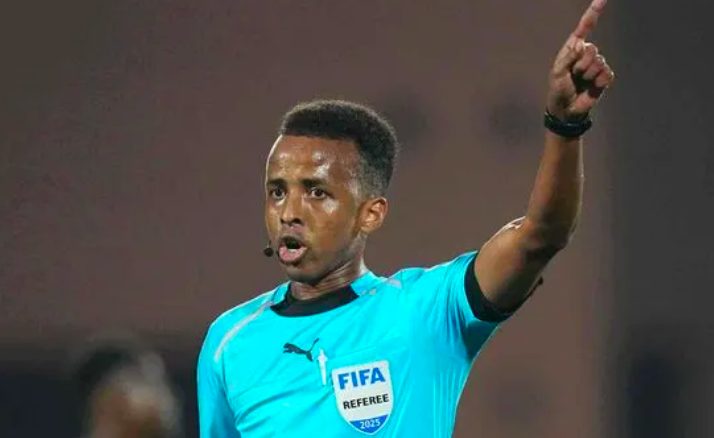
As the world gathers to celebrate the beautiful game at the 2026 FIFA World Cup, a troubling story reminds us that not everyone is invited equally to the global table. Omar Abdulkadir Artan, the first Somali referee ever selected to officiate at a FIFA World Cup, was denied entry into the United States despite holding a valid visa and despite being officially appointed by FIFA to participate in the tournament. After arriving in Miami, he was declared inadmissible due to unspecified “vetting concerns” and sent back, ending what would have been a historic moment not only for him, but also for Somalia and the entire African continent.
FIFA’s acquiescence to this denial, justified by the familiar claim that it respects the immigration laws and decisions of the host country, is deeply troubling. It is particularly shocking because FIFA’s “Kick Out Racism” campaign was created to combat precisely the kinds of discriminatory attitudes, policies, and practices that appear to have been at work in the treatment meted out to Referee Omar. While every nation has the right to secure its borders, it is difficult to understand how a widely traveled, internationally recognized, and officially accredited FIFA referee could suddenly be subject to unspecified “vetting concerns” upon arrival.
Equally disturbing is the silence of the Confederation of African Football (CAF) and much of the African leadership. Such silence is unacceptable. If Africa cannot speak with one voice when one of its most accomplished sporting ambassadors is publicly humiliated on the global stage, then when will it speak? This is about more than football. It is about dignity, fairness, and the equal treatment of all peoples in a world that too often preaches inclusion while practicing exclusion.
I cannot conjugate the language of equality with the grammar of exclusion; I cannot conjugate the promise of universal human rights with the lived experience of selective suspicion.
Perhaps what is most disturbing is not only this shocking denial, nor the condescending opacity of the U.S. government’s purported “vetting concerns” about a widely traveled and highly decorated African referee, but also the absence of the outrage, questioning, and moral scrutiny that would surely have followed had the same indignity been visited upon someone from a more powerful nation. Perhaps what troubles me most is that, as an African who longs for a world in which every human being is treated with equal dignity, I find myself unable to conjugate this reality. I cannot conjugate the language of equality with the grammar of exclusion; I cannot conjugate the promise of universal human rights with the lived experience of selective suspicion; I cannot conjugate our shared humanity with an injustice that appears to judge a person not by his character, achievements, or integrity, but by the passport he carries, the color of his skin, his nationality, religion, gender or sex and other socially constructed hierarchies that assign labels of recognition, and erasure while denying agency and access based on them.
For many people in wealthy and powerful nations, a passport is merely a travel document. For millions in Africa and other parts of the Global South, a passport often becomes a measure of human worth. The accident of birth determines who can move freely across borders and who must constantly prove their innocence before being allowed to enter spaces that proclaim themselves global and inclusive.
For millions in Africa and other parts of the Global South, a passport often becomes a measure of human worth.
What makes this story particularly painful is that Omar Artan’s journey represented more than just football. Born in a country that has endured decades of conflict, instability, and international stereotyping, he rose through determination, discipline, and excellence to become one of Africa’s most respected referees and the 2025 CAF Best Male Referee. He was selected on merit, not charity. He earned his place. Yet at the decisive moment, his nationality appears to have mattered more than his accomplishments. I do not think that is simply a story about immigration policy. There is more to it. Every nation has the right to secure its borders. But this sad event is a story about the human consequences of systems that often judge entire peoples by the circumstances of their countries rather than by their individual character and achievements.
We live in a world that celebrates diversity in speeches, conferences, and sporting events. But true inclusion is tested not by our slogans but by our willingness to welcome the stranger, recognize excellence wherever it is found, and resist the temptation to reduce human beings to externally assigned, polluting categories of risk.
As an African, I cannot help but see in Omar Artan’s experience the story of countless Africans whose talents are often overshadowed by assumptions attached to their nationality, race, or passport. We ask our young people to dream big, work hard, and compete globally. But stories like this send a different message: that even when you do everything right, some doors may still remain closed. I hope that one day Omar Artan will stand on the world’s biggest football stage. More importantly, I hope we build a world where a young person from Mogadishu, Lagos, Kinshasa, Nairobi, Soweto, or Accra is first seen for their gifts and achievements, not for the stereotypes attached to their passport. Indeed, I believe that the measure of our humanity is not how we treat the powerful and privileged. It is how we treat everyone, especially those who arrive at our borders and doors carrying nothing but their dreams and hope for a better tomorrow.
We ask our young people to dream big, work hard, and compete globally. But stories like this send a different message: that even when you do everything right, some doors may still remain closed.
But Africans cannot simply fold their hands and allow the humiliation of our continent to continue in this way. The discriminatory treatment meted out to Referee Omar Abdulkadir Artan is not directed only at one man. It is directed at what he represents: Africa. It is directed at the dignity of a continent whose sons and daughters continue to be judged not by their achievements, character, or contributions to the common good, but by the passports they carry and the stereotypes attached to their countries of origin. This decision deserves strong condemnation. African governments, regional organizations, sporting bodies, and civil society groups should take measured but meaningful steps to compel the United States government to reconsider this decision and to explain, transparently and publicly, the nature of these alleged “vetting concerns.” Silence in the face of indignity only emboldens those who believe that Africans can be treated differently without consequence.
Sadly, given the current state of our continent, our fragmented politics, and our often limited capacity for collective action in defense of our common dignity, this may become yet another lost opportunity. We have become accustomed to absorbing insult after insult, visa restriction after visa restriction, humiliation after humiliation, while speaking eloquently about African unity but rarely acting in concert to defend African interests.
History teaches us that collective action can be a powerful moral force. In 1966, virtually the entire African continent boycotted the FIFA World Cup qualifiers after FIFA allocated only one qualifying place for Africa, Asia, and Oceania combined, effectively denying African nations a fair opportunity to compete on the world stage. African leaders and football associations refused to accept a system that treated their nations as second-class participants in the global game. Their boycott succeeded. By 1970, Africa had secured its own guaranteed place in the World Cup.
Likewise, in 1980, the United States led more than sixty nations in boycotting the Moscow Olympic Games to protest the Soviet invasion of Afghanistan. Whether one agreed with that decision or not, it demonstrated that nations can use collective action and international sporting events to make a moral and political statement when they believe fundamental principles have been violated. Why then should Africa remain silent when one of its most accomplished sporting ambassadors is denied entry into a tournament to which he was officially appointed by FIFA? Why should we not ask difficult questions when a widely traveled, internationally respected, and award-winning referee is suddenly deemed inadmissible despite possessing the necessary documentation?
The time has come for Africa to stand up against the unrelenting pattern of discriminatory treatment directed at people of African descent across many parts of the world. This is not merely about Omar Artan. It is about all of us. For there is something of Omar Artan in me as an African. There is something of him in every African who has ever stood in a visa line, wondering whether their humanity would be weighed against the passport they carry. There is something of him in every African scholar, entrepreneur, athlete, missionary, priest, student, diplomat, and professional who has had to work twice as hard to prove that they belong in spaces where others are welcomed without question.
There is something of Omar Artan in every African who has ever stood in a visa line, wondering whether their humanity would be weighed against the passport they carry.
And it is that something—beautiful, noble, resilient, and great—that appears once again to have been treated with suspicion. Not because of any demonstrated wrongdoing. Not because of any credible security threat. But because, for too many people, African identity itself remains burdened by assumptions that would never be applied to others.

1 comment
I am so impressed with the authencity of this write up. Bravo to us and to you Padre and Prof. We need to be a voice for the voiceless… We can’t keep compromising any thing that goes against humanity in anyway…