
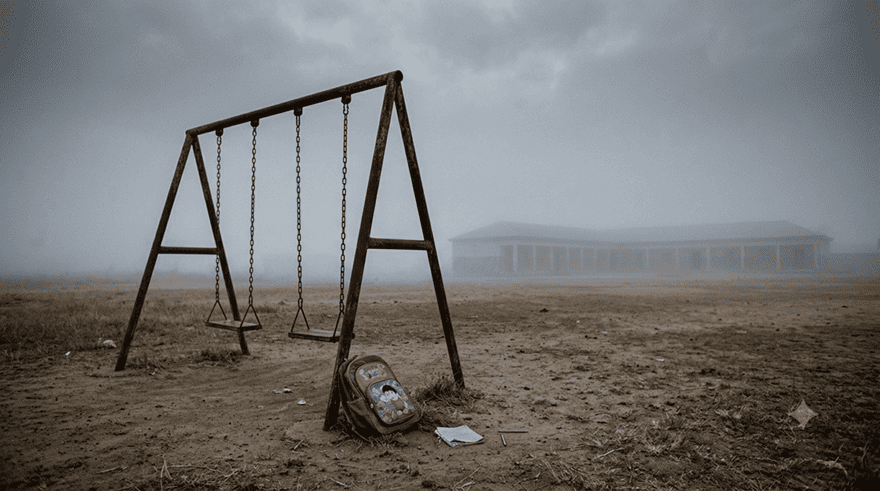
When you think Nigeria is getting better, you hear a new story that sends chills into your bones. Whether it is terrorists ravaging a city or bandits kidnapping citizens from schools, hardly a week passes without a headline casting Nigeria in a dark shadow, slowly slipping into a nightmare. The recurrent mass school kidnappings in Nigeria have exposed a deeper and more systemic failure within the country’s counter-terrorism framework.
Recent figures demonstrate just how deeply this crisis has penetrated everyday life, particularly for children, families, and faith communities. Between January and May 2026, kidnappings intensified dramatically, posing an existential threat to citizens. While communities in Kaduna and Ngoshe, Borno State, watched 166 worshippers and 400 civilians respectively disappear into captivity, schools in Borno and Oyo States witnessed the abduction of 42 pupils each, along with several educators in Oyo.
According to a civil society group, 81 children remained in captivity as of May 2026. At the same time, Amnesty International reported that at least 1,100 people—most of them children—were abducted between January and April 2026.
When you think Nigeria is getting better, you hear a new story that sends chills into your bones.
A Situation Weaponized and a Fate Trapped Between Politics and Propaganda
Nigeria has a very bad precedence, security wise, but the weaponization of mass abduction of pupils for political gain began with the watershed crisis of the Chibok girls. This was on April 14, 2014, when Boko Haram invaded a secondary school and abducted 276 schoolgirls, sparking global condemnation. Since then, the fate of Nigerian schoolchildren has hung precariously in the balance as the kidnapping of school children became a signature not only for Boko Haram and ISWAP, but also for decentralized bandits and armed groups.
Unfortunately, what could have been a unifying catalyst against terror has consistently been weaponized for political advantage, silencing innocent voices within a maze of bitter politics and propaganda. In 2014, for instance, the opposition All Progressives Congress (APC) used the kidnapping of the Chibok girls as an instrument of campaign and propaganda against the then-ruling government, rather than fostering a unified front to ensure their release.
Decades later, this political mindset remains deeply entrenched. Following the series of kidnappings in Oyo and Borno States, both the government and opposition have reclined to trading blame rather than implementing concrete security measures. A concrete example occurred in March 2024, when President Tinubu referred to the abduction of 280 schoolchildren in Kuriga, Kaduna State, as an act intended to foster public disaffection and undermine state authority.
While state loyalists capitalize on this rhetoric to frame these tragedies as opposition-sponsored sabotage aimed at destabilizing the government, critics argue that repeated mass kidnappings fundamentally expose vulnerabilities in state security, intelligence gathering, school protection frameworks, and the ruling party’s commitment to neutralizing the threats.
What could have been a unifying catalyst against terror has consistently been weaponized for political advantage, silencing innocent voices within a maze of bitter politics and propaganda.
Beyond creating an atmosphere of fear and violence, these kidnappings have severely crippled the educational landscape of Northern Nigeria. A 2022 UNICEF report revealed that 11,536 schools have closed their doors since December 2020, disrupting the education of 1.3 million schoolchildren. Following the resurgence of kidnappings between 2025 and 2026, the government officially closed between 41 and 47 federal secondary schools.
Amnesty International also documented that, beyond isolated abduction crises, the compounding effects of regional insecurity have affected 20,468 schools across seven northern states in Nigeria.
Security analysts attribute the current rise in mass child abduction to a complex matrix of bandit groups, Boko Haram, and ISWAP militants, whose motives often combine ransom-seeking, territorial control, fear, and the deliberate erosion of state legitimacy. The continuous inability of state authorities to curb worsening insecurity has severely compromised Nigeria’s sovereign stability, prompting critics to regard its trajectory as moving toward failed-state status.
Beyond creating an atmosphere of fear and violence, these kidnappings have severely crippled the educational landscape of Northern Nigeria.
A Time for Accountability, Commitment, and Unity Against Terror
Critics argue that the state’s counter-terrorism response is fundamentally compromised by electoral pragmatism, prioritizing political survival over robust security enforcement. This perceived deficit in political will is exacerbated by a culture of operational opacity characterized by secret lobbying and negotiations that have drawn public outcry.
It was widely reported in major Nigerian newspapers, including The Cable (January 13, 2026), that the Tinubu administration paid $9 million to a Washington firm to help push back against narratives of Christian persecution and genocide that contributed to Nigeria’s redesignation as a Country of Particular Concern over religious freedom by the United States in 2025.
A report by Vanguard (February 23, 2026) claimed that the Nigerian government secretly paid a multi-million-dollar ransom to Boko Haram militants for the release of the 230 schoolchildren kidnapped from St. Mary’s Catholic School, Papiri, in November.
By resorting to backdoor negotiations and image management for political benefit, the Nigerian government attracts skepticism concerning its true capacity and commitment to dismantling the country’s terror networks.
Reflecting on the African proverb, “When two elephants fight, the grass suffers,” Nigerian schoolchildren are left at the mercy of terrorists, caught between political calculations, bureaucratic manipulations, and desperation for power.
Nigerian schoolchildren are left at the mercy of terrorists, caught between political calculations, bureaucratic manipulations, and desperation for power.
While addressing participants at the Vatican, Pope Leo XIV insisted that safeguarding the dignity of children and minors cannot be reduced to policies alone and called upon governments to design measures aimed at protecting the wellbeing of children. Children, as gifts from God, possess an inviolable dignity that nothing and no one should destroy.
Thus, the Nigerian government, stakeholders, faith communities, and the general public are called to unite against the mass kidnapping of children. Every child deserves protection, love, education, and hope. A nation that cannot guarantee the safety of its children risks losing not only its future, but also its moral soul.

1 comment
Padre your write up is sincere one. How can we make a change? One of it is to write and denouce evil. Nigeria is a good nation but with alot of disasters… The worst of these disasters is having leaders without the fear of God and humanity. Life is meaningless in thier hands. If Nigeria and Nigerians are lead well. It will be a wonderful place to be… Thank you once again…